


Happy Valentine’s Day, friends! May this day be a way for you to celebrate love, in whatever manner that is appropriate for you. If this day causes you pain or activation in any way, I wish for your grace and serenity. And if this day brings you joy, may you find spiritual depth and meaning in the pleasure that love brings you.
I figured to celebrate Valentine’s Day today I would write about Julian of Norwich. She is more typically associated with the month of May, since her mystical visions occurred in May 1373. But I’m thinking the month of May could lend her to February just for today, since Julian is arguably the greatest Western mystic whose spirituality is focused on, grounded in, and affirming of love. This is evident even in the title of her book of mystical visions, often rendered as Revelations of Divine Love or the charming, Middle English-inspired Showing of Love.
Five Lessons on Love from Julian of Norwich
The following list of “lessons on love” does not even begin to exhaust the wisdom of Lady Julian. But it’s a great starting point (or even if you’ve loved Julian for years, like I have, I hope this list will be joyful for you to review). So I invite you to meditate on the amazing spiritual implications of each of these principles found in her mystical teachings.
I. Love is the Primary Way God Relates to Us
One of the most renowned and beloved of images found in Julian’s writing (and her writing is full of vivid images) is the vision of a small thing “the size of a hazelnut,” that appeared in the very first of her sixteen visions. Julian tells the story of the hazelnut in chapter 5 of her book. This quote speaks of how Julian received insight into the nature of God (the Divine) from this humble vision:
These words entered my understanding [regarding the small thing]: It lasts, and will last forever, because God loves it. Everything that is has its being through the love of God. I saw three attributes of this small thing: the first is that God made it; the second is that he loves it; and the third that he sustains it.
We are made, we are loved, we are kept (sustained). Whatever you may believe about God, Julian invites you to consider that these are the three facts that shape the relationship between divinity and humanity. What Julian called “God” we can call “Divine Love” which follows the teaching from the first letter of John in the New Testament: “God is love” (I John 4:8, 4:16). Interestingly, it’s the only time any of the Biblical writers attempts to offer such a succinct definition of God. We may speak of the creator of the universe as Divine Love, for Love truly is the creator. And this Love that creates us, that gives us our very being, also sustains us: keeps us. And it is all woven together and held together in love.
II. Divine Love for Us Even Predates Our Very Creation
Julian makes this point fairly late in her book, in fact, it’s found in the very last chapter (86). But it’s such a foundational concept that I believe this direct quote really represents her re-stating a principle that is central to her wisdom:
God wants us to know that he loved us before he even made us, and this love has never diminished and never will. All his actions unfold from this love, and through this love he makes everything that happens of value to us, and in this love we find everlasting life. Our creation has a starting point, but the love in which he made us has no beginning, and this love is our true source.
Wow. I don't know about you, but I could probably spend the next twenty years meditating just on this one paragraph. Divine Love predates even our very creation, and remains steady and constant, now and for all eternity. Therefore it makes sense to believe in the gift of eternal life, for that is just a natural outgrowth of the gift of even our mortal life. We can think about our lives as having a “starting point” — a moment of pure creation, before which we simply did not exist — but the love out of which we began has no beginning, just as it has no end. And while our mortal bodies will “end” through the experience of death, the love that created us remains: and we remain in that love.
III. Divine Love Transcends Gender — and Therefore, Transcends Limits
Julian is famous for how cleverly and poetically she subverts the patriarchal images of God that limit God to “Father” — as she so concisely puts it in chapter 59:
As truly as God is our Father, just as truly is God our Mother.
She wasn’t the first or the only mystic in the Middle Ages to speak about the Divine Feminine, but she may well have been the most daring, even though (as we have seeen) she is comfortable referring to God using he pronouns. While Julian’s treatment of God and gender may not seem to be directly about love, I believe her teachings about this topic directly relate to her wisdom regarding love. For one thing, gender (on a purely human level) is a way we organize our social expectations regarding love: We expect men to embody in certain ways, and women in other, hopefully complementary ways. In Julian’s day, deep in the medieval period, she would have understood “masculine” love as dominating, controlling, powerful, boundary-setting, but also hopefully providential. By contrast, “feminine” love she probably saw as nurturing, compassionate, affectionate, embodied, self-giving. We can argue whether any of these ways of thinking about love have any necessary relationship with gender, but the plain fact of the matter is, most people even today do often have a very gendered understanding of love, which may often operate subconsciously.
Julian understands that love is better than gender or sexuality — and that the only way to truly open up our limitless and unbounded experience of Divine Love is to make sure that our image of God is not confined to just one gender.
IV. Where Do We Find Divine Love? Inquire Within
Julian of Norwich was hardly the first mystic to proclaim that God is found within (frankly, that honor goes all the way back to Biblical writers like the Apostle Paul), but she certainly and explicitly includes that teaching in her own writings. Consider this nugget from chapter 54 of her book:
It is a sublime realization to see with inner eyes that God, our Creator, dwells inside us, and it is an even more exalted thing to understand inwardly that the essence of our soul, which is created, dwells in God. It is by this essence that, through God, we are what we are. I saw no difference between the divine substance and the human substance; it was all God.
God, our creator, dwells inside us: this is standard mystical theology 101, and no more daring than clear teachings you can find in the New Testament. But for Julian, this is just the stage on which the fullness of Divine Union is realized: not only does God (Love) dwell in us, but we dwell in Divine Love: and this is more than just some sort of contemplative Möbius strip — our mutual in-dwelling leads to the inescapable conclusion that we are substantially (completely) one with the Divine: all is God, all is Divine. You are not just loved by God, you are Divine Love. By grace, of course, a completely freely given gift from the Divine Lover, yet the gift has been given. We are one. One with the Divine, one with each other, for all is Love. To find the love in our loves, we truly have to go no further than to the depth within our heart.
V. Love is the Meaning of Life
Towards the end of her book, Julian recounts an insight she received more than fifteen years after her visions:
This is what I heard. “Would you like to know our Lord’s meaning in all this? Know it well: love was his meaning. Who revealed this to you? Love. What did he reveal to you? Love. Why did he reveal it to you? For love. Stay with this and you will know more of the same. You will never know anything but love, without end.” (Chapter 86)
This brings us back to the principle that Divine Love predates even our own making. Here we find the summation and integration of all Julian’s teachings, as if she were merrily unpacking the simple but radical New Testament teaching: “God is Love” (I John 4). Love is the name of the Divine Lover, so love is sentient and conscious, and therefore: Love loves us. Love gives our life meaning. Love reveals that meaning to us, and in revealing that meaning, Love is simply revealing Love’s own Divine Self to us. Love is its own purpose, and when we dive into love, we find that Love just keeps getting bigger and more heavenly, the deeper we go.
There certainly is more that can be said, but I feel like I should stop here both to keep this post from getting any longer than it already is, but also to leave you with plenty of treasures hidden with Julian’s mystical teachings to find for yourself. I myself have been reading, studying, and meditating on Julian’s words for more than 40 years now, and I feel like I’ve barely scratched the surface: I’m always finding some new insight, some new treasure, some new way of understanding life and love and God (the Divine) through her. May you have a similar journey of ever-expanding insight.
A Final Caveat
Finally, I would be remiss if I didn’t acknowledge one important note of caution when we reflect on Julian as a teacher of love. Her understanding of love is like that of most medieval mystics: it’s sexless and pretty much disconnected from both the human body and the lived experience of human beings loving one another (in whatever form that might take). Julian’s love, inspiring and poetic though it may be, is strictly a heavenly love: Divine Love, the love of God. So while I’m happy to celebrate Julian’s teachings of love on this day when we honor the down-to-earth, fully enfleshed love of romantic and erotic bonding, let’s remember that as beautiful as Julian’s vision of love may be, it is still incomplete.
Yes, incomplete, but yes, beautiful, especially in a spiritual sense. So let us remember to allow Julian to inspire us: to remind us that no matter how good (or bad) we may have it in terms of our experience of earthly love, that’s not the whole story, either. Love is a spectrum, and the passions and pleasures of love between humans is just one end of the rainbow. The New Testament offers this perspective: “We love because God first loved us” (I John 4:19) — so whenever you experience love, receive love, or give love, in whatever form, you are sharing a light that has its origins in the heartbeat at the center of the universe and all things. You are a being of love because you are being loved. May we all truly embody this principle, both for our own capacity for joy but also so that we may more generously and vigorously share love with others, especially with those whom we find it challenging to love.
May it ever be so.
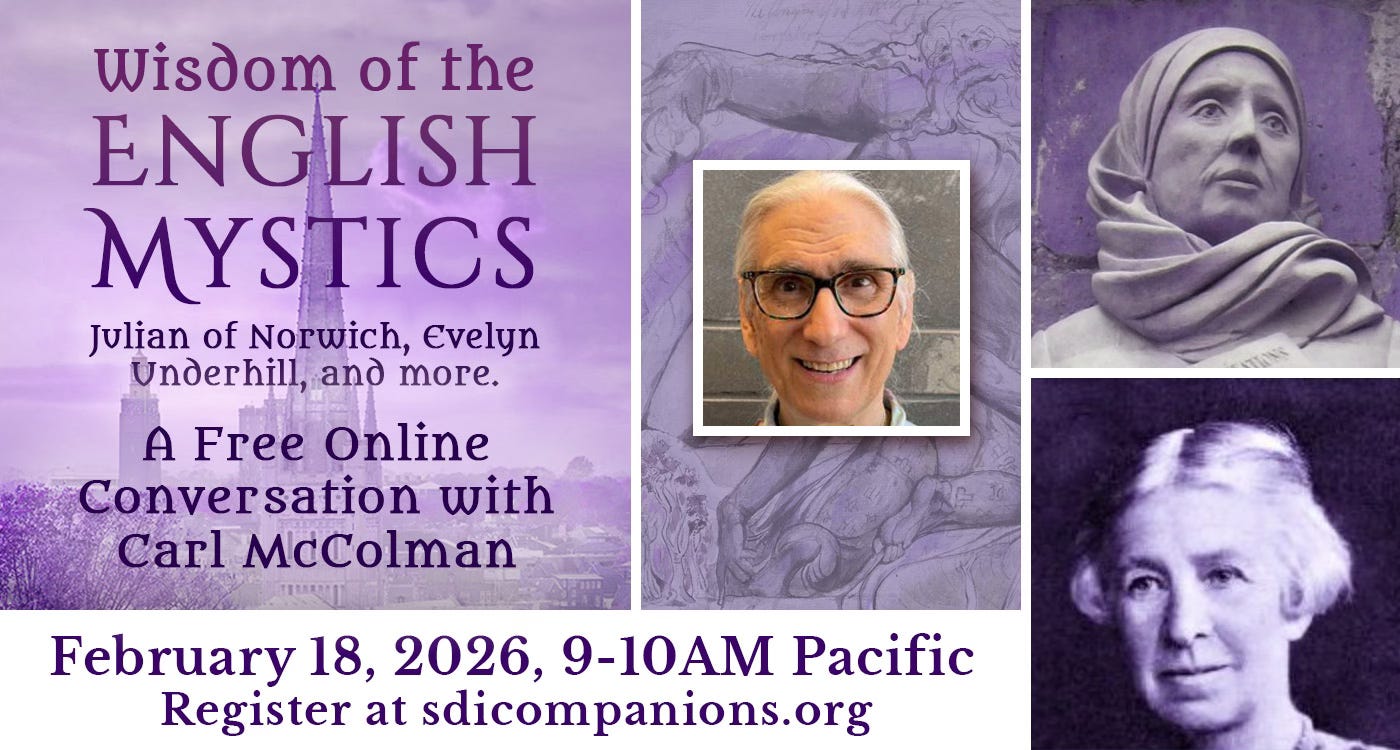
Would you like to explore the spirituality of Julian of Norwich (and other mystics from England) more fully? Then please join me for a conversation on the Wisdom of the English Mystics, this coming Wednesday, February 18, 2025, at 9 AM Pacific Time / Noon Eastern Time (USA). To register for this free event, click here: www.sdicompanions.org/event/the-wisdom-of-the-english-mystics/
We’ll spend time feasting on the wisdom of several great mystics, and also tell you about a week-long pilgrimage in search of the Wisdom of the English Mystics, May 26-June 3, 2025.

Quotation sources are from the Mirabai Starr translation of Julian of Norwich: The Showings (Hampton Roads Publishing, 2022). If you prefer audiobooks, get this beautiful version of Mirabai’s translation, narrated by Kate Scarfe: Audible Version.