


In 1930, Evelyn Underhill wrote a letter addressed to the Archbishop of Canterbury, Cosmo Lang, intending for him to share it with the over 300 Bishops of the Anglican Communion who would be meeting with him at the Lambeth Conference that took place in July of that year.
There is no evidence that Underhill ever sent the letter; a handwritten draft of it was found among her papers after her death in 1941. Because the letter only exists in that form, it was not included in the two different collections of Underhill’s letters that have been published since her passing, nor has it appeared in any other publication of her writings. Nevertheless, it has been widely circulated among Underhill scholars and appears on multiple websites. The letter is reprinted below.
At that time, Underhill was an established authority on the subject of Christian Mysticism—her “big book” on that topic had been published almost 20 years previously, in 1911. If she had in fact submitted the letter to Archbishop Lang, we might assume it would have been taken at least somewhat seriously. Underhill understood that she was a layperson — indeed, a laywoman — writing at a time when people who were not ordained clergy (which is to say, men called to be priests or bishops) were regarded as having no real authority to teach or guide the bishops who led the church. Keenly aware of the social limitations she faced, Underhill speaks with humility and deference—but she still makes her request.
And what does she ask of the bishops? That they make it a priority to cultivate the spiritual life of the priests under their care.
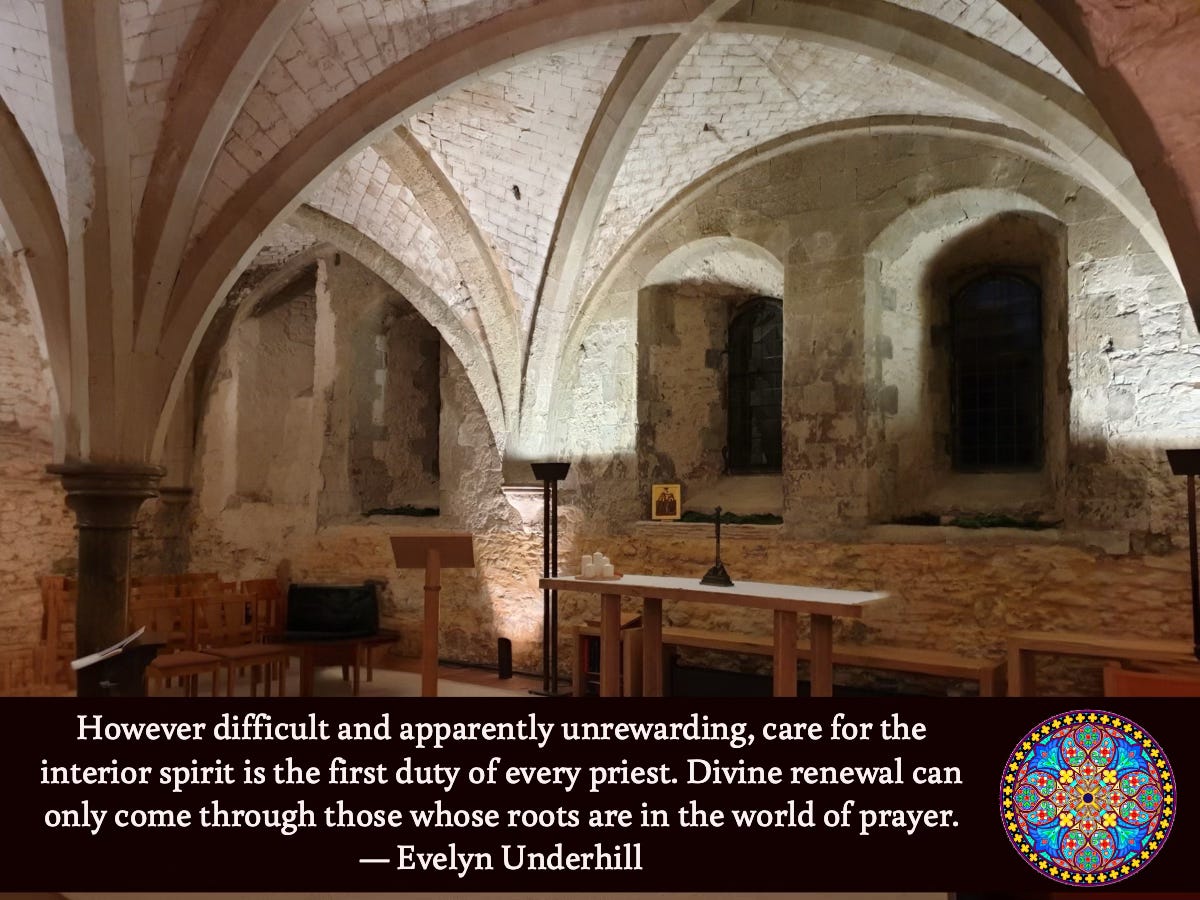
However difficult and apparently unrewarding, care for the interior spirit is the first duty of every priest. Divine renewal can only come through those whose roots are in the world of prayer.
Evelyn Underhill certainly was neither the first nor the last observer to lament on how religious leaders often did not make spirituality a priority — either in their own lives, or the lives of the congregations they shepherded. But as a well-known a writer who promoted the revival of mystical spirituality among all people, Underhill’s call for prioritizing the spiritual life of ministers is meaningful indeed, and worth reflecting on, even almost 100 years later.
I know most people who read this Substack are not necessarily clergy — but I assume most of you share my interest in seeing contemplative spirituality prosper, both inside and outside the boundaries of traditional religion. I’m sharing Underhill’s letter with you today not because I’m particularly worried about the spiritual lives of priests. Granted, I want religious leaders to take their own spiritual lives seriously, not only for their own sake but also so they can also take seriously the spiritual lives of those under their care. But my main reason for sharing this letter arises from my conviction that what Underhill wanted for the priests is something I believe would benefit everyone — whether religious or not, whether ordained or not.
As a woman of her time, Underhill equated spiritual welfare with church membership, and saw that the single most important way to make churches more spiritually healthy would be to take good care of the clergy serving the church. In our time, more and more people regard church membership (and participation) to be a more optional feature in one’s spiritual life. However you stand on that particular issue, I hope you can agree with me that Underhill’s wisdom belongs to every body — not just bishops, or priests, but to anyone who seeks to grow spiritually.
And what does Underhill promote as important steps for anyone to take who seeks to grow spiritually? She calls for better education in the spiritual life, followed by the importance of making an annual retreat, and cultivating a personal rule of life, and—especially for ministers—to work to make their churches “a real home of prayer.”
I hope you can see how each of these recommendations is adaptable to the circumstances of spirituality among lay persons—now as much as ever.
Spiritual seekers deserve a spiritual education. Spirituality—including mystical and contemplative forms of spirituality—is countercultural; which is to say, it goes against the grain of the dog-eat-dog, looking-out-for-number-one values that shape our society. We learn the ropes of the culture we are born into, just by the normal socialization process of a child. But if we want to learn a countercultural set of values, that takes conscious, intentional work — in other words, it requires some sort of training or education. Spirituality cannot just be learned from books: we learn spirituality through a combination of intellectual study, embodied practice, and following the guidance of mentors or elders. A trust spiritual education will provide support in each of these areas.
Spiritual seekers grow more readily if they adopt a personal rule of life. If you start a business, sooner or later you’ll learn the value of a company mission statement and business plan. Sure, you can just set up shop and start selling whatever product or service you want to promote. That’s fine—but if you want to grow your business to its full potentional, having a game plan can make the difference between focussed effort or aimless wandering. In the spiritual life, a personal rule is like those corporate documents: it’s a way of focussing your intention on your spiritual values and the steps you want to take to make them a sustainable part of your life.
Spiritual seekers benefit from making an annual retreat. My first “real” job out of college was a management position with a retail corporation; every summer we had a manager’s conference in the Connecticut Berkshires, a time when we all focussed on our goals for the year to come and our game plans for making those goals a reality. The spiritual life, generally speaking, is not goal-oriented like a corporation, but there is a similar value in taking a week or so off from your regular schedule to go away —preferably to a monastery or retreat center—and dive deep into silence for prayer, personal reflection, and meditation. Just like a year of work with no vacation increases the risk of burnout, so a daily regimen of spiritual practice without time away for deep rest can prove to unsustainable. Avoid spiritual exhaustion: make a retreat at least once a year.
Spiritual seekers a real home for regular prayer. It doesn’t have to be your church, and maybe not even your home (although I would recommend that every home needs at least a corner dedicated to the inner life). But just as football needs a field and musicians need a band or an orchestra, so do people who seek a deeper spiritual life need some place where it is safe and sensible to go within.
Keeping a rule of life, making an annual retreat, regarding one’s home as a site for regular prayer, and maintaining an ongoing practice of spiritual education may not seem to be the most glamorous steps one can take to nurture and grow spiritually. For that matter, I imagine most people could also come up with other important steps anyone could take to nurture their own spirituality (like regular time devoted to caring for the poor).
What matters most of all? That we make spirituality a priority for our lives. We may not dive into the all-encompassing lifestyle of a monk or a nun, but there’s still plenty of room in anyone’s life for prioritizing the mystical path. What Evelyn Underhill encouraged bishops to do for their priests, you and I can do for our own souls—nurture an interior life that matters.

A letter from Evelyn Underhill to Archbishop Lang of Canterbury
(Found among her papers. c.1930)
MAY it please your Grace:
I desire very humbly to suggest with bishops assembled at Lambeth that the greatest and most necessary work they could do at the present time for the spiritual renewal of the Anglican Church would be to call the clergy as a whole, solemnly and insistently to a greater interiority and cultivation of the personal life of prayer. This was the original aim of the founders of the Jerusalem Chamber Fellowship, of whom I am one. We were convinced that the real failures, difficulties and weaknesses of the Church are spiritual and can only be remedied by spiritual effort and sacrifice, and that her deepest need is a renewal, first in the clergy and through them in the laity; of the great Christian tradition of the inner life. The Church wants not more consecrated philanthropists, but a disciplined priesthood of theocentric souls who shall be tools and channels of the Spirit of God: and this she cannot have until Communion with God is recognized as the first duty of the priest. But under modern conditions this is so difficult that unless our fathers in God solemnly require it of us, the necessary efforts and readjustments will not be made. With the development of that which is now called “The Way of Renewal” more and more emphasis has been placed on the nurture and improvement of the intellect, less and less, on that of the soul. I do not underrate the importance of the intellectual side of religion. But all who do personal religious work know that the real hunger among the laity is not for halting attempts to reconcile theology and physical science, but for the deep things of the Spirit.
We look to the Church to give us an experience of God, mystery, holiness and prayer which, though it may not solve the antinomies of the natural world, shall lift us to contact with the supernatural world and minister eternal life. We look to the clergy to help and direct our spiritual growth. We are seldom satisfied because with a few noble exceptions they are so lacking in spiritual realism, so ignorant of the laws and experiences of the life of prayer. Their Christianity as a whole is humanitarian rather than theocentric. So their dealings with souls are often vague and amateurish. Those needing spiritual help may find much kindliness, but seldom that firm touch of firsthand knowledge of interior ways which comes only from a disciplined personal life of prayer. In public worship they often fail to evoke the spirit of adoration because they do not possess it themselves. Hence the dreary character of many church services and the result in the increasing alienation of the laity from institutional forms.
God is the interesting thing about religion, and people are hungry for God. But only a priest whose life is soaked in prayer, sacrifice, and love can, by his own spirit of adoring worship, help us to apprehend Him. We ask the bishops . . . to declare to the Church and especially its ministers, that the future of organized Christianity hinges not on the triumph of this or that type of churchman’s theology or doctrine, but on the interior spirit of poverty, chastity and obedience of the ordained. However difficult and apparently unrewarding, care for the interior spirit is the first duty of every priest. Divine renewal can only come through those whose roots are in the world of prayer.
THE TWO things that the laity want from the priesthood are spiritual realism and genuine love of souls. It is by these that all Christian successes have been won in the past and it is to these that men always respond. We instantly recognize those services and sermons that are the outward expression of the priest’s interior adherence to God and the selfless love of souls. These always give us a religious experience. On the other hand, every perfunctory service, every cold and slovenly celebration (for these are more frequent than the bishops realize because when they are present, everything is at its best), is a lost opportunity which discredits corporate worship and again reflects back to the poor and shallow quality of the Priest’s inner life... It is perhaps worthwhile to recall the humbling fact that recent notable secessions to the Roman Catholic communion have been caused by declaration by a felt need of the supernatural which the Church of England failed to satisfy, while the astonishing success of the Oxford Group Movement among young people of the educated class witnesses to the widespread desire for an experience of God unmet by the ordinary ministrations of the Church. History shows that these quasi-mystical movements among the laity do not flourish where the invisible side of institutional religion is vigorously maintained.
I know that recovering the ordered interior life of prayer and meditation will be very difficult for clergy immersed increasingly in routine work. It will mean for many a complete rearrangement of values and a reduction of social activities. They will not do it unless they are made to feel its crucial importance. This will not be achieved through “schools of prayer” which stimulate the mind rather than the spirit. But the solemn voice of the united episcopate, recalling the Church to that personal, realistic contact with the Supernatural which has been since Pentecost the one source of her power, will give authoritative support to those who already feel the need of a deeper spirituality and will remind the others that the renewal of a spiritual society must depend on giving absolute priority to the spiritual life.
I venture to put before the conference the following practical recommendations: (1) Education of Ordinands— That the bishops shall emphasize the need and importance of a far more thorough, varied, interesting and expert devotional training in our theological colleges which, with a few striking exceptions, seem to me to give insufficient attention to this vital part of their work. (2) The Clergy— That they should call upon every ordained clergyman, as an essential part of his pastoral duty and not merely for his own sake: (a) To adopt a rule of life which shall include a fixed daily period of prayer and reading of a type that feeds, pacifies and expands his soul, and deepens his communion with God; b) To make an annual retreat; (c) To use every endeavour to make his church into a real home of prayer and teach his people, both by exhortation and example so to use it.