

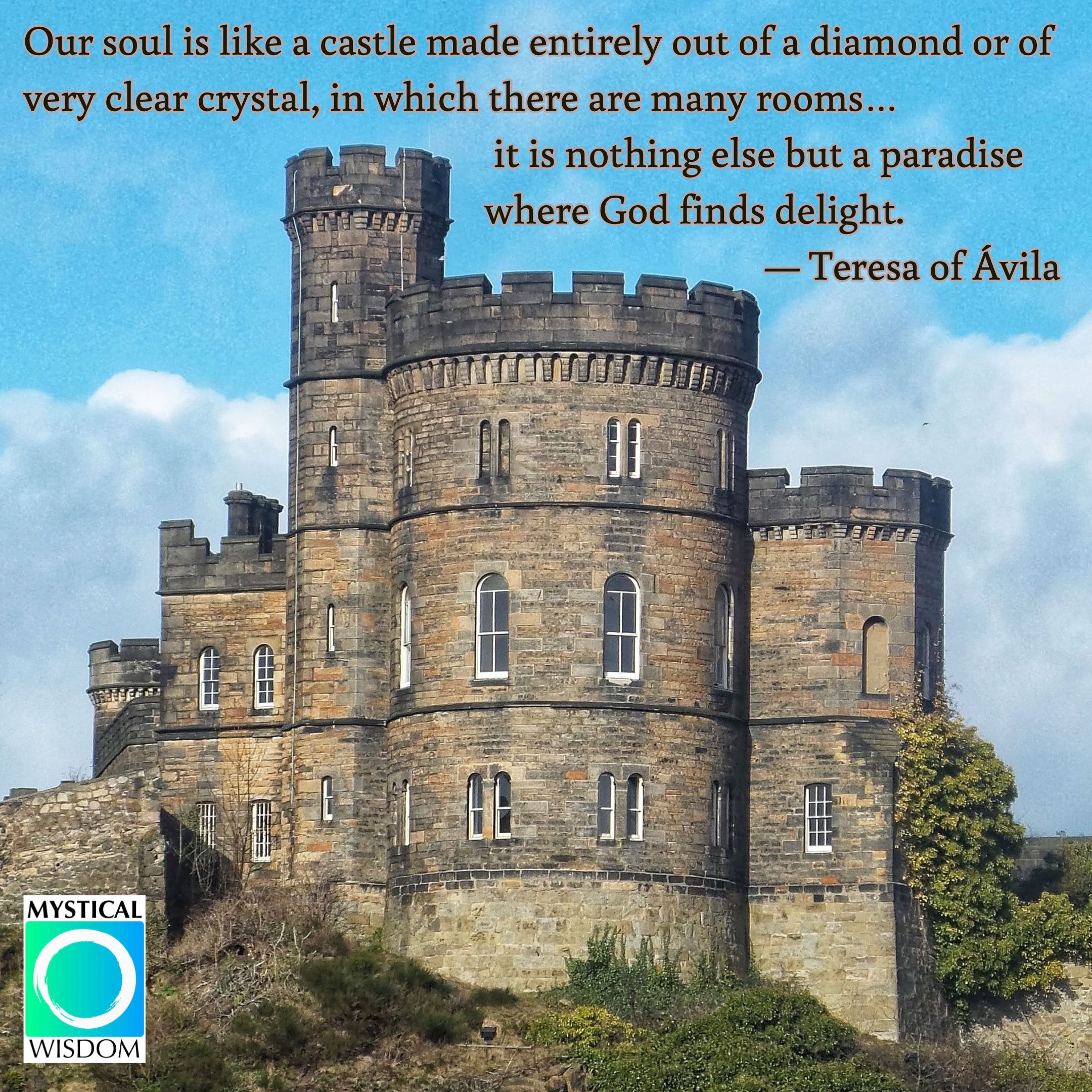
“Our soul is like a castle made entirely out of a diamond or of very clear crystal, in which there are many rooms… it is nothing else but a paradise where God finds delight.” — Saint Teresa of Ávila
Teresa of Ávila (1515-1582) is widely considered one of the greatest mystics of the Catholic Christian tradition. A Spanish Carmelite nun who lived at the time of the Protestant Reformation, her writing is colorful, intuitive, non-linear, and filled with striking images and useful insights into the experience of Divine Love. The Interior Castle, one of several books she wrote on the mystical life, is her most enduring classic, but other books well worth reading include her autobiography and The Way of Perfection.
Teresa lived in a tumultuous time — the Protestant Reformations began in northern Europe when she was just a small child; closer to home in Spain, the papal-sanctioned but state-run Tribunal of the Holy Office of the Inquisition — in other words, the Spanish Inquisition — was actively at work seeking to enforce orthodoxy and suppress heresy, but in practice this was mainly about oppressing Jews and even Catholic converts from Judaism who were accused of remaining observant Jews in secret. Several thousand people were executed because of the Inquisition’s power. She herself was the granddaughter of a Jewish converso who in 1485 was investigated by the Inquisition, and while he was not condemned, he nevertheless was very publicly humiliated for his alleged “crimes.”
Given this background, it’s rather amazing that Teresa had such an optimistic view of humanity that she could see our souls “made entirely of a diamond or of very clear crystal!” Especially given that during her lifetime, Reformers like John Calvin were developing theological ideas that would eventually result in the concept of “total depravity” — a profoundly pessimistic assessment of humanity. By contrast, the soul as a shimmering, sparkling castle suggests that humanity is not depraved so much as divine. Even though we may make many mistakes (a fact Teresa never soft-pedals), still, her sense of the beauty of the soul is both mystically inspired and a source of deep hope.
October 15 is Saint Teresa’s feast day. As we remember her, let’s not lose sight of how precious (and diamond-like) each and every soul is — and if we cannot see that beauty, we know it is not hidden from the eyes of the Divine.

From the AnamChara archive: This article was first published on November 19, 2024. I’ve edited and expanded it, and am happy to share it with new readers and longtime subscribers alike.
Note: I’ll be on the road speaking in Virginia and Maryland now through October 27. I’ll be sharing several of these archival posts while I’m traveling.
