

After my post How Crucial is the Cross was published on December 28, I received rather more emails from readers than usual. It’s always gratifying to hear that people are reading—and hopefully enjoying—what I’ve written, even when they write to point out that I didn’t really answer the question I set out to answer.
First, I received this email from a reader named Bill:
Carl, I’ve appreciated your information and WISDOM for a long time—books and emails. Thank you. In this post, the writer specifically asked if the cross and resurrection were necessary for salvation. Dualism aside, you never specifically said yes or no. Your final statements indicated maybe no, but I wish you would expand on the no somewhat more.
Just a few minutes later, another email showed up, this one from Gerry:
Thank you, Carl, for this insightful article. It would appear that you’re yet to address Gary’s question re the cross of Christ, or the crucifixion of Jesus, and presumably the scriptures that record his resurrection. Hopefully this will be covered in a follow-up Substack. Thank you so much for your inspirational writing.
I get the hint, friends. And while I wasn’t planning on writing a follow-up, I’m happy to do it. So let’s dive in.
Jesus ≠ the Cross
First, let me confess my own theological bias (or blind spot). When I was given the question “Is the cross necessary?” I promptly got caught up in a different—related, but different—question: Is Jesus necessary? That proved to be the question that became the through-line of my previous post.
Julian of Norwich is famous for saying, “it seems to me that where Jesus is spoken of, the Holy Trinity is to be understood.” I take that to heart — and perhaps to my detriment, as I find questions like “is the cross necessary” pretty much unimportant to me. Of course the cross is necessary: it was the means by which Jesus died. And whenever we speak of Jesus, we are actually speaking of the Trinity, so the cross is important (“necessary”) as the means by which the Trinity enters into solidarity with the suffering and mortality of humanity, and therefore it is the way in which the vast, infinite plenitude of divine love was showered upon suffering humanity.
But it’s not that simple, is it? Because, as I pointed out in my previous post, all the rhetoric about “the necessity of Jesus” is, in itself, highly problematic: if we claim that relating to Jesus in just the right way is essential for salvation, then we are envisioning a heaven with very few (perhaps no) non-Christians in it. And to me, a so-called paradise that is dogmatically exclusive like that is, by definition, not heaven.
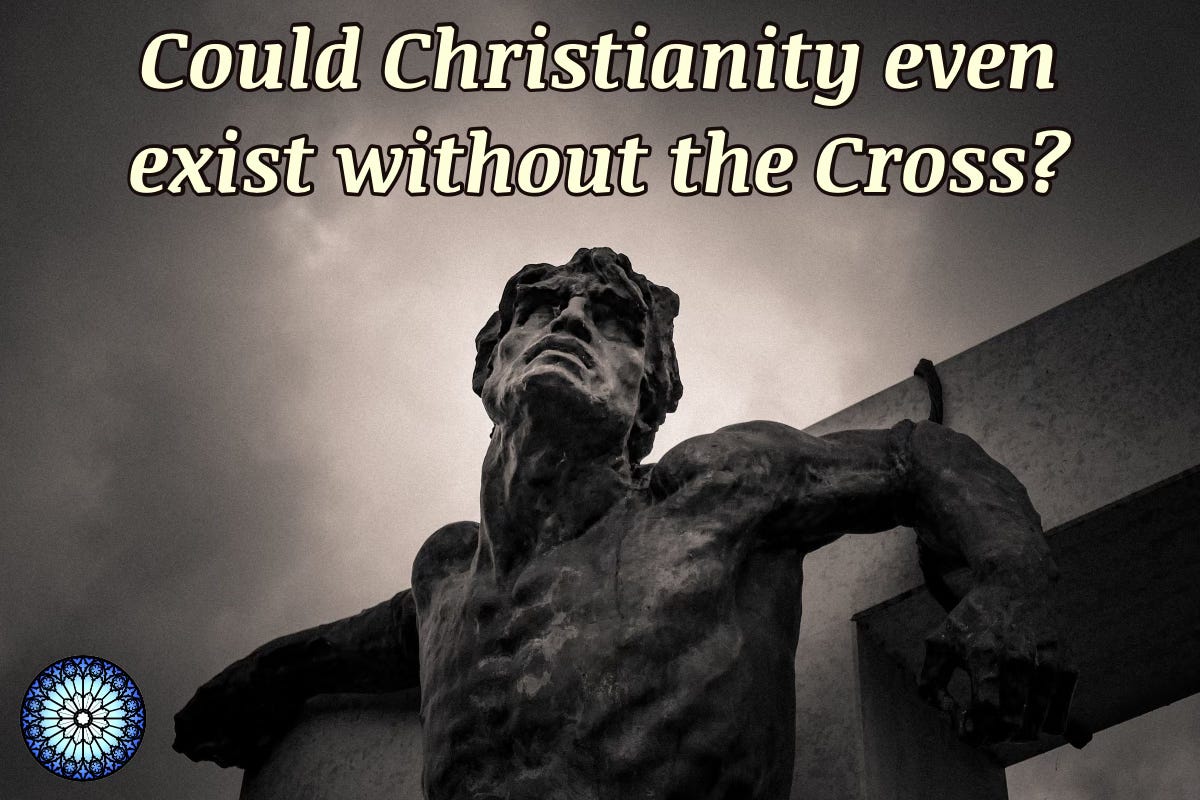
If I can’t proclaim that Jesus is “necessary,” then why would, or how could, I see the cross as necessary? Could Christianity even exist without the cross? Isn’t the heart of the Christian story a tale of radical self-giving love — that Jesus embraced death on a cross as the ultimate way he could meet and respond to human violence, scapegoating, and sin — with the radical forgiveness of divine love? The cross was necessary: as Richard Rohr would put it, not to change God’s mind about us, but to change our mind about God.
Is Necessary Really Necessary?
But I still chafe against the question. Why even worry about whether the cross was necessary or not? To what end? Are we trying to visualize a world in which Jesus was never crucified? But such a world only exists in the imagination: as best anyone can tell, Jesus really was crucified in the real world we’ve got. Asking “is the cross necessary?” is kind of like asking “is Artificial Intelligence necessary?” or “Is sexual pleasure necessary?” or whatever other tidbit of human experience you might want to philosophize over. We can imagine a world without ChatGPT or without orgasms, but it’s only a thought experiment. What we’ve got is what we’ve got.
Julian of Norwich has something to say about this too—not about the cross, but about sin (which, not so incidentally, mainstream Christian theology suggests the cross is meant to counteract).
Sin is befitting, but all shall be well, and all shall be well, and all manner of things shall be well.
This comes from the translation of Julian’s book by Elizabeth Spearing; but other translators offer slightly different renderings: they have Jesus saying “Sin is inevitable,” “Sin is unavoidable,” or—most relevant to our topic—“Sin is necessary” (scholars like Grace Warrack, Edmund Colledge, and James Walsh, among others, have Julian saying sin is “necessary”). All these scholars are trying to translate the essentially untranslatable Middle English word behovely. Julian wrote, “Synne is behovely”—think of the archaic word behoove, which lingers on in contemporary English as “it would behoove you to do something”—in other words, you’d better do it. It’s what needs to happen, whether you like it or not.
I only know just enough Middle English to be dangerous, but my understanding of behovely is that it carries connotations of necessary, befitting, inevitable—all the words that show up in modern English translations of Julian—but it does not mean that something is therefore good or desirable. Sin causes suffering and destroys relationships, so no one in their right mind wants it. But it exists. It happens. In fact, when I teach Julian, I often colloquially translate this tricky little sentence as “Sin happened” or “it is what it is.” No one wanted it, but we’ve got it.
The Cross Was Behovely…
So is the cross necessary? Maybe only in the behovely sense: it just had to happen. No getting around it. Not because God required it, or the devil demanded it, or because human sin is so nasty that no other cure could do the trick. (This is why I don’t like talk about the necessity of the cross: such rhetoric has traditionally been weaponized against people who, by chance or choice, do not adhere to the Christian faith. Whatever we may mean by “the cross is necessary,” I am clear that it doesn’t mean “only believers in the cross get to go to heaven.” That idea is simply monstrous theology, and I don’t see how any compassionate and knowledgeable human being can truly affirm it.)
The cross was behovely—necessary—because sin had happened, and it is weighty enough as a countersign to give us human beings a pathway away from sin or from the horror of sin’s consequences. Once again, I don’t believe the cross of Christ is the only tool in the human toolbox for dealing with suffering, harm, or the stubborn human capacity to consciously make bad choices (check out the teachings of the Buddha, for starters). But, speaking on a purely mythic/archetypal level, it’s quite a powerful and meaningful necessity indeed.
Could God love us without the cross? Sure—ask any observant Jew. Could God save us without the cross? Again, yes—ask any devout Muslim. So how can the cross be “necessary”? Well, I don’t believe it is necessary in the “do this or else” sense. But I can accept that the cross offers us a powerful sign of how love and grace operate that perhaps no other sign or story could convey quite so effectively. In that sense, the cross is very much necessary—and not just for “believing Christians” either.
Quotation source: Julian of Norwich. Revelations of Divine Love, translated by Elizabeth Spearing (Penguin Classics), Kindle edition, p. 46, 79.