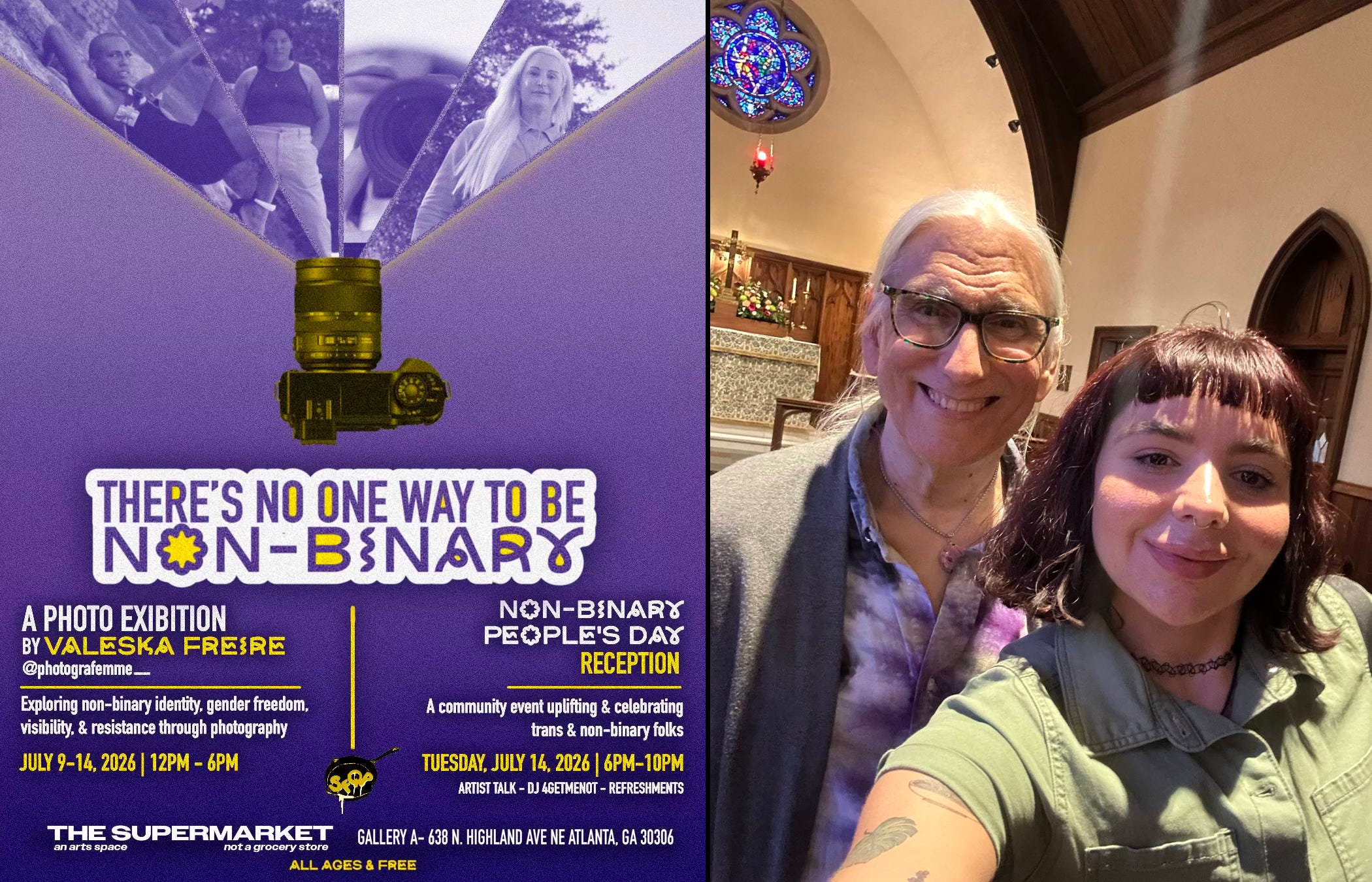
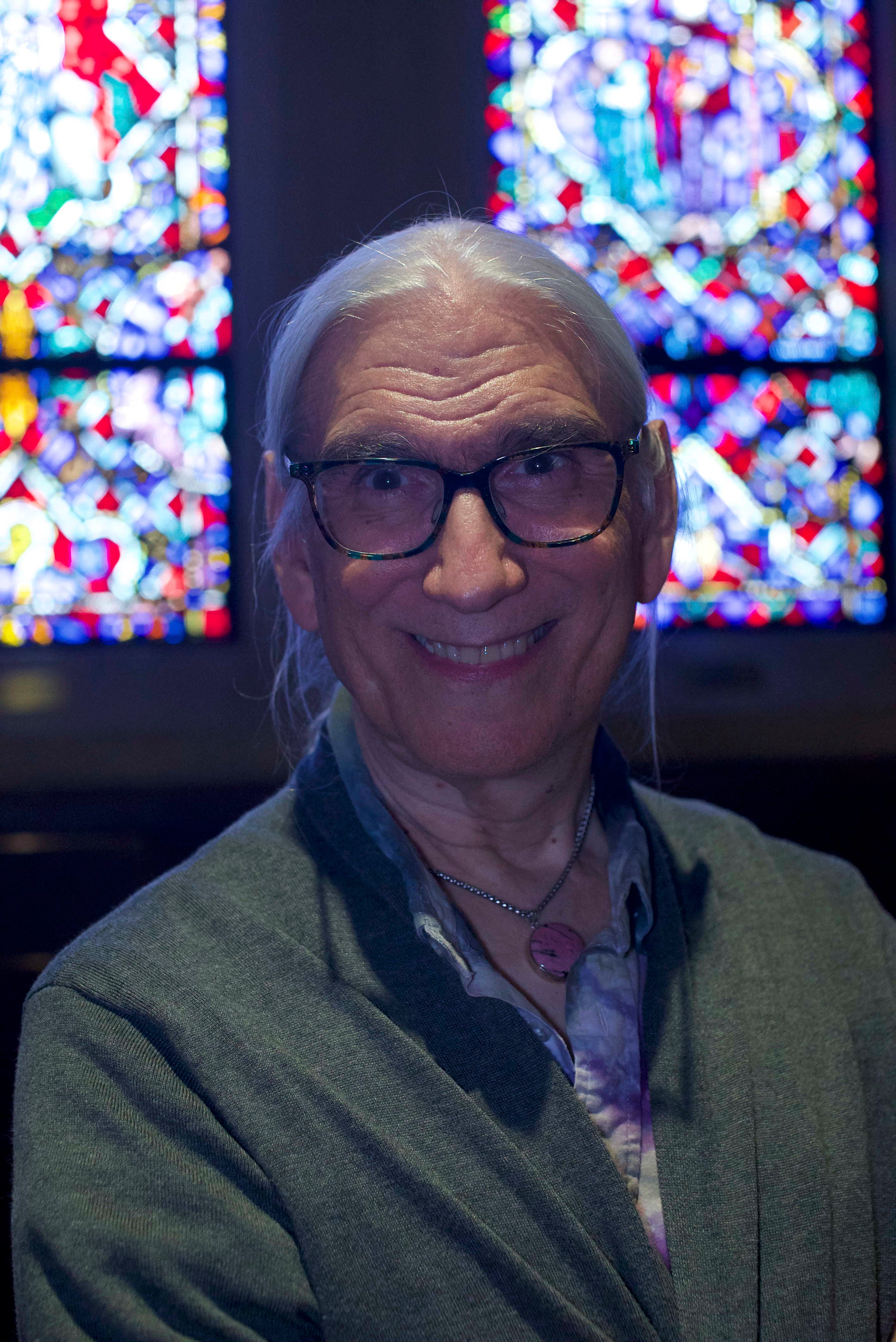
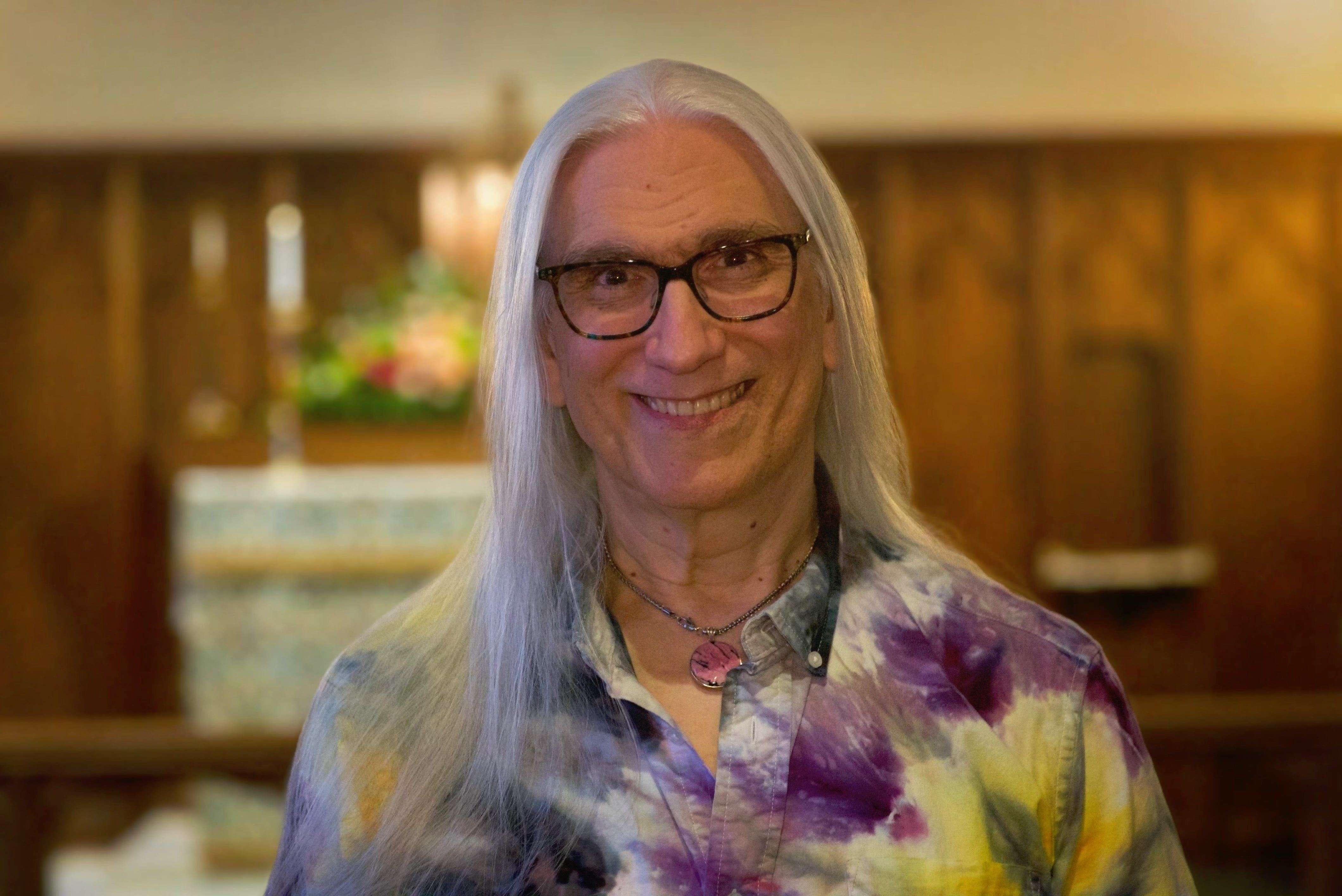
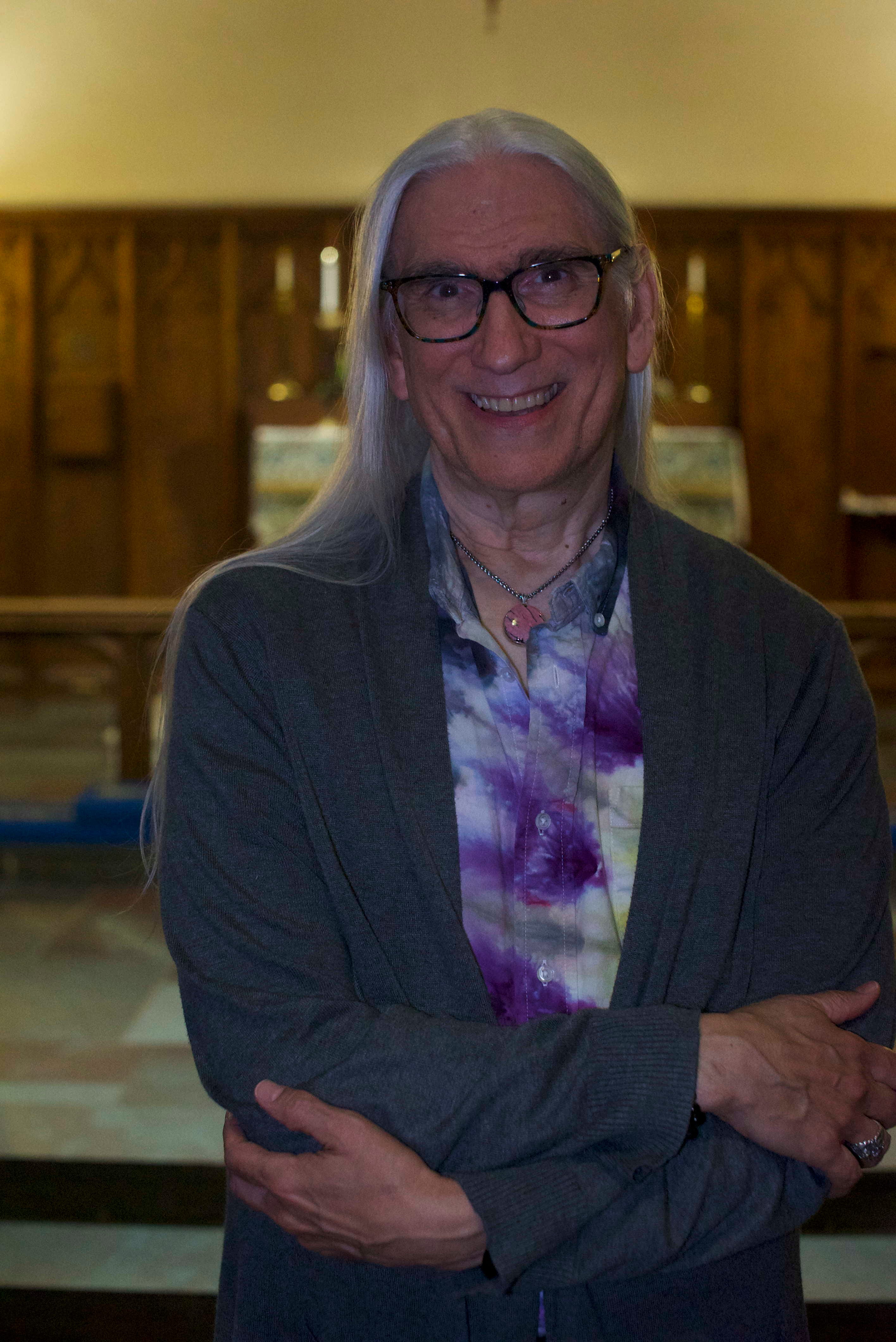
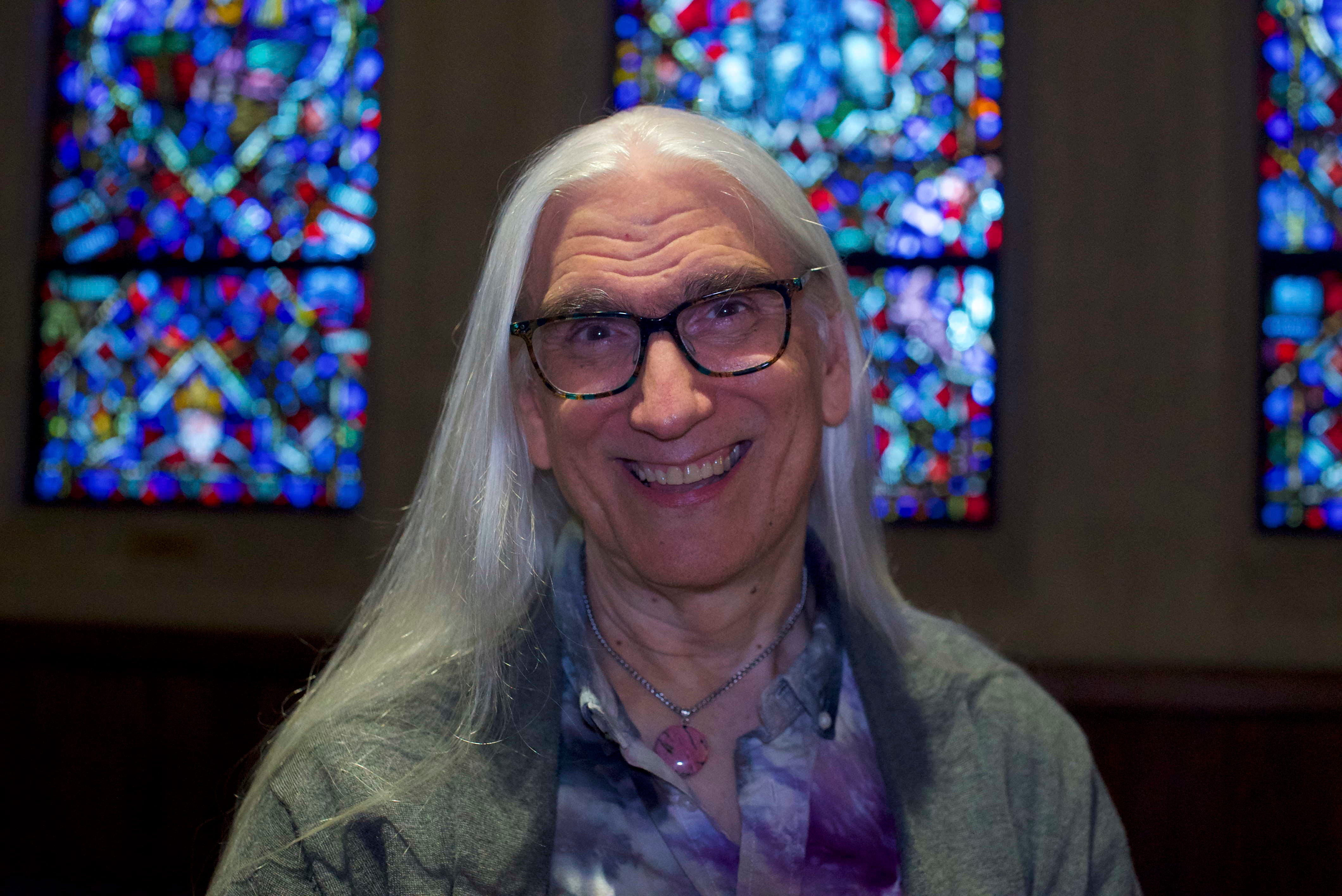
In the spring of 2025 an Atlanta-based photographer, Valeska Freire, sought people to photograph for a project documenting the lives and experiences of non-binary persons. I volunteered to one of the subjects, and was honored when she accepted me. I just love the images that resulted (all the photos of me in this post come from that photo shoot, and are used with permission of the photographer). We got permission to use one of the chapels at the Episcopal Cathedral here in Atlanta for the photo shoot, which gave the pictures a — dare I say it — contemplative feel.
Now Val will have their first public showing of this series, called There’s No One Way to Be Non-Binary. The exhibit will run at a gallery in Virginia Highlands, with a reception on July 14. For those of you who are in Atlanta, please come to the reception (or at least, stop by to enjoy the photographs).
There’s more information about this reception at the bottom of this article. The reception is free but the gallery is asking people to register for it. Click here to learn more or to get your free tickets.
To help prepare materials for the exhibition, Val asked all the models to complete a questionnaire about their experience being non-binary. Her questions, and my answers, appear below. This serves as a follow up to my original coming out article, “God’s Pronouns,” which was published in the book Soul Friend: Nourishing Essays on Contemplative Living and Leadership.
How do you personally define or describe your gender identity?
The most helpful word for me is definitely non-binary, and that’s the word I typically share with anyone when I come out to them. But the words genderfluid, gender-expansive, genderqueer, and even androgynous all carry meaning for me as well.
Was there a moment or period in your life when you began questioning or redefining gender for yourself?
I knew something was going on even in childhood, but I am a boomer, which means I was 8 years old when Stonewall happened. So as you can imagine, there was no support—in my family, or in society at large—for being gender-divergent. I was assigned male at birth, so I learned from a very early age to perform masculinity as best I could (or else). What all this means is that, beginning in childhood, I had a strong sense of myself as a “failure” — a failure at being a boy. That led to feelings of inadequacy, low self-esteem, shyness, and anxiety.
Getting teased for running, laughing, etc. “like a girl” did not help to boost my self-esteem, that’s for sure. Even into my young adult years, people would make jokes about what a “girl” I was, or simply reject me for being “too gay.” At the time, incidents like that filled me with shame. But today, I see them as important moments when, even through the cruelty of others, I was invited to see something true about myself.
As the years went by, I would have little glimmers of hope, ranging from friends who would encourage me to crossdress to romantic partners who would gently affirm me for just being who I am. But I was well into midlife— my mid-50s, really — when I finally reached a point of gentle self-acceptance, so that I could affirm and name myself as non-binary. So it’s been a long journey!
What does being non-binary mean to you personally?
More than anything else, it simply means being true to myself. It means trusting myself, radically and joyfully. To be non-binary means to trust my heart, my intuition, my compassion, my desire for relationship and connection which is as strong as my desire for agency and ambition. It means to dress the way I want to dress, the way that makes me happy and feel good. It means to inhabit my body the way I naturally do, without a constant stream of self-censorship because of some voice in my head that tells me I need to perform my gender a certain way. In that sense, being non-binary is a radical act of deep self-love and non-aggression. It’s very spiritual. It’s a movement of compassion not only toward myself, but toward all people (and especially all of us who are courageous enough to live authentically, beyond the binary).
Do you feel like people often expect non-binary people to look or behave a certain way? If so, how has that affected you?
Maybe it’s because of my age, or because of how carefully I choose my friends, but I don’t run into any real expectations regarding the performance of my gender. For me, the really important question is, what are my expectations for myself? There were many years of my life when I was desperately trying to fit in with my assigned gender, and I felt deeply imprisoned by it. Since coming out to myself, I went through a period when it was really important for me to dress and behave as androgynously as possible, depending on how safe the setting was — I work in very conservative spaces, so that’s another consideration. But as I have become more comfortable with being genderqueer, and recognizing that my gender identity is mostly about loving myself unconditionally, I have become much freer internally to perform gender any way I want. Paradoxically, I feel much more free and at home in expressing myself, even in a “butch” or strongly masculine way, than I did 20 or 50 years ago! I believe that all gender is performance, so why not find a way to have fun with it all? At least, that’s how I feel these days.
Have there been moments where you felt especially seen, affirmed, or understood in your identity?
Two things come to mind. First is that I have an amazing network of affirming and supportive friends, chosen family, and loved ones, including my life partner, who is herself cisgender and yet just keeps on supporting me to be my true self. It hasn’t always been easy for her, this is a journey for us all, but we’ve reached a place of incredible sweetness and care. The other thing is that for the last 15 months or so, we’ve been participating in an explicitly LGBTQ+ affirming faith community, where the associate minister is themself non-binary. So that has become a deeply important safe space where I feel very much “seen, affirmed, and understood” — and we get to be there at least once a week.
Have you experienced moments of discomfort, dysphoria, or being misunderstood because of gendered expectations?
Heavens yes, from being bullied as a child to getting stared at when I’m wearing something that is too transgressive in public. As I mentioned above, my life partner had her own journey to undergo, learning to be the powerful ally she is today, and there were a few bumps along the road. And while I have long since found a way to be at peace with almost always being gendered as male in public, whenever someone calls me “sir,” or treats me with the deference that I know is embedded in male privilege, I have a twinge of sadness. But at this point in my life, that’s less sadness for me personally and more of a generalized sadness for how much gender constraint affects everyone.
How would you describe your relationship with masculinity, femininity, or androgyny?
Like a Facebook status, I’d say my relationship with masculinity is “complicated.”
I was assigned male at birth, so I have a “male body” and was socialized as a male, and to this day most people gender me as masculine, even when I am trying to present myself in an androgynous way. There are definitely perks to being gendered as male (male privilege is a real thing, especially for white people), so I will admit that I appreciate having access to the social benefits of my assigned gender. On the other hand, I’ve known since childhood that in very real ways I don’t “fit in” with the culture of masculinity in America, especially in regard to sports, to violence, to aggression, to competitive ambition, to the need to dominate, and so forth.
While I have a fraught relationship with masculinity, my relationship with femininity is perhaps even more involved. Masculinity feels like being confined to a room where I partially fit in but I know I won’t ever truly feel at home, whereas femininity feels like an adjacent room where I believe I would be at least as happy if not more so, but that room appears to be locked with a stern “Do not enter” sign barring my way. I’m conscious of the fact that I’m drawn to what I see as beautiful, creative, intuitive or graceful about feminine identity or expression, and I’m much less interested in the many constraints that are placed on women in our culture. Does that make me a hypocrite — or is it a clue to the fact that I’ll only ever be truly “at home” in non-binary or genderqueer spaces?
Finally, my relationship with androgyny is certainly the one where I feel most at home, and have the most fun and playfulness. I love to explore androgynous ways of dress and appearance, and feel that my embodied life (mannerisms, ways of speaking and thinking, etc.) are more truly and naturally androgynous than either masculine or feminine. But is that surprising, given that I identify as non-binary?
Are there objects, clothes, rituals, spaces, or experiences that make you feel more connected to yourself and your identity?
I had long hair in college and briefly in my mid-30s, but then hadn’t worn it long for 25 years or so, until the pandemic came along. I’ve let it grow back out and I love it. Surprisingly, no one ever gendered me as female when I had long hair in the past, but it does happen to me now — which I find both amusing and satisfying. Beyond that, I love women’s clothing but I tend to dress androgynously in public — I’m not interested in performing drag or signaling myself as a crossdresser, and I want my fashion choices to be an expression of genderfluidity more than anything else. But in private or with very close friends, I’m more likely to dress in a more transgressive way, which can be liberating but mainly just seems to be fun. I don’t wear makeup (I find it to be more annoying than liberating), but I do love self-grooming activities, from brushing my hair to moisturizing. I appreciate being able to talk about my gender, with my life partner, close friends, my therapist and my spiritual director; and to shop, either alone or with close friends and my partner, for clothing and accessories that embody my style — in both the men’s and the women’s departments!
How has your relationship with your body evolved over time?
As a child, it was torturous. I certainly experienced a kind of non-binary gender dysphoria — not in the sense of “oops, I’m supposed to be a girl, not a boy” but simply “wow, I really am lousy at being a boy.” So much of that feeling of being a failure was connected to my body: I wasn’t athletic enough, wasn’t strong enough, wasn’t interested in working out or training, and so forth. It was eventually really liberating for me to discover practices like yoga and meditation, which of course are for all genders but for me represented a wonderful alternative to all the masculine-coded practices that I had no interest in at all. I think as I have become more comfortable naming my identity as non-binary and genderqueer, I’ve learned to be more loving and kind with my own body — enforcing the binary always seemed to have an undercurrent of self-directed hostility or aggression about it, so it’s really nice to let that go, and just simply cherish myself instead.
What do you wish more people understood about non-binary people?
I can’t speak for all non-binary people, of course. But for myself, I wish people could intuitively grasp that I find being genderfluid to be joyful and fun. I have no desire to offend anyone else or infringe on anyone else’s rights, but likewise, I want to be faithful to my own rights: to be happy, to be mentally healthy, to be authentic and real. That’s all I’m asking for. I see my gender identity and expression to be not only a way for me to be authentic, to be true to who God made me to be, but also to be a source of serenity, joy and even fun!
I wish people who might be tempted to criticize me for not “trying harder to be a man” or whatever, to understand that I did spend many, many years trying to regulate my gender identity and expression, to no avail. When I finally chose to simply accept who I truly am, it was not a capitulation to someone else’s “agenda” but very much a liberation that emerged from within. It was simply a compassionate and caring way to free up my time and energy that had been devoted to self-shaming and self-regulation, toward using that energy in more positive ways: for my work, for creativity, and for building positive relationships with others.
I wish more people understood that non-binary people are like everyone else: we simply want to be happy and to make a positive difference in the world — only we do this in androgynous or gender-creative ways.
How do you navigate visibility? Do you feel more comfortable being openly non-binary, more private about it, or somewhere in between?
Definitely somewhere in between (although I suppose doing this interview is a move toward greater visibility!). When I’m in very conservative spaces (like some rural areas, or some of my work environments), I definitely tend to downplay my androgyny, but in those environments I also downplay my hippie vibes, so it’s not just about making my queerness invisible. Everyone wears a costume to work, on some level: we even jokingly call business attire “corporate drag.” So I have a strong commitment to doing what I need to do to feel safe, even if that means I navigate some spaces expressing gender in a narrow way that conforms to my assigned gender. But I do have relationships and spaces in my life where I can freely and joyfully let my genderfluid flag fly — from my own home to the homes of close friends, my very progressive and queer-affirming faith community, and some other spaces. So I work hard to be more fully authentic in those spaces, so when I do dress in a manner consistent with my assigned gender, it’s easier to remember that this is a conscious choice I’ve made — I haven’t traded away my agency.
Has community played a role in your experience with gender?
Most definitely. Primarily, of course, the community of my friends and chosen family — those who may not be DNA relatives but who relate with me as if we were truly siblings of the heart. They are my anchor and show me what true, unconditional love looks like (I do have biological family members who are also that loving, thank heaven). I’m also happy to be a member of an affirming church — which has not always been the case, I’ve also participated in churches in the past that were queer-phobic. So I’ve seen both the positive and the negative effect that community can have on my experience of gender.
What emotions come up when you think about gender?
Pretty much all the emotions. In the past, especially, I’ve felt shame, fear, confusion, anxiety, depression, and self-judgment in regard to my gender. But especially since I came out to myself and have been coming out to friends and chosen family, I mostly experience the more positive emotions: joy, happiness, serenity, trust, acceptance, delight… I don’t think any one particular emotion or type of emotion is particularly connected to gender. Rather, I believe when we have clear values and commitments and beliefs regarding our gender, then we are more likely to have positive emotional experiences as well.
Do you think language helps you express yourself, or do you sometimes feel limited by it?
Honestly, I think language tends to be more limiting — and I’m a professional writer, so I work with language for a living! But at its best, I do think language can help us express ourselves, at least in part. So I have appreciated the positive role that language plays in connecting me with others, but I’m clear that language sometimes seems to get in the way. As a student of mysticism, I believe that “God’s first language is silence” and so sometimes, even on a human level, silence speaks louder than words. Put another way: I don’t always have to defend my gender, sometimes it’s best just to live it.
Is there anything you’ve never been asked about your identity that you wish people would ask more often?
Nothing immediately comes to mind. I’m happy to talk about gender with anyone, but I also don’t need to be talking about it all the time. It’s just one part of me. My main wish is that people would treat queer people, including non-binary people, with basic decency, civility and respect. But really, I wish that for all people.
What name would you like to go by?
For years, I never seriously entertained expanding my name beyond my legal name. I actually like my name given to me at birth, even though it’s very masculine. But in December 2025, I was inspired to take on a preferred name/nickname that is much more of a unisex, even feminine-leaning, name. My legal name is not a dead name, however, so now I have two names. Please feel free to call me Carl (given, masculine name) or Skye (chosen, gender-inclusive name) after the beautiful Isle of Skye in Scotland.
What would you tell your younger self about gender?
Mainly that it’s just okay. It’s okay to love myself, just as I am. It’s okay to be queer. It’s okay to be femme or butch or androgynous or something else entirely. It’s okay to love identifying and performing gender in the way that brings me joy, and that when I am taking good care of my own joy, then those who truly like or love me will participate in that joy as well. I know “It gets better” seems almost like a cliché, but it’s true, and I would reassure my younger self how true it is.
Where were you born and where do you live now?
I was born in Louisiana, spent most of my childhood, college years, and young adult years in Virginia, and lived for a few years in Tennessee before settling in Georgia, where I’ve been for over 30 years now. I tell people I’m based in Atlanta, but I also like to point out I live in Clarkston, which is a beautifully diverse community.
What are your pronouns?
He/they. But if someone uses feminine pronouns, I take it as a compliment. 😇
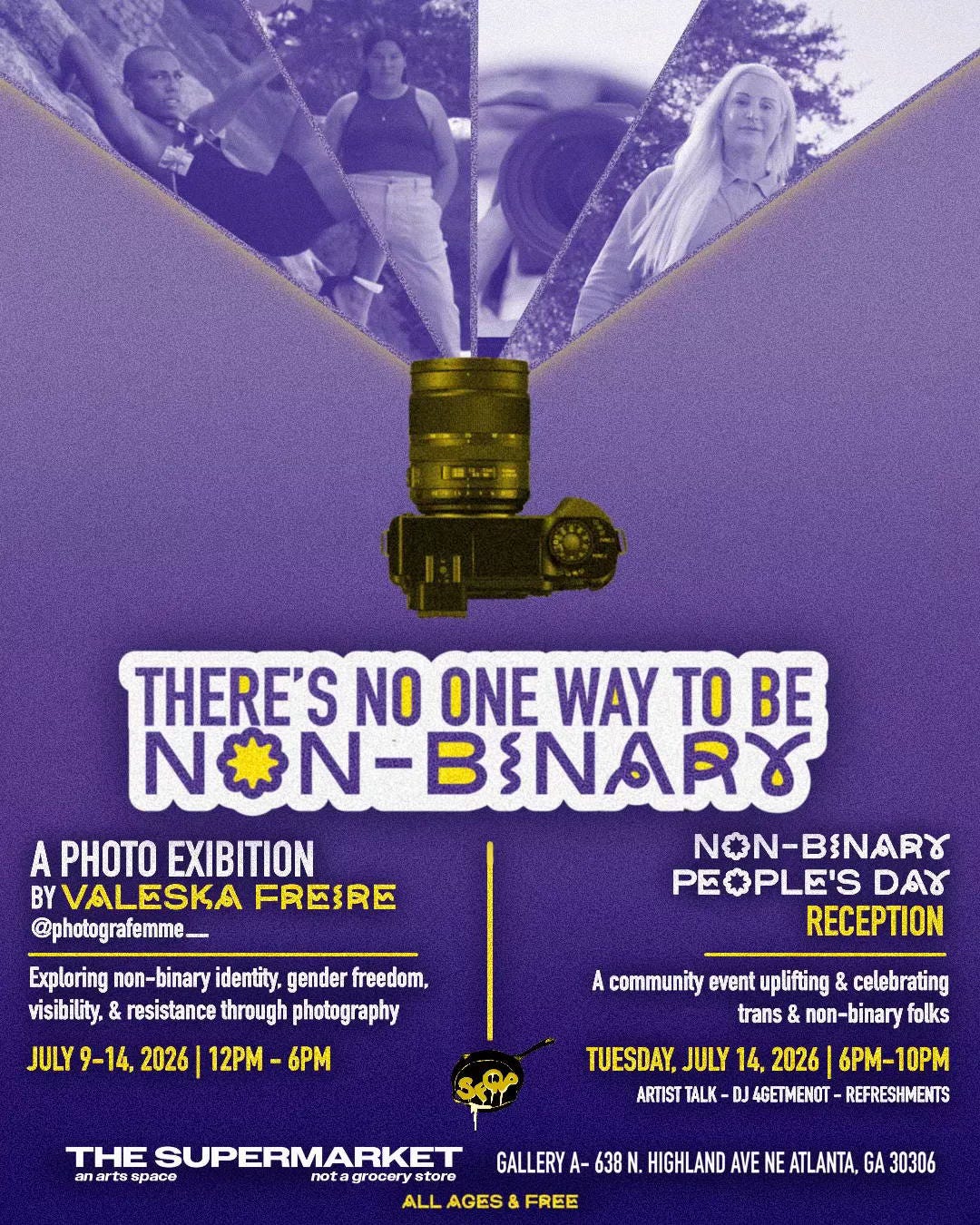
Come to the Photography Exhibit (I’ll be at the Closing Reception!)
🏳️⚧️🟡⚪️ There’s no one way to be Non-Binary 🟣⚫️🏳️⚧️
A photography exhibition exploring gender freedom, visibility, and resistance. Featuring portraits by Valeska Freire, presented in collaboration with Southern Fried Queer Pride.
Location:
The Supermarket – Gallery A - 638 N Highland Ave NE Atlanta, GA 30306
Dates and Times (July 9–14, 2026):
Thursday 7/9 — 12 - 10 PM
Friday 7/10 — 12 - 3 PM
Saturday 7/11 — 12 - 6 PM
Sunday 7/12 — 12 - 10 PM
Monday 7/13 — 12 – 6 PM
Tuesday 7/14 — 12 - 10 PM
Closing Reception (Non-Binary People’s Day): July 14 — 6–10 PM
Join us for a night celebrating trans and non-binary existence. Featuring:
Closing reception
Artist Talk
DJ
Drinks and refreshments
Free. All ages. Wheelchair accessible.
Meet some of the people in the photographs (including Skye McColman)
Parking:
There are no free parking spots at The Supermarket; however, if you have a few minutes to spare and walk, street parking can be found nearby. Paid parking on site.
Entrances to The Supermarket:
Main entrance: Located on N Highland Ave NE. Our door is between Big Softie and Colette Bakeshop, leading you down a hallway and a staircase.
Side entrance: Our secondary entrance is through a residential courtyard. Enter through the black metal gate on the side of Otto’s building from the parking lot (at N. Highland and Blue Ridge). Note: this entrance has a few stairs.
Accessible entrance: Backside of the building, accessible via Otto’s parking lot. Signage is in the works, in the meantime, please call to be escorted to our back entrance. (404) 458-1738.