

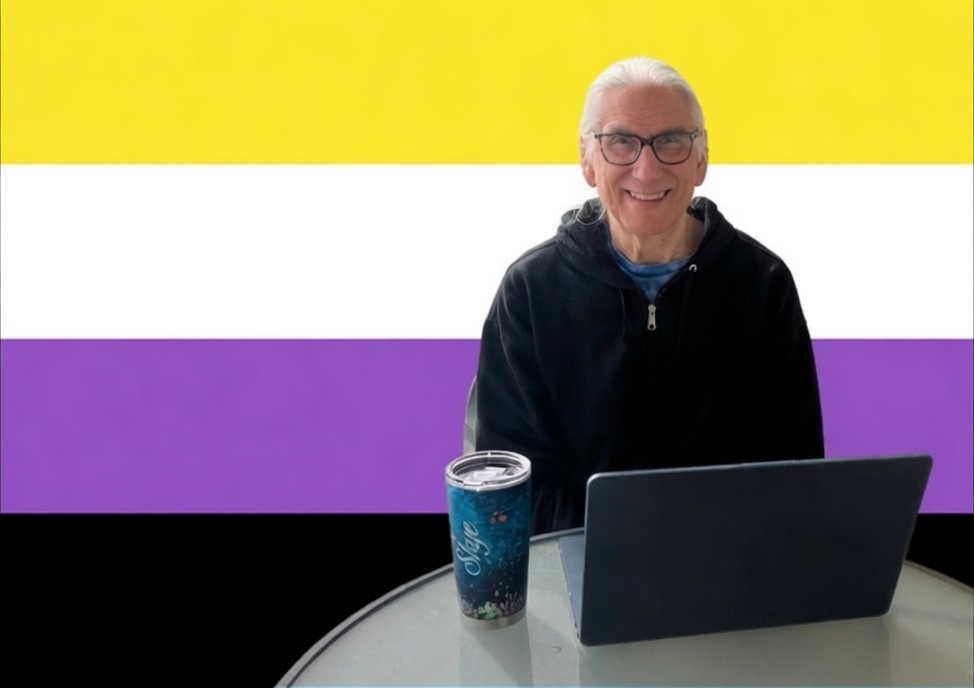
N.B. I get asked from time to time why I identify as nonbinary, or how I came to see myself as such. I wrote my coming out story several years ago; it’s in an essay called “God’s Pronouns” from Soul Food: Nourishing Essays on Contemplative Living and Leadership.1 See below to read what I wrote. For the full essay, get the book — its proceeds support the Shalem Institute for Spiritual Formation, so please purchase a copy. Along with my essay, it includes writing by Lerita Coleman Brown, Valerie Brown, Gay L. Byron and many others.
Gender is a profound mystery, and so much of the language we traditionally use to describe gender can be criticized as stereotypical or limiting. Men are strong, aggressive, competitive, athletic, and proud, while women are compassionate, gentle, sensual, cooperative, and nurturing. Even as I write these words (merely for the purpose of illustration), I wince at how they seem to pigeonhole both genders. If someone truly embodies the gifts of masculinity and femininity, does it make sense to say their gender identity or expression exists beyond the binary? So often our understanding of God emerges out of our understanding of ourselves. For me, seeing God’s gender as nonbinary makes perfect sense, because it tracks with my own experience.
I still remember the first time I met someone who identified themself as nonbinary. It was at a neighborhood program in my local community for artists-as-activists, where one of the speakers introduced themself using that term. Being unfamiliar with the word but also being a writer, naturally I looked it up. I discovered that nonbinary is related to a cluster of words, mostly neologisms, that have emerged since the 1980s and 1990s to describe gender diversity and gender variance, especially beyond the binary of male and female. Words like genderfluid, gender-expansive, genderqueer, gender-nonconforming, and demigender all convey slightly different and nuanced ways of gender identity and expression. Neither male nor female, indeed! But also profoundly meaningful for me.
I was born in 1960, which means my childhood and adolescence stretched from the final days of the Eisenhower administration to the murder of John Lennon, the week I turned twenty. I was assigned male at birth, although back then no one talked about it like that. Just “It’s a boy!” But as my childhood unfolded, my boy-ness seemed to be a bit off-kilter. In fact, I came to think I was something of a failure as a boy. In my family and neighborhood, markers of masculinity included sports, hunting, fishing, working on cars, and developing physical strength—yet I remained stubbornly uninterested in all these things. Granted, on occasion I tried to “be a man,” but only for the sake of fitting in; after a couple of seasons of going hunting with my dad, I felt so relieved when I finally found the courage to tell him I really didn’t like it and wouldn’t go with him anymore, even though that meant a loss of time we spent together. My interests skewed more toward the arts, toward poetry and music and painting. And I also was interested in fashion, although I could barely admit that even to myself. And let’s just say it wasn’t just boys’ and men’s fashion that caught my eye.
As it turned out, I was not the only one who could see that my gender didn’t quite line up with the cultural expectations of our time. Other kids would point out to me (or tease me) for running, laughing, acting like a girl. Friends, trying to be helpful, would counsel me to try to tone down my femme mannerisms and body language. And kids who weren’t interested in being my friend would bully me, an easy target since I was such a “girl.”
I don’t recall ever feeling any sort of all-pervasive gender dysphoria, at least not in the way that transgender persons like Nicole Maines or Jazz Jennings have described it: an “insistent, persistent, and consistent” sense of being a girl in a boy’s body (or vice versa). When I heard about famous transpersons like Christine Jorgenson or Renée Richards, I thought they were interesting, but I never had the sense of “that’s me.” I had no sense of being in the wrong body altogether, just a kind of awareness that I wasn’t entirely at home with the expectations placed on me for being a boy—but I knew that I would be just as much a misfit if I had been born with a female body. There was plenty that I liked about being male, even with all my natural girlishness. Grasping for language to make sense of myself, by the time I was an adult I would say “I’m very androgynous” or “I’m really in touch with my feminine side.” Carl Jung’s ideas that everyone contains both a feminine anima and a masculine animus, and that one of the goals of maturity is to integrate both dimensions into our individuated psyche, resonated deeply with me.
I lived more than a half century before I stumbled across concepts like nonbinary or genderfluid. I suppose if I were born a generation or two later, I might have known—and embraced—those concepts for myself, even at a young age. And I especially wonder if, in my childhood I had been exposed to an image of God that encompassed the entire gender spectrum (with nonbinary pronouns to match), I might have been spared plenty of angst as I tried to make sense of who, in fact, God created me to be.
As I write these words, I see that they represent a coming out, and I suppose some people might find them startling or even shocking. But to me, it’s no big deal—or at least, I don’t think it ought to be a big deal. Once I understood that nonbinary gender identity is a thing, I said to myself, “Oh, so that’s what folks like me are called.”

Westina Matthews, Margaret Benefiel and Jackson Droney. Soul Food: Nourishing Essays on Contemplative Living and Leadership. New York: Church Publishing, 2023.