

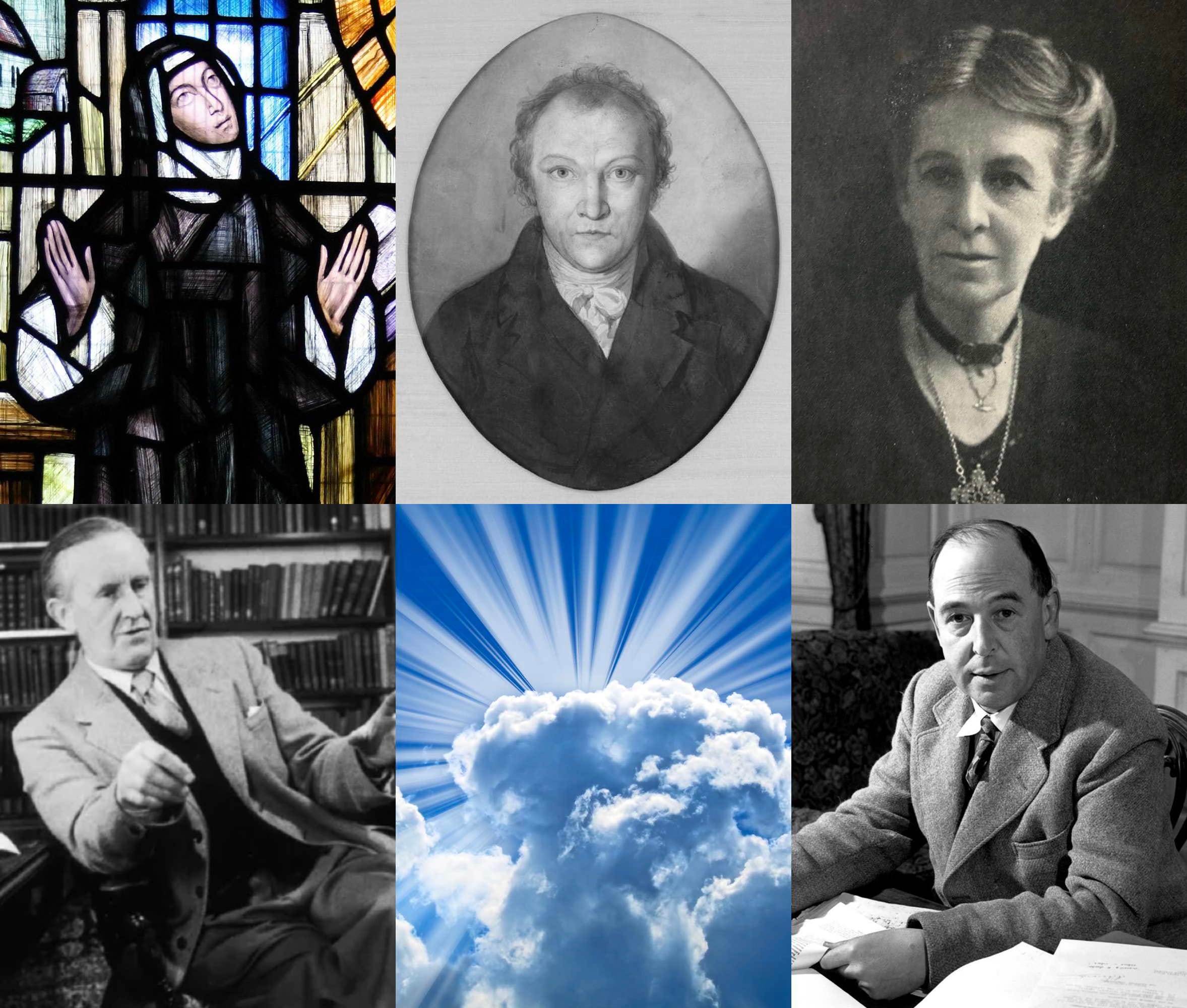
The other day I appeared on a webinar hosted by Spiritual Directors International (SDI) on “the Wisdom of the English Mystics” (see the end of this post for a link to watch this free webinar). In it, the executive director of SDI, Rev. SeiFu Anil Singh-Molares, and I discussed the spiritual wisdom that can be found in the writings of such amazing guides as Julian of Norwich, William Blake, Evelyn Underhill, and even C.S. Lewis and J.R.R. Tolkien. This webinar was originally conceived to help raise awareness of our upcoming SDI Wisdom of the English Mystics Pilgrimage that Rev. Seifu and I will be leading this spring — but currently we only have two openings for that event, so if you’re interested, sign up soon!
But even if you are not interested in the pilgrimage, I hope you’ll watch the webinar and learn a bit more about the wonderful mystics of England and how their words of wisdom remain jewels of spiritual guidance, even today.
Our webinar was only one hour long, and right at the very end I noticed that one of the participants posted a question in the chat box, asking me if I could recommend a book that explored the mysticism of William Blake. I didn’t have time to get to the question (sorry about that), but I figured posting a reply here on Substack would be the next best thing. And while I was at it, I could post some recommended books by (or about) some of the other mystics we had discussed as well. So here you go…
Some Books for Diving Deeper Into the Wisdom of the English Mystics
For exploring Julian of Norwich…
Julian of Norwich is one of the two greatest mystics writing in the English language (the other being the anonymous author of The Cloud of Unknowing). Her ideas are daring, her writing lyrical, and her visions (while sometimes difficult because of their medieval sensibility) are striking and memorable. Her writing is rich and nuanced, so a good commentary is a great help.
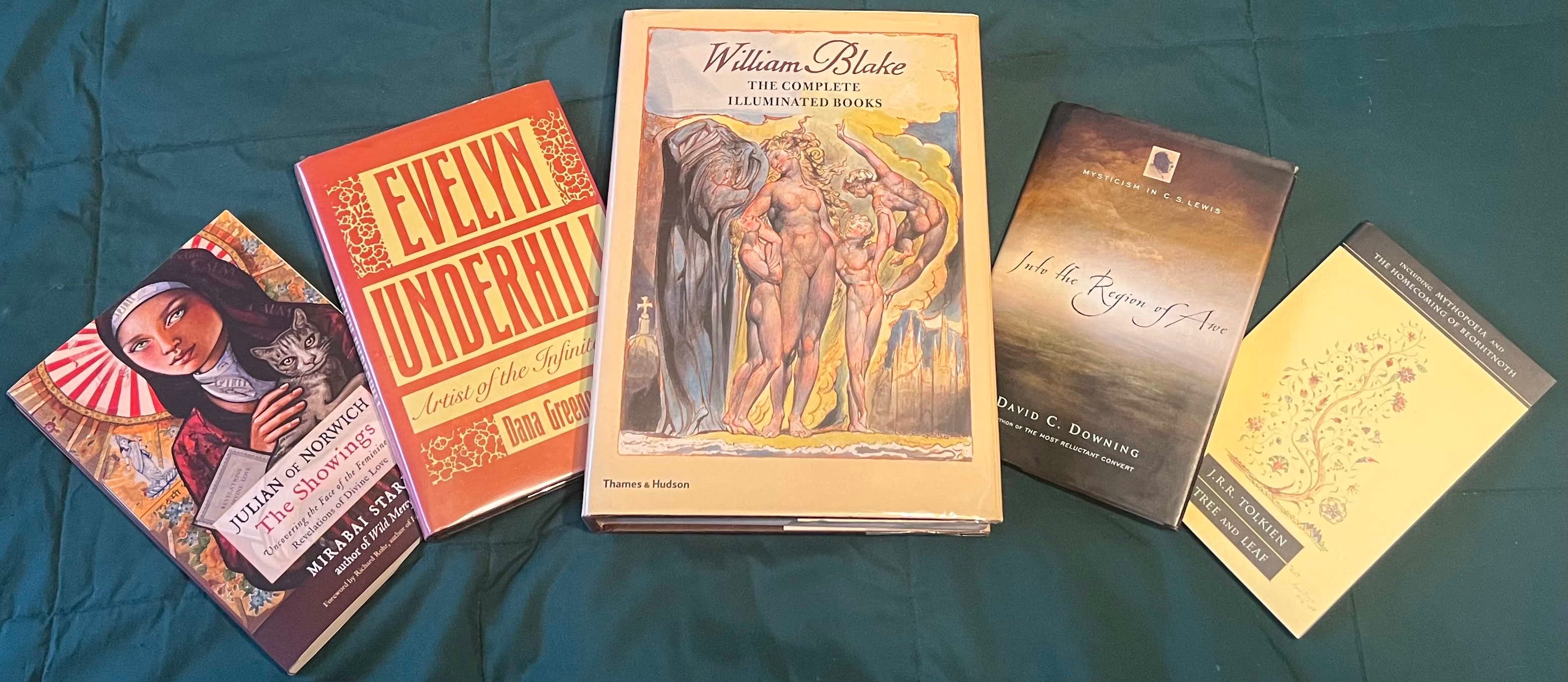
Julian of Norwich, The Showings: Uncovering the Face of the Feminine in Revelations of Divine Love, translated from the Middle English by Mirabai Starr — There are many great translations of Julian, but Mirabai Starr truly makes Julian’s voice come alive for our time. As a bonus, check out the audio vision, narrated by Katie Scarfe.
Robert Llewelyn, With Pity Not With Blame — Llewelyn was for many years the guardian of the Julian Shrine in Norwich. This book approaches Julian as a spiritual teacher, and looks at her mystical wisdom alongside that of her anonymous contemporary, the author of The Cloud of Unknowing.
Amy Frykholm, Julian of Norwich: A Contemplative Biography — There are many excellent studies of Julian (check out works by Veronica Rolf, Grace Jantzen and Andrew Louth, to name a few), but I’m partial to this book because it looks at Julian the woman, more than just the writer or the spiritual teacher. Mysticism is ultimately a story, so here is a delightful imagining of the story of Julian’s life.
For exploring William Blake…
When William Blake died in 1827, he was buried in a pauper’s grave. But today he is regarded as both a great British poet and artist as well as a mystic unencumbered by church dogma; it is widely recognized that the best way to unpack his quirky and idiosyncratic vision is by seeking to appreciate him for his contemplative vision.
William Blake, The Complete Illuminated Books — Blake was an artist as well as a poet, so it’s wise to approach his work visually, feasting on his quirky otherworldly illustrations that accompanied his poetry. As for the poems, get the Erdman edition.
John Higgs, William Blake vs. the World — Too many critics of Blake have either misunderstood his singular spirituality or tried to explain it away (often dismissing it as madness). Higgs, by contrast, accepts Blake the mystic and invites us to take a closer look.
Mark Vernon, Awake! William Blake and the Power of the Imagination — Blake, like St. Ignatius of Loyola, saw the imagination as an essential component of the spiritual life (as well as the artistic life); Vernon helps us see how the imagination is the key to Blake’s universal mysticism.
For exploring Evelyn Underhill…
This 20th century novelist and poet turned retreat leader and spiritual director made her name by writing accessible and inspirational books on how mysticism remains relevant even in the modern secular age. Although Underhill’s prose can seem really stuffy in our time, she is not afraid to celebrate mysticism’s inner beauty — making her work a celebration of how infinitely attractive mysticism is.
Evelyn Underhill, Practical Mysticism — Perhaps the most accessible entry into the words of wisdom of Underhill herself. This book finds her making the case that mysticism is for everyone, even the folks she amusingly calls “normal people.” Even those of us who think of ourselves as anything but normal (!) can appreciate the accessibility of this short book.
Dana Greene, Evelyn Underhill, Artist of the Inner Life — Several good biographies of Underhill have been published, but I’m partial to this one, written by a respected Underhill scholar who was herself very much a contemplative.
Robin Wrigley-Carr, The Spiritual Formation of Evelyn Underhill — This insightful book takes a close look at how Underhill’s spirituality evolved over her lifetime, by focusing on her relationships with her spiritual directors, including the renowned Baron Von Hügel.
For exploring J.R.R. Tolkien…
Tolkien is chiefly remembered today as the author of The Hobbit and The Lord of the Rings — he practically invented the modern genre of fantasy, and his ideas about fairy tales remain worth pondering, a half a century after his passing. But like his colleague C.S. Lewis (see below), Tolkien weaves a rich sacramental and mystical sensibility into his fiction.
J.R.R. Tolkien, The Silmarillion — Strange, incantatory, heroic, and deeply mythic, it’s become almost a cliché to say reading The Silmarillion feels like reading the Bible — such was Tolkien’s gift, that he could create mystical fiction that lands as a type of sacred scripture.
J.R.R. Tolkien, Tree and Leaf — This anthology includes two works essential for appreciating Tolkien’s approach to myth and mystery: “On Fairy Stories,” where he makes the case that magical tales are for adults, and “Mythopoeia,” a similar defense of myth in verse.
Verlyn Flieger, Splintered Light: Logos and Language in Tolkien’s World — like so many mythical (and mystical) writers, Tolkien is fascinated by the interplay between light and dark; Flieger uses this as an entry point into Tolkien’s spiritual depth.
Patrick Curry, Defending Middle Earth: Tolkien, Myth and Modernity — This study of Tolkien celebrates how he combines a deeply otherworldly spirituality with a lyrical love for and appreciation of nature and the earth, making his relevant to our age.
For exploring C.S. Lewis…
Another writer remembered primarily for his fiction (and also his “pop theology”), Lewis’ writing lacks the layered depth of Tolkien’s, but more than made up for it with the shimmering luminosity of his best work, writing that practically sang with an embodied invitation into spiritual truth.
C. S. Lewis, The Voyage of the Dawn Treader — As humble as The Silmarillion is grand, this entry from the Narnia series reveals Lewis’s ideas about the shape of the mystical life. Shaped by Platonic dualism, it’s flawed, but filled with lyrical paeans to silence and light.
David C. Downing, Into the Region of Awe: Mysticism in C. S. Lewis — a commentary written to introduce evangelicals to the mysticism of Lewis, this book nevertheless offers a clear, accessible guide to the contemplative dimension of Lewis’s writing, especially his fiction.
Carl McColman, The Lion, the Mouse and the Dawn Treader: Spiritual Lessons from C.S. Lewis’s Narnia — A shout out to one of my own books! 😇 This companion volume to The Voyage of the Dawn Treader highlights and unpacks that book’s mystical heart.
If you’d like to watch the video, click here: Wisdom of the English Mystics Free Webinar with Carl McColman (you may be asked to register with the SDI website in order to watch it).
