

Here’s a summer memory that profoundly shapes how I remember my childhood. More than fifty years later, it not only gives me insight into my youth, but into the nature of contemplative or even mystical experience as well — at least, those that occur in the most down-to-earth and seemingly ordinary ways.
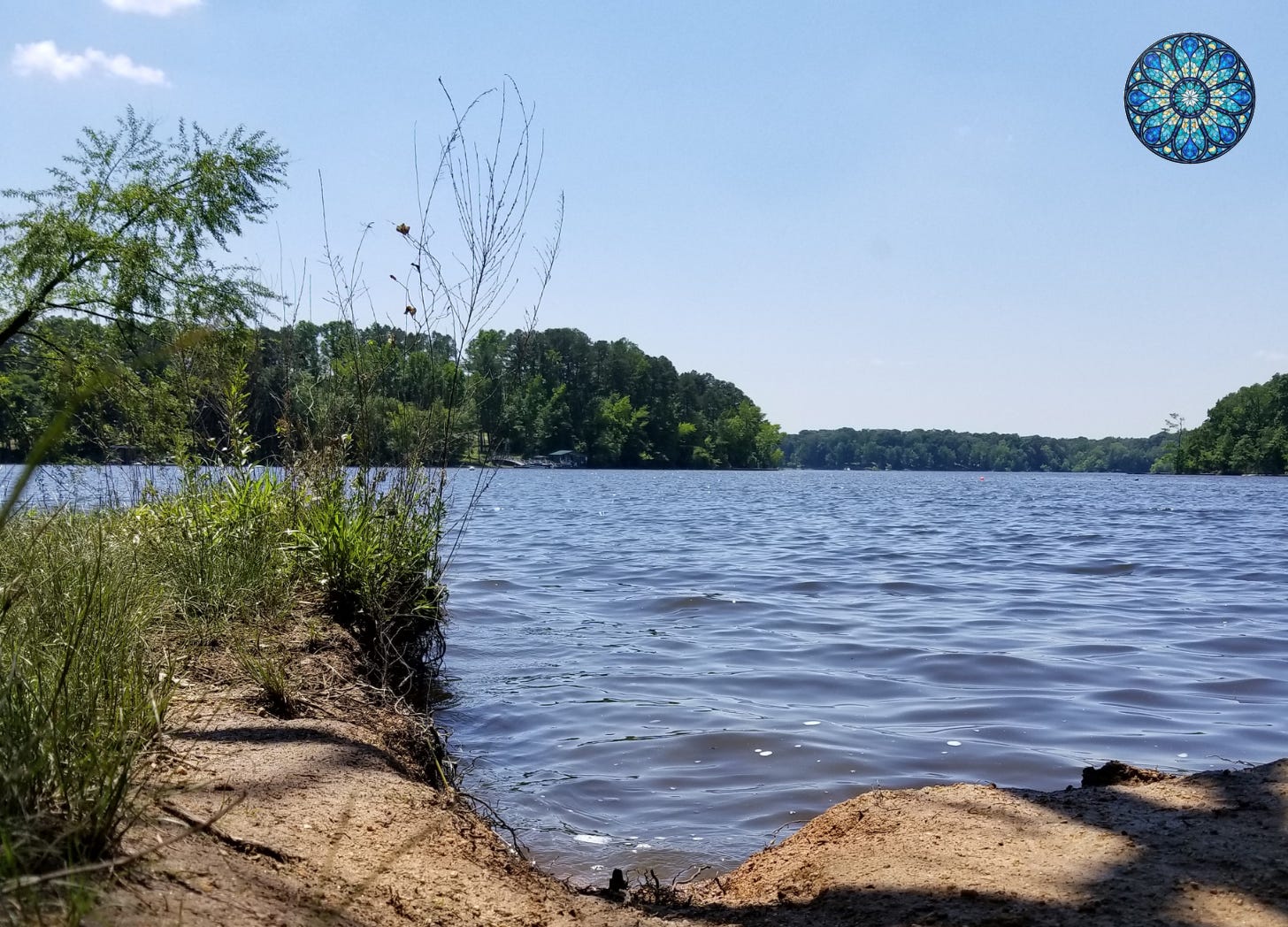
This particular July day must have been in the early 1970s — I’m thinking ’71 or ’72. My brother Don and his wife Julie were married in November 1969, so I know it was after that, and I don’t believe I had yet entered junior high school (which happened in the fall of 1973). I was young, maybe 10 or 11 years old. My parents and I were camping at Buggs Island Lake, a beautiful recreational center straddling the Virginia-North Carolina border. My brother and his wife were also there; I can’t recall if they were camping as well or had just driven up for the day (the lake is about 135 miles from the Virginia Peninsula, where we lived). My memory involves a walk that Don, Julie and I took along the lakeside, the morning after the fourth of July.
The beach — not a sandy beach, but a lake shore where trees extended almost down to the edge of the water — was covered with used bottle rockets, a silent witness to the festivities of the night before. It was a beautiful, sunny summer day; I don’t recall it being particularly warm (certainly not like the blistering swelter of summer here in America this year). I recall that Julie found an arrowhead; 1 this land had historically been the home of the Occaneechi people, although I think we can assume that any arrowhead found there in the 1970s had just been recently dropped by a previous passerby. Nevertheless, as a kid I was a bit jealous of her good fortune, and desperately wanted to find an arrowhead of my own. No such luck, though — all I seemed to be able to find were those used bottle rockets.
At some point during our time walking along the lake, something happened. By “something” I don’t mean anything particularly dramatic, as if I had a vision or some awe-inspiring mystical experience. It’s more that I simply and spontaneously dropped into the pure presence of the moment. I wasn’t overwhelmed by any particular emotion or feeling; I didn’t feel that I had any kind of mind-expanding insight or vision. I was just simply there. Fully present, completely in the moment. It was peaceful, serene, beautiful. Looking back from so many years later, I think that part of what may have made this so special is that, if only for a moment, my ongoing sense of anxiety dropped away. Without any sense of the day or the moment being special or extraordinary, I nevertheless seemed to be given, for just a moment, a wider and deeper ability to see into the heart of things.
It was a moment of wonder. And as is so often the case with these kinds of things, it was a moment of wonder that passed quickly by. I didn’t say anything to my brother or sister-in-law, we were just three family members out for a walk. It was an ordinary day, unusual only for all those bottle rockets.

I put it out of my mind for many years.
It was several years later, in 1977, that I had a much more meaningful “peak” experience of feeling oneness with God, which I have written about on several occasions (most notably in my books The Aspiring Mystic and Unteachable Lessons). That was the more remarkable, “oh wow” experience that launched me on my lifelong love for contemplative and mystical spirituality. In comparison, my Buggs Island Lake memory seems sweet but not especially noteworthy.
That is, until I started moving more deeply into my own intentional practice of Centering Prayer and contemplative meditation (a practice that I began in earnest more than ten years after that July day on Buggs Island Lake). As I began to pay closer attention to the grace of silence and of what Cynthia Bourgeault calls “objectless attention” (see The Heart of Centering Prayer for more about this), I came to realize that I had been spontaneously brought into such a singular moment, there on the shore of the lake with all those bottle rockets.
It happened freely. Naturally. Without any intentionality or planning or even conscious desire on my part. It was simply there. Maybe just for a few moments, maybe a couple of minutes. My brother and sister-in-law and I kept walking along. The moment of pure presence passed, and I reverted back to what was “ordinary” consciousness for me. But it made enough of a lingering imprint on my mind that, years later, I could recall it and say “that’s like what I experience when I’m deep into Centering Prayer.”
Consider this insight from contemplative neuroscientist Gerald G. May:
It is my impression that extremely brief unitive experiences happen to most people numerous times each day, but are so very short-lived that they go unnoticed. There is, I am certain, the potential for unitive experience at each blinking of the eyes, at each pause in the breath. But such experiences are seldom recognized.2
Everyone has multiple unitive experiences each and every day, only we’re really good at filtering them out. It’s as if the brain intuitively recognizes that such experiences might be meaningful and wonderful, but they don’t put food on the table. So we have learned to ignore them, unless they are long-lasting or powerful enough to inescapably catch our attention.

Walking along a lake in July, looking for arrowheads and only finding spent bottle rockets, may hardly seem to qualify as a unitive experience. But Saint Ignatius counsels us to find God in all things. Saint Benedict says “we believe the divine presence is everywhere.” What I experienced there as a child so many years ago was purely a matter of grace: I had no idea that meditation, or contemplative spirituality, or the practice of the presence of God, were even things worth wanting. They simply were not on my map. And so, what I did feel, what I did notice, was something I didn’t even have the language to describe, not only to others but even to myself.
This inclines me to sense that mystical experience is, in the words of Zen teacher Charlotte Joko Beck, “Nothing special.” In other words, perfectly ordinary, down-to-earth, humble: and available to everyone. Even for a young child whose family never went to church and whose hero was Mr. Spock (in other words, I was a little science nerd).3 Which means, of course, that the in-rushing presence of the Spirit, manifested through a sense of grace and clear seeing, is available to you, and me, and everyone — even the people we don’t like or think are “not worthy.” The miracle of mindfulness, as Thich Nhat Hanh calls it. The mystery of the divine indwelling. The sacrament of the present moment.
I suppose when you compare my moment by the lake to, say, the showings of Julian of Norwich or the “transverberation” of Saint Teresa of Avila — or even the 4th & Walnut Epiphany of Thomas Merton — then what I experienced was pretty small potatoes. But that’s okay.
The mystical life is not a race, there’s no blue ribbon for the person who has the biggest or most awe-inspiring vision.
Maybe the most down-to-earth encounter with grace can be just as life-transforming as the most profound enlightenment moment. To be sure, I never had a sense that my walk by the lake changed my life. If it did, it did so in such a subtle way that I can tell you nothing about it. Isn’t expecting a mystical experience to yield life-changing “results” just another form of spiritual materialism? Just another game of one-upmanship that we can sometimes play with each other (or ourselves). In other words, it’s nonsense. Don’t evaluate, don’t judge, don’t create artificial criteria that we use to think about our encounters with the mystery. Just have the encounter. That, in itself, is enough.

I checked in with my family and yes, she did find an arrowhead that day; and likewise doubts that it had any archaeological value; probably just the kind of mass-produced arrowhead sold in souvenir shops, that someone must have dropped there by the lakeshore.
Gerald G. May. Will and Spirit: A Contemplative Psychology, p. 64.
To the best of my knowledge, only once in the original Star Trek is Spock shown meditating, and that was during a time of personal crisis (pon farr). By contrast, in the most recent Star Trek series (“Strange New Worlds”), Spock is regularly depicted practicing meditation. Science and spirituality reunited at last.