

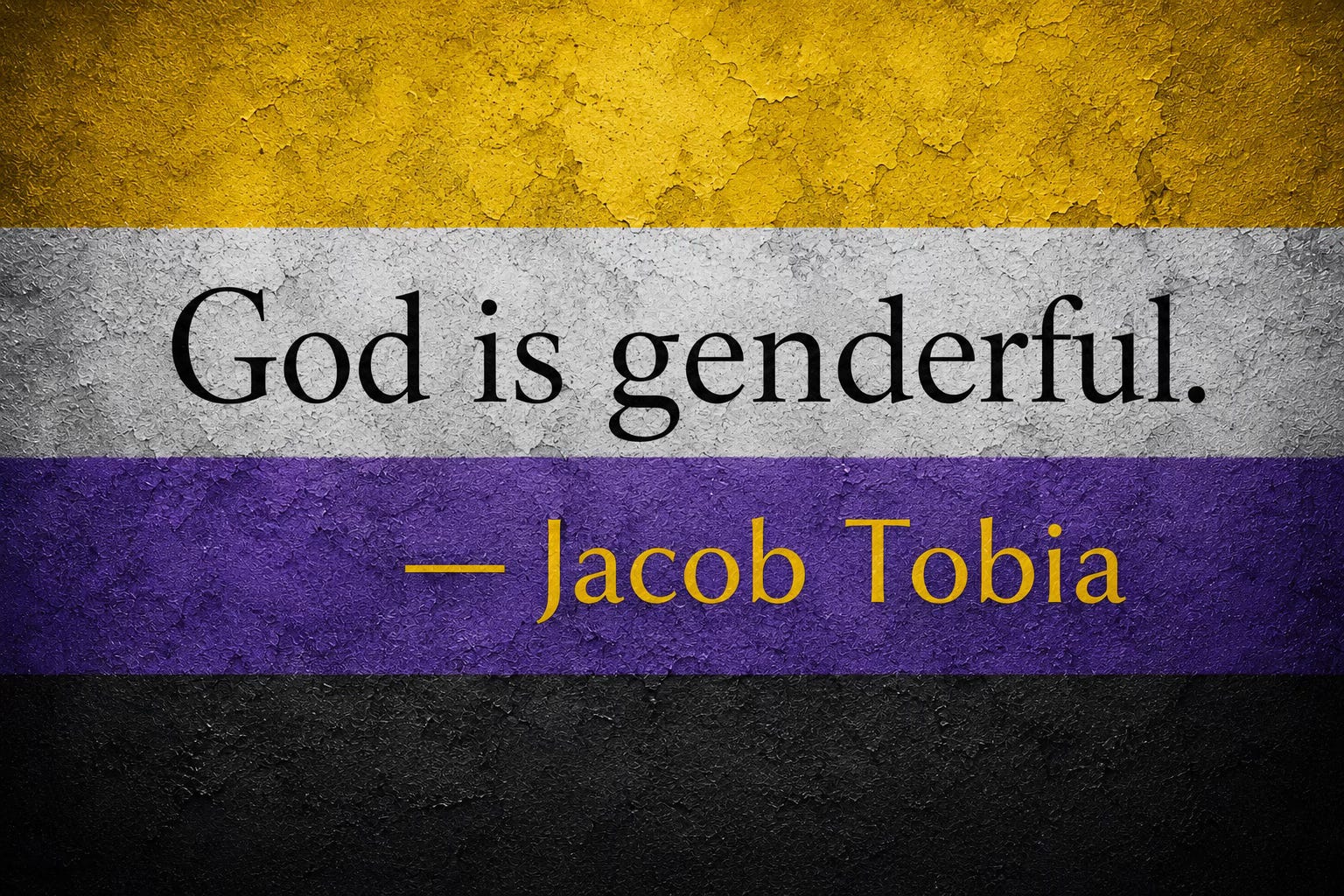
July 14 is International Non-Binary People’s Day. Non-binary refers to a sense of gender as being neither exclusively male nor female — a word that describes an embodied experience, not just some sort of political or ideological viewpoint.
For those of us who are contemplative or journeyers along the mystical way (regardless of our gender identity), I think we can discern a fascinating point of convergence between non-binary gender and non-dual spirituality.
To have non-dual consciousness means to be someone whose way of seeing emphasizes what unites us rather than what divides us. Mystically speaking, this primarily means to see union with God as a more real and pervasive reality than the sense of being separate from God (even though it is normal to have that sense of separation). Non-dual spirituality does not pretend that dualities don’t exist: there are still real distinctions between good and evil, healthy and unhealthy, heaven and earth, and so forth. But a non-dual consciousness sees a unity that is deeper and more stable than even the most all-encompassing distinction. “Evil” people are still deeply loved by God. Democrats and Republicans share a common humanity that matters more than our adversarial politics (yes, I know that one’s hard).
Richard Rohr calls Jesus the first non-dual teacher in the West, and I think that’s an apt and mystically illuminating recognition.
Compare that with this fascinating, if startling, insight from activist Jacob Tobia (b. 1991): “You also know that Jesus was nonbinary… God is clearly too big, too wise, too omnipotent to have an easily discernible binary human gender. I mean, God made all the genders, so clearly God isn’t just one. God is genderless, or rather, genderful.”1
Feminist and queer theologians and spiritual teachers have been pointing out for years how limiting it is to reduce God to just the masculine gender. To say “God is our Father” is to negate the beautiful insights that come from calling God our Mother. Of course, even feminist theologians readily acknowledge that it would be just as narrow and limiting to view God as exclusively feminine.
If God is neither exclusively masculine nor exclusively feminine, doesn’t it make sense to describe God as non-binary?

Non-binary is a word that gender-nonconforming people have been using for some time now to describe the experience of sensing one’s gender identity as neither fully male nor fully female (regardless of what the person’s biological sex might be)2. But like non-dual, the weakness of the word is that it is fundamentally negative: it stops at saying what it is not, leaving no space to affirm what it positively is.
For Jacob Tobia, God is genderful: God’s gender encompasses all possibilities. It is therefore a non-dual gender, and perhaps human beings who are non-binary can find within their gender identity a path to a non-dual appreciation of the mystery of human gender — or even the mystery of divine love.
But just as genderful is a wonderful alternative to non-binary, we contemplatives need a positive word to balance non-dual. My votes goes to unitive, the word Evelyn Underhill uses to describe the experience of union with God (what traditionally has been described as theosis or deification, theological terms to point to the experience of divine union).
To be unitive is to be “Godful” and therefore to see all things through the eyes of divine love. May we all open our hearts to such a heavenly perspective.

Jacob Tobia. Sissy: A Coming-of-Gender Story (Kindle Edition), p. 312.
Many writers today prefer to speak of “gender assigned at birth” rather than “biological sex,” simply to acknowledge how gender is so intricately bound up with cultural and social conventions, that it often cannot be neatly correlated to physical sex characteristics.
Regarding Tobia's comment on Jesus being non-binary, my first thought was, "yeah but Jesus was circumcised. Soooo....." And the Gospels are full of references to Jesus' male gender. (I am aware of anthropological and cultural influences on identity.) If there is reference in the NT to Jesus' questioning his "maleness," particularly as it pertains to his messaging of love and forgiveness, please share. I follow your account because I admire and appreciate your grasp of the mystical path toward a more encompassing grasp of God and the universe. And while there is much to learn---much I don't know---the "identitarian" efforts to insert the unlikely (if not absurd) into the facts as we know them seems to diminish the effort. It can be enough for Jesus to be a "dude." Even a very masculine one . One who represented the universal soul and light of each gender, endlessly. That doesn't make him non-binary. It makes him distinctly binary with a message of fulsome light and spirit. Why can't that be enough? (Rhetorical question.)