

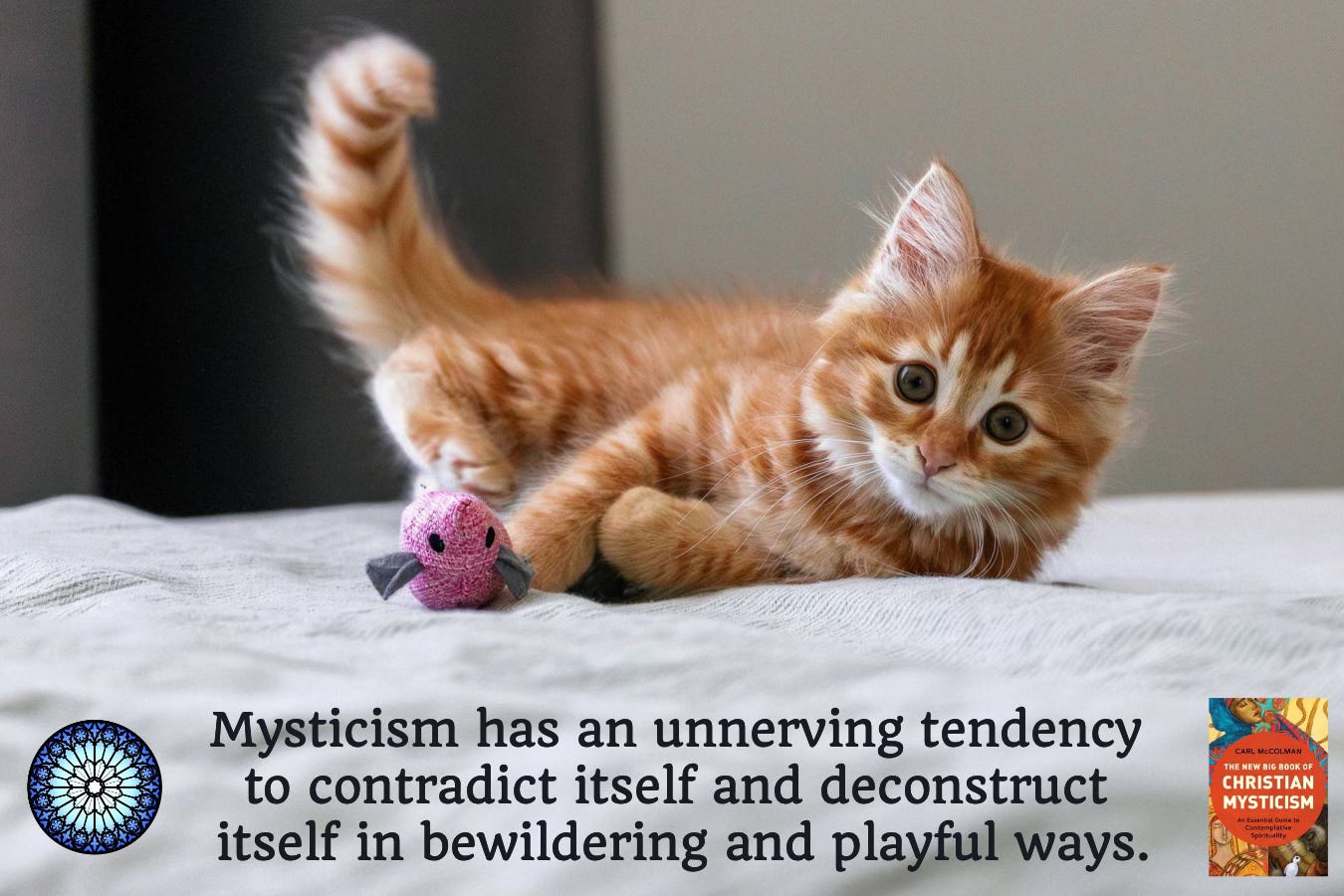
Even within a single religious framework like Christianity, mysticism has an unnerving tendency to contradict itself and deconstruct itself in bewildering and playful ways. — The New Big Book of Christian Mysticism1
Anyone who has ever lived with a kitten knows that they are tiny furry agents of chaos. More than once I have heard my wife mutter under her breath “God made them cute so we wouldn’t kill them” as she dealt with whatever the latest kittenly swath of destruction might be. From broken glass or claw marks on the curtains, to the ungodly banshee wails that they could emit when rumbling with each other (how can something so very tiny emit such banshee-level sounds?), the one thing you can safely predict about kittens (well, and really cats in general), is simply how hopelessly unpredictable they are.
But they are cute! Adorable, funny, charming, affectionate, endearing. When one of those five-pound balls of claws and fur climbs into your lap and starts to purr, it is just about the sweetest thing anyone can experience (with due acknowledgment that those who are allergic to cat dander will naturally have a very different response).
I suppose it might be stretching most people’s imaginations to compare God to a kitten. But maybe it’s not quite so far a leap to assume that we human beings might be like kittens in the eye of God! Maybe we are not all cute and cuddly, but I rather think that chaos follows us mortals around the way a kitten will tag along behind whatever human it has bonded with.
I bring this up to comment on a sentence you’ll find in chapter two of The New Big Book of Christian Mysticism. I aver that mysticism can be internally self-contradictory and fosters the experience that we have come to call “deconstruction” — to enter the mystical life is to render ourselves vulnerable to a kind of spiritual (and/or religious) chaos.
The apostle Paul insisted that religious activities should be performed “decently and in order.”2 In other words, don’t put the kittens in charge. And I might add, don’t put the mystics in charge either.
It’s not that contemplatives are hostile to dignity and good order! But there’s a quality in the mystical life that places the liberating action of the Spirit above all other concerns. Sometimes our staid and stuffy ways of doing things need a kitten-quality shake-up. Such destabilizing moments can be upsetting — but if we listen carefully, they might result in some purring as well.

Join me for an online conversation on some of the ideas and themes in The New Big Book of Christian Mysticism! This free Zoom call takes place July 22, 2026 at 7 PM EST. Everyone is welcome, but pre-registration is required. Click here to register.

The New Big Book of Christian Mysticism: An Essential Guide to Contemplative Spirituality (Kindle edition), p. 29.
I Corinthians 14:40