

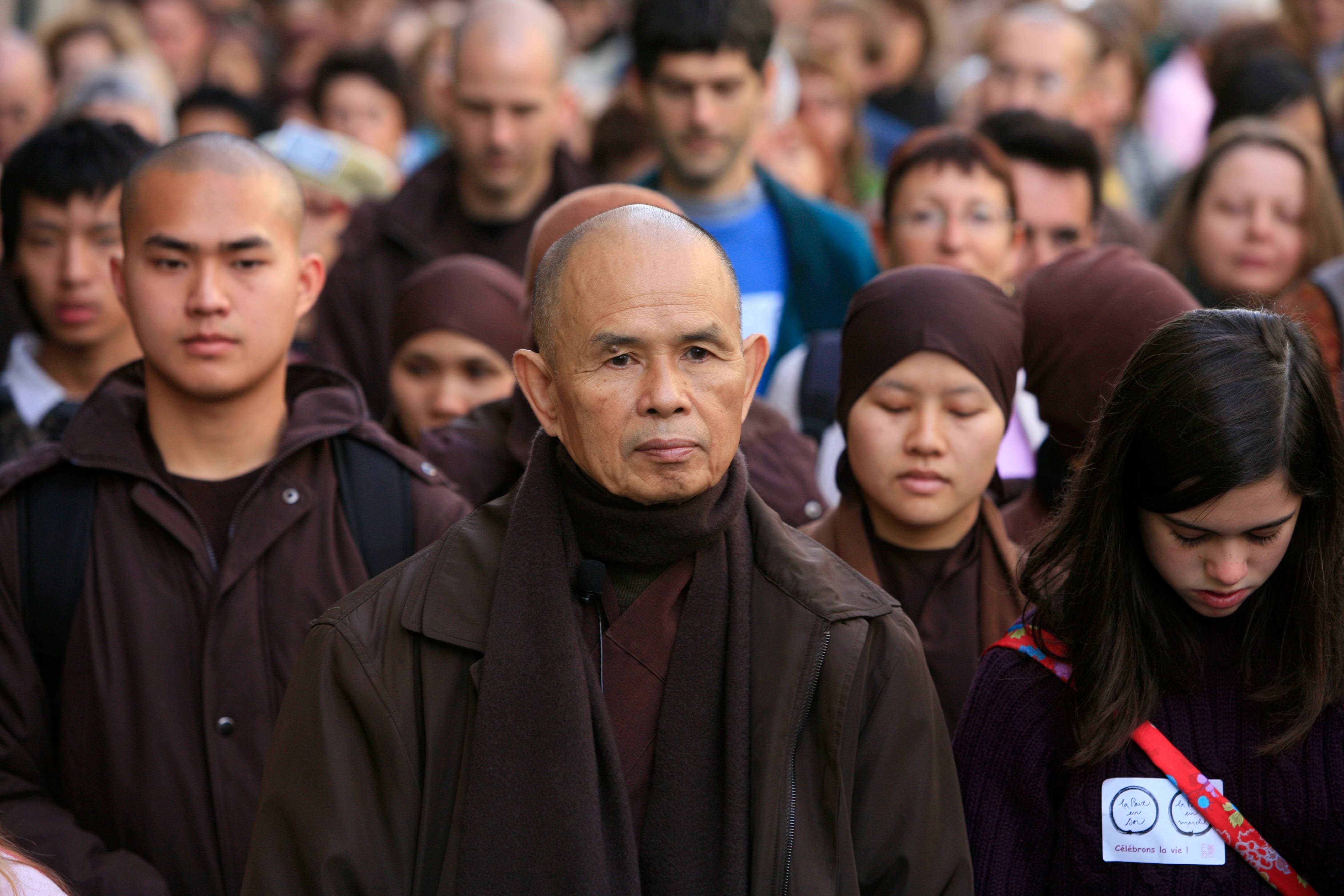
Thích Nhất Hạnh was born on October 11, 1926. So today would have been his 100th birthday.
Propelled onto the world stage by his anti-war activism during the Vietnam era, and renowned as a friend to Thomas Merton and Martin Luther King Jr. (who nominated him for the Nobel Peace Prize)1, Thích Nhất Hạnh (affectionately known as Thầy, which means “teacher”) will deservedly be recognized not only as one of the great Buddhists of our time, but also as one of the great contemplatives of any spiritual tradition.
He did more than perhaps any other recent world-renowned spiritual teacher to elevate the concept of mindfulness as a core spiritual practice. As Thầy used the term, it meant far more than just focused awareness — his distinctive understanding of mindfulness revealed a truly contemplative sense of the word, referring to the fruit of a stable and sustained meditative practice. Mindfulness quickly transcended Buddhism to become a widely recognized word for the deep abiding calm that emerges from the practice of meditation or contemplation. Mindfulness, in this sense, seems to be roughly analogous to the ongoing sense of heightened consciousness that, in Christian tradition, might be seen as equivalent to “the practice of the presence of God.”
Thầy died at the age of 95 in early 2022, after a long life in exile (he lived in France for over half his life) and seven years after surviving a debilitating stroke that left him incapable of speaking. Despite a stormy relationship with the Vietnamese government, he spent the final years of his life back home, and died while in residence at Từ Hiếu Temple in central Vietnam.
To celebrate what would have been his 100th birthday, I’d like to highlight some of his many books. He wrote more than 100, so I’m just going to focus on a few titles that I personally have found meaningful or helpful. This is not meant to be a comprehensive “best of” list. If you love Thầy as much as (or more than) than I do, it is likely that my list will exclude one or several books that are especially meaningful to you. Such is the nature of lists like these; they always are somewhat subjective. If you are bemused or horrified about a book that I have ignored, please leave a comment and make the case for the book you love. It may be nothing more momentous than that I just haven’t read your particular favorite yet, and your recommendation will be helpful to me as well as to other readers of this Substack.
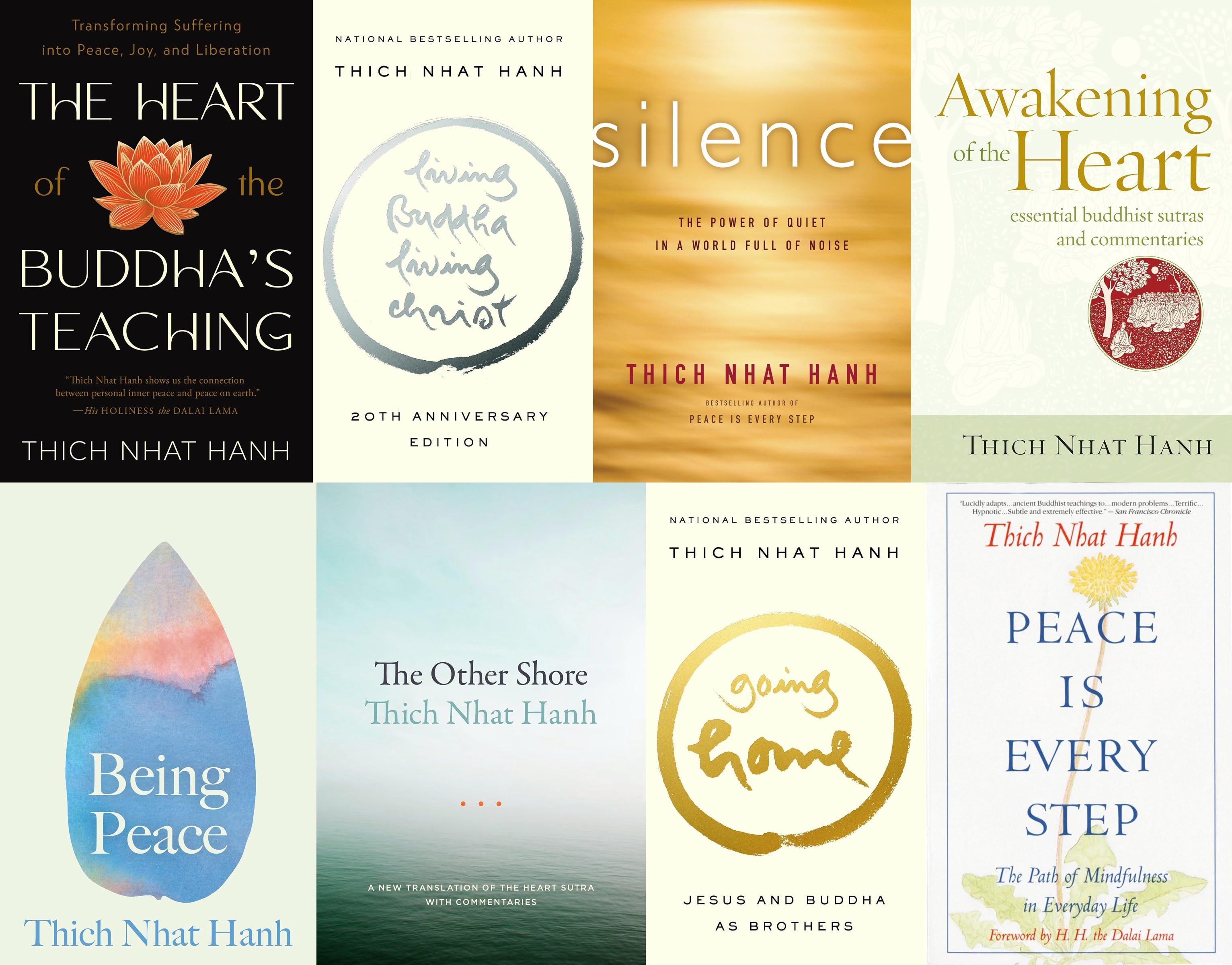
Living Buddha, Living Christ — This was my introduction to Thầy and his wisdom. A deceptively simple book that functions partially as a manifesto of the author’s own spiritual pluralism, as a Buddhist monk with longstanding ties to the Christian Community — but it’s more than just a confessional book. In its discussions of mindfulness, interbeing and enlightenment, Living Buddha, Living Christ offers a practical map for a spiritual integration of Christian and Buddhist contemplation that is accessible to everyone.
Going Home: Jesus and Buddha as Brothers — Gathering together a number of talks giving by Thầy at his monastery in France during the Christmas season, this book is more or less a sequel to Living Buddha, Living Christ — not as groundbreaking as the first book, but a solid companion volume and a nice glimpse into what a truly interfaith/interspiritual conversation between Christianity and Buddhism can look like.
Being Peace — A classic text drawn from talks given to peace activists. Building on his understanding of “engaged Buddhism,” in this book Thầy calls for peace as more than just an activist’s project, but truly as an embodied way of life.
Peace is Every Step: The Path of Mindfulness in Everyday Life — If Being Peace was Thầy’s teaching on peace for dedicated activists, Peace is Every Step expands his teaching on peace — and mindfulness — for a wider, general audience. Given Thầy’s longstanding reputation not only as a Buddhist but also as a spokesperson for peace, this is to my knowledge one of his most beloved and acclaimed books. If you want to enter his wisdom from a Christian perspective, begin with Living Buddha, Living Christ, and then move on to this one; if the interfaith angle doesn’t interest you, this is the book to start with.
Silence: The Power of Quiet in a World Full of Noise — Thích Nhất Hạnh joins the ranks of authors like Sara Maitland, George Prochnik, Maggie Ross and Diarmaid MacCulloch in writing an engaging book about a topic that is impossible to put into words. Naturally, Thầy invites us into silence both as an antidote to the noise and intensity of contemporary world, and also as a way to settle into the healing gifts of mindfulness.
The Heart of the Buddha’s Teaching: Transforming Suffering Into Peace, Joy and Liberation — This and the final two books on my list invite us deeper into Buddhist teaching as interpreted by Thích Nhất Hạnh. Before he was a peace activist or an advocate for mindfulness, Thầy was first and foremost a Buddhist monk, and so many of his books are based on his dharma talks or otherwise geared toward Buddhist practitioners. This book, also considered one of his essential works, starts at the beginning by presenting Thầy’s commentary on the Buddha’s Four Noble Truths and Noble Eightfold Path, along with some other foundational teachings.
The Other Shore: A New Translation of the Heart Sutra with Commentaries — The Heart Sutra is one of the most important documents in Mahayana Buddhism, but it’s also quite a puzzle for those of us steeped in Western ways of thinking and meditating. Thầy offers a lucid new translation of the Sutra and an accessible, thematic commentary that helps to make this ancient text truly come alive.
Awakening of the Heart: Essential Buddhist Sutras and Commentaries — If you enjoyed his basic books on the Buddha’s teachings and the Heart Sutra, Awakening of the Heart is an invitation to go even deeper. Important texts like the Diamond Sutra, the Sutra on the Full Awareness of Breathing, the Sutra on the Four Establishments of Mindfulness, and others are cracked open for readers who enjoy Thầy’s gentle, spacious teaching style — whether or not you yourself are a Buddhist.

The Nobel Committee did not award the Peace prize to anyone in 1967, the year Thích Nhất Hạnh was nominated. In retrospect, that seems like truly a missed opportunity.