

Forty years ago, I spent the Fourth of July with my brother and sister-in-law on an island in the Chesapeake Bay. Then I went home to northern Virginia, where I went to a concert that changed my life.
My brother Don and his wife Julie lived in a sweet little house on Gwynn’s Island, Virginia. Don worked for a car parts company in Newport News and Julie ran the lab at the hospital in Williamsburg, so they balanced two demanding jobs with a peaceful home in an island forest. I was living in Falls Church at the time, 25 years old, single, with a master’s degree in professional writing but most decidedly had not found my voice yet. At that point in my life I was in the midst of what would be a fifteen-year run managing college bookstores (I was working at the George Mason University Bookstore in Fairfax, VA; the following year I would move to Atlanta to take a similar position at Georgia State University, and have remained in the Deep South ever since).
Spiritually, I had discovered contemplative prayer and spiritual direction, but was very much a novice at both. Just a few months earlier I had joined the Episcopal Church, and had completed a 6-month program on personal spiritual development through the Shalem Institute in DC. All this to say, my life was sweet but nothing really tied it all together.
After a quiet day just living life away from the pace and stress of city life, we watched fireworks from a boat in the Chesapeake Bay. Even though the following morning was only Saturday, I packed up to go back to DC — because I had tickets for a stadium concert on July 6, featuring three musicians I liked but none of whom I had ever seen before: Tom Petty and the Heartbreakers, Bob Dylan, and the Grateful Dead.
The concert took place at RFK Stadium, with over 50,000 people in attendance. It was the last stop of a three-city tour that included Akron, OH and Buffalo NY before heading to DC for two shows (I caught the first night). Sunday, July 6, turned out to be a blisteringly hot day, with temperatures peaking at over 100 degrees Fahrenheit.1
While I was looking forward to seeing all three acts, my primary motivation for going was to see Bob Dylan. I knew that he would be sharing the stage with the Heartbreakers, so I figured the Dead would be the opening act. How surprised I was when the concert began with Petty and the Heartbreakers performing, and Dylan joining them after just a few songs.
I was a bit scandalized. While I liked the Grateful Dead and was happy to be seeing them, I felt that they were far less “important” than Dylan, whose place in the rock and roll firmament, in my mind, was equaled only by the Beatles and the Rolling Stones.
By comparison, the Dead were just a respectable band that had scored a few minor hits over the years (like “Truckin’” and the deliciously weird “Casey Jones”), but were remarkable more for their ties to the LSD counterculture than for their music. The great Bob Dylan, opening for a (relatively) minor band like that? Give me a break!
But before the day was over, I would understand why.
Listen to the Thunder Shout
Tom Petty and the Heartbreakers opened with an economical set including songs like “The Waiting,” “Don’t Do Me Like That,” and “Refugee.” Joining them on stage, Bob Dylan played some of his classic songs like “Positively 4th Street,” “Masters of War,” “It Ain’t Me, Babe,” “Ballad of a Thin Man,” “Rainy Day Women #12 & 35,” “Like a Rolling Stone,” “Blowin’ in the Wind” and “Knockin’ on Heaven’s Door.”
My friends and I spent some of the time on the stadium field baking under the cloudless sky, but eventually we climbed up into the upper deck and found seats where the sound wasn’t nearly so good, but we were in the shade where we could relax and enjoy the show — and the ambience.
None of us would have thought of ourselves as deadheads, as the Grateful Dead’s intensely devoted fans were called. But we all loved music, and here was an opportunity to see a band that, by that point, was 20 years into its career and so had their bona fides as rock and roll legends (even if they were not the luminaries I considered Dylan to be). When they took the stage, I was immediately struck by the excitement in the crowd. We may not have been intensely devoted fans, but most everyone else there clearly was.
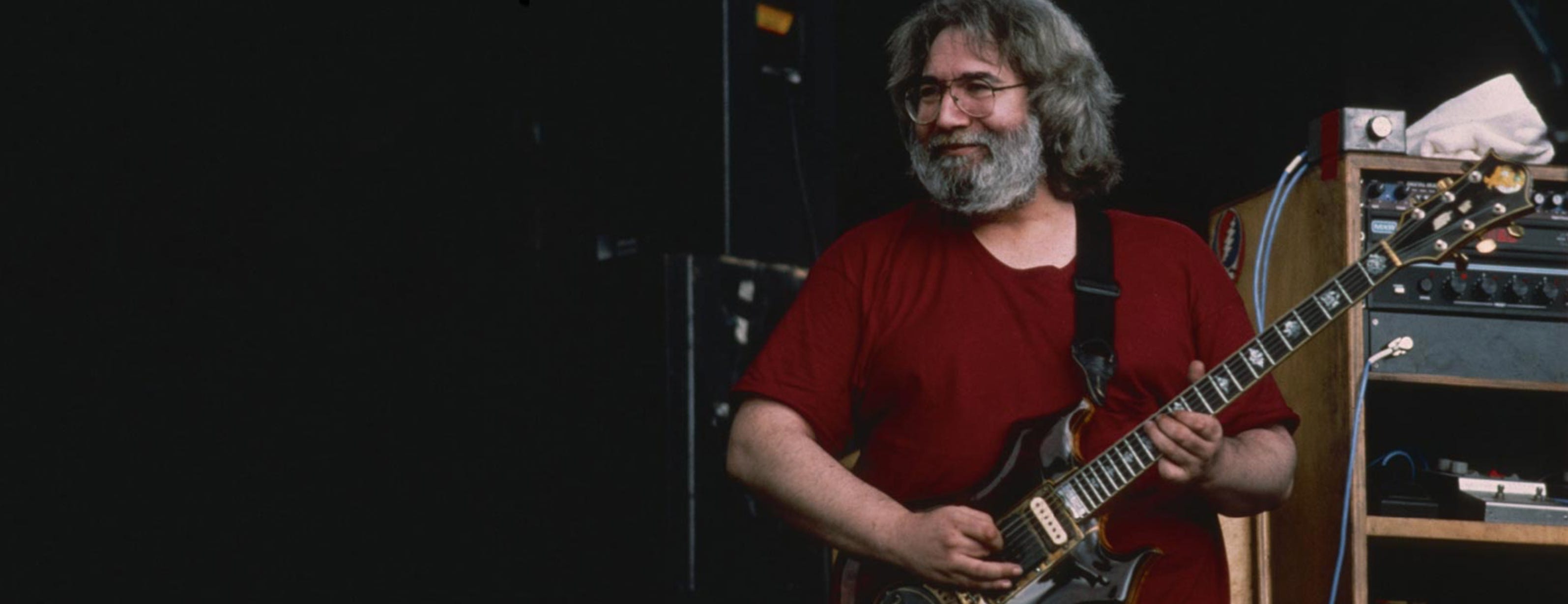
Jerry Garcia, lead guitarist and one of the band’s vocalists, was the only member whose name I knew. But even up in the nosebleed seats (this was long before Jumbotrons), I could easily pick him out. Sporting a red t-shirt over his corpulent frame, his thick beard and unkempt head of grey hair made me think that he was putting off a definite “Santa Claus” vibe.
As soon as the band began playing — a song I had never heard before, but later learned was called “Hell in a Bucket”2 — the deadheads started to dance. That may not seem so remarkable to many readers today. But I was a white middle-class kid who had grown up listening to bands like Yes, Pink Floyd, Emerson Lake & Palmer, Genesis, Led Zeppelin and so forth. These were bands famous for making what we used to call “head music” — which meant it wasn’t really about the body. In other words, we didn’t dance. We listened to the music, maybe indulging in a little bit of air guitar or air drumming, but that was about as far as it went. The musical soundtrack of my childhood was very much a cerebral experience.
By contrast, the deadheads, regardless of their gender or the depth of their childhood repression, were all dancing, with abandon and obvious joy.
Some of them unfurled huge banners from the stadium’s upper deck, mostly featuring lyrics from songs which, once again, I was not familiar with. One, however, particularly caught my eye, with a message that seemed so appropriate in Reagan’s America — and even more urgent now in the age of Trump:
Kids they dance, and shake their bones
And politicians throwing stones…
It did not escape me that this was in Washington DC, the natural habitat of all those rock-hurling politicos.3
The band played for just under an hour before they took an intermission. I did not know a single song, and sitting up in the nosebleed seats, it was pretty hard to truly appreciate the music. I do remember the closing song of the set, a lengthy tune that featured a striking set of lyrics in its refrain:
Listen to the Thunder Shout:
“I am! I am! I am!”
When later on I reviewed the setlist from that concert, I could see that it was not especially remarkable, although it contained a number of songs I would grow to love over the following years, “Sugaree,” “Row Jimmy,” “Cassidy,” “Let it Grow” and in the second set, “Iko Iko,” “He’s Gone,” “Throwing Stones,” — and if I had stayed all the way to the encore, I would have finally heard one song that I knew: “Brokedown Palace,” a lovely ballad from what is one of the band’s best studio albums, American Beauty.
But my friends and I were all there mainly to see Bob Dylan, so the happy dance-y deadhead love fest was largely lost on us, and we finally left the stadium while the band was playing “Iko Iko” — an old New Orleans groove stomper that had been covered by the Dixie Cups, Dr. John and even Cindi Lauper. As my friends and I walked down the stairs and reached the ground level, that’s when it happened.
By “it” I mean, I could hear the music clearly. And I was blown away. It wasn’t the most virtuoso playing I’ve ever heard (that honor probably went to Yes), nor was it a particularly polished performance. But the band clearly was on a roll,4 the audience was clapping a complicated, intricate eight-beat syncopated handclap, in perfect unison (we’re talking upwards of 50,000 people) — something far more intricate and complex than a normal four-four backbeat clap you might hear when a church choir sings an upbeat gospel song.
The gathering of deadheads had organically become part of the performance, their rhythmically sophisticated clapping collectively functioning almost like a third percussionist.5 But even more hypnotic to my ears was Garcia’s lead guitar playing, lyrically trilling above the beat with a singular, hypnotic beauty. I stopped and listened for maybe 30 seconds, maybe a minute, before my friends urged me to go on with them. And so we left the concert.
Learning to Shake My Bones
Readers, you know what happened next.
First, I went home and began listening much more closely to the few Grateful Dead albums in my own record library. Then I hit up my roommate David to borrow the records he had — I was thrilled when I played the album Wake of the Flood and recognized “Let it Grow,” the song about the thunder shouting “I am.”6
I went to Penguin Feather, our local independent record shop (oh, those glorious days before streaming or ordering CDs online) and bought a few more Dead LPs. A week or so after that, my roommate and I were at Tyson’s Corner, our local shopping mall, and I bought some Grateful Dead merchandise, like a keychain, bumper sticker, and T-shirt. Watching this, David laughed and said, “You’ve turned into a deadhead.”
“I have not!” I muttered defensively. “I just really liked them, that’s all, and so I figured I needed to, you know, get to know their music better.”
“And wear their T-shirts,” he smirked.
“Well,” I huffed, “you’re not a deadhead until you start trading concert tapes with other deadheads. And I don’t even have any such tapes.”
David’s smile got bigger. “I could introduce you to a buddy of mine who has a huge collection of Dead concert tapes. I bet if you bought him a box of blank tapes, he would get you started.”
“Would you?” I asked, excited at the thought.
The guy he introduced me to did kindly trade a box of blank cassette tapes for a selection of some of the band’s greatest shows: Ithaca in 1977, Kezar Stadium 1973, and Richmond 1985, among others.
Eventually I would go on to see the Grateful Dead some 36 times (including five shows in Europe), which in the deadhead world is not that impressive a number, but it was enough for me to sink deep into the music and (especially) the ecstatic experience of attending multiple nights of Dead shows, dancing — yes, dancing — for hours on end and losing myself to the Dionysian wonder of it all.
Eventually I grew weary of the energy and expense it took to chase after the Dead, and by the time I met Fran and Rhiannon, it was easy for me to trade the youthful indulgence of being a deadhead for the much more responsible adult tasks of marriage and parenting. But to this day, I can’t hear a song like “Eyes of the World” or “Franklin’s Tower” without feeling a surge of joy and an embodied desire to dance.
What the Dead did for me
Why did any of this matter?
Why did going to see a hippie jam band in 1986, when they were arguably well past their prime (I’m of the opinion that 1977 was their best year), make a difference in my life, so much so that here I am writing about it, forty years later? Here are a few thoughts.
The Grateful Dead have always been about more than just their music — while I think they are much better than their detractors are willing to admit, I also understand that for most people, their quirky, rootsy/psychedelic jamband music is definitely an acquired taste. But the magic of the Dead was always primarily embedded in the countercultural world of their fans: the deadheads. In other words, the dancers spoke to me even more than the band who made them dance.
Going to a deadshow, especially in the 80s and 90s, felt like a time travel experience: for just a few hours, we were plucked out of the nightmare funhouse of the Reagan/Bush era, and invited back into a world where peace, and consciousness expansion, and creativity, and communal living, all mattered more than conspicuous consumption and big-money capitalism. When I first encountered the deadheads, not only did they give me permission to dance, but they also were the kind of people who were reading Alan Watts, Ram Dass and Starhawk — at a time when The Art of the Deal (ahem) and The One-Minute Manager were sitting at the top of the New York Times Bestseller lists.
So for me, becoming immersed in deadhead culture meant more than just wrapping myself in patchouli and tie-dye — it meant finding an “alternative narrative” that helped me to see beyond the dogmas of the 80s.
And this even went so far as to impact my relationship with religion as well. As I mentioned at the beginning of this article, by 1986 I was in spiritual direction, a member of an Episcopal Church, and learning the ropes of contemplative practice through classes at the Shalem Institute. By all indications, I was on the road to becoming a thoroughly respectable, if liberal, contemplative Christian.
And clearly, contemplative Christianity has been, and continues to be, an essential part of my understanding of what a healthy and visionary spirituality can look like. But even liberal Christians have their dogmas, their blind spots, and their temptations: chiefly a temptation to a kind of upper-middle-class respectability that can easily ignore those who don’t fit in.
The Dead, and deadhead culture, kept me honest: because I didn’t fit in to proper Christian culture. Even though I spent a number of years trying to fit in. Like it or not, I was a hippie. I liked loud music and loud clothes. I thought the war on drugs was morally wrong. I was suspicious of the devotion to greed that the Reagan era made fashionable (one of the poster children for that culture of avarice now lives in the White House). I thought feminism made sense, that gay pride (as we called it back then) was healthy and good, that our government wasn’t doing enough to combat AIDS, and that care for the environment mattered more than unfettered capitalism. Meanwhile, as much as I loved mystical and contemplative Christianity, I still intuitively understood that indigenous and eastern spiritualities were just as valid paths to both inner and societal liberation.
And for some reason, falling in with an aging acid rock band and their tie-dyed, Rainbow Family followers encapsulated for me these various “counterculture” positions. My heart belonged to the likes of Thomas Merton and Evelyn Underhill, but the Dead helped me remember that my heart also belonged to the likes of Ram Dass and Starhawk. Not either or: both/and. And that creative tension continues to enliven and inspire me to this day.
But most of all, the Dead and the deadheads inspired me to dance.
The early 20th century anarchist Emma Goldman was famous for loving to dance, and for insisting that being a radical did not require or demand “the denial of life and joy.” Her stance has been immortalized in a line which she never directly said, but it certainly captures her spirit:
If I can’t dance, I don’t want to be part of your revolution.
Amen, Sister Emma. Deadhead culture is a dancing culture, but it is (or can be) also a revolutionary culture: advocating for radical care for the environment, sustainable economics, peace and justice, and dismantling the systems of privilege that oppress women and queer people. This is not to say that there aren’t plenty of conservatives who love the Dead (just like there are plenty of liberals who love Catholic spirituality). But the center of gravity in the deadhead world is people who dance and shake their bones as an act of resistance against all the politicians and others who are throwing stones.
There’s a lot of talk in the contemplative Christian world about action and contemplation. It’s an important conversation, and I’m happy to chime in whenever I feel like I have something to say. But I think we need to be careful with this conversation, because it’s too easy to see activists and contemplatives as polarized opposites. What we really need are people who seamlessly embody both the quiet stillness of a monk and the revolutionary dancing of Emma Goldman. I suppose the particulars of that will look different for different people, and that’s okay. For me, it looks like Ram Dass and Evelyn Underhill hanging out together. They meditate deeply, but then, I like to imagine, they would get up and dance.
Famously, Jerry Garcia would suffer a diabetes-related coma just three days after the end of that tour; it was said that he came quite close to death, and when he finally did regain consciousness, he had to learn how to play the guitar from scratch, necessitating the Dead to take a five-month hiatus.
Deadheads would keep meticulous notes on the concerts they attended, and many of them taped the shows for personal use, with the band’s blessing; so it is easy to visit sites like jerrybase.com, the setlist program, or setlist.fm and learn what songs were played on any given night. Archive.org also hosts an impressive archive (duh) not only of fan-recorded concerts, but even recordings from the band’s sound engineers, captured on the soundboard, which often sound as good any commercially released “in concert” album.
The Dead actually played “Throwing Stones” toward the end of that concert, but I had already left the stadium, and would not have known the song even if I were still there. But it became one of my favorite songs by the band, and I saw them perform it a number of times over the following five years.
I later read someone say that by the 1980s, most rock bands had forgotten that the music was once called “rock and roll,” with the Grateful Dead being one of the few touring bands that could still roll as much as they rocked.
The Grateful Dead, like the Allman Brothers Band, famously featured two drummers.
To this day, one of my favorite GD songs.
Wow! Thank you dear Carl. What a gift you've given me (and us) with this stroll down memory lane. "We are all just walking each other home." And, dancing!