

As it is not by the methods of the laboratory that we learn to know life, so it is not by the methods of the intellect that we learn to know God.
— Evelyn Underhill, Practical Mysticism
For the past several months I’ve been leading a study of Evelyn Underhill’s Practical Mysticism: A Little Book for Normal People. Reading the book for the umpteenth time, and then preparing talks to give on each chapter, has just inspired me to fall more and more in love with Underhill’s unique approach to the mystical life as something for everyone. Practical Mysticism is over 100 years old — it was published in 1914. So it is an interesting look at how western mysticism was understood before the coming of Vatican II, or Thomas Merton, or the spirituality movement that kicked off in the 1960s.
In the last 20 years of her life, Evelyn Underhill became quite active in the Church of England, but this book predated her ministry as a Christian spiritual director and retreat leader. When she wrote Practical Mysticism, Underhill was what we would today call “spiritual but not religious.” Thus, her vision of mystical spirituality owes as much to Greek philosophers (Plato and Plotinus) as to Christian visionaries like Teresa of Ávila or Julian of Norwich. Indeed, in chapter 8 of the book, where she addresses how contemplation tends to invite us from nature-centered mysticism to a more transcendental spirituality, she invokes Plotinus to illustrate her point.
The doctrine of Plotinus concerning a higher life of unity, a lower life of multiplicity, possible to every human spirit, will now appear to you not a fantastic theory, but a plain statement of fact, which you have verified in your own experience. You perceive that these are the two complementary ways of apprehending and uniting with Reality--the one as a dynamic process, the other as an eternal whole. Thus understood, they do not conflict. You know that the flow, the broken-up world of change and multiplicity, is still going on; and that you, as a creature of the time-world, are moving and growing with it. But, thanks to the development of the higher side of your consciousness, you are now lifted to a new poise; a direct participation in that simple, transcendent life “broken, yet not divided,” which gives to this time-world all its meaning and validity.
— Evelyn Underhill, Practical Mysticism
She never uses the words nonduality or nondualism to name what she is describing here, even though some western writers (especially Theosophists or other esotericists) were already connecting the dots between mystical Christianity and Advaita Vedanta (“nondual Vedanta”) in the early 20th century. But it wouldn’t be until long after Underhill’s death (1941) that writers as diverse as Henri Le Saux, Bede Griffiths, Sara Grant, Richard Rohr or Cynthia Bourgeault began to explicitly speak of nonduality and nondualism as descriptors of the mystical experience of unity or oneness.
So, how did Christians talk about unity or oneness before the language of nonduality became common? Underhill gives us a wonderful insight in her commentary on Plotinus.
First, let me say that I am sorry she indulges in a kind of hierarchy, suggesting that Plotinus differentiates between a “higher” realm of unity and a “lower” plane of existence where “multiplicity” manifests. It’s the old idea “spirituality is higher than materiality” which unfortunately reinforces its own kind of dualism. Once again, she’s writing more than a century ago, so we can forgive her — but we still need to acknowledge that this kind of higher/lower language is problematic.
But by differentiating between a “higher life of unity” and a “lower life of multiplicity,” Underhill is able to affirm the reality of nondual existence without denying all the tensions and differences and apparent dualities of the manifest world in which we live. If I were Evelyn Underhill’s editor, I might encourage her to use language of concentric circles rather than higher/lower: that the world of multiplicity is cradled in a “larger” reality of nonduality (or, equally true, that nonduality is the still center-point around which the manifest world of multiplicity and duality is manifest).
When she says that this ability to perceive both duality and nonduality “now appears to you,” what she means is that progress in the practice of contemplation enables us to move into this deeper perception. She goes on to use a charming metaphor — of moving from a busy and noisy street into a silent, serene church — to illustrate how the practice of contemplation helps us to (in the words of Richard Rohr) “see as the mystics see”:
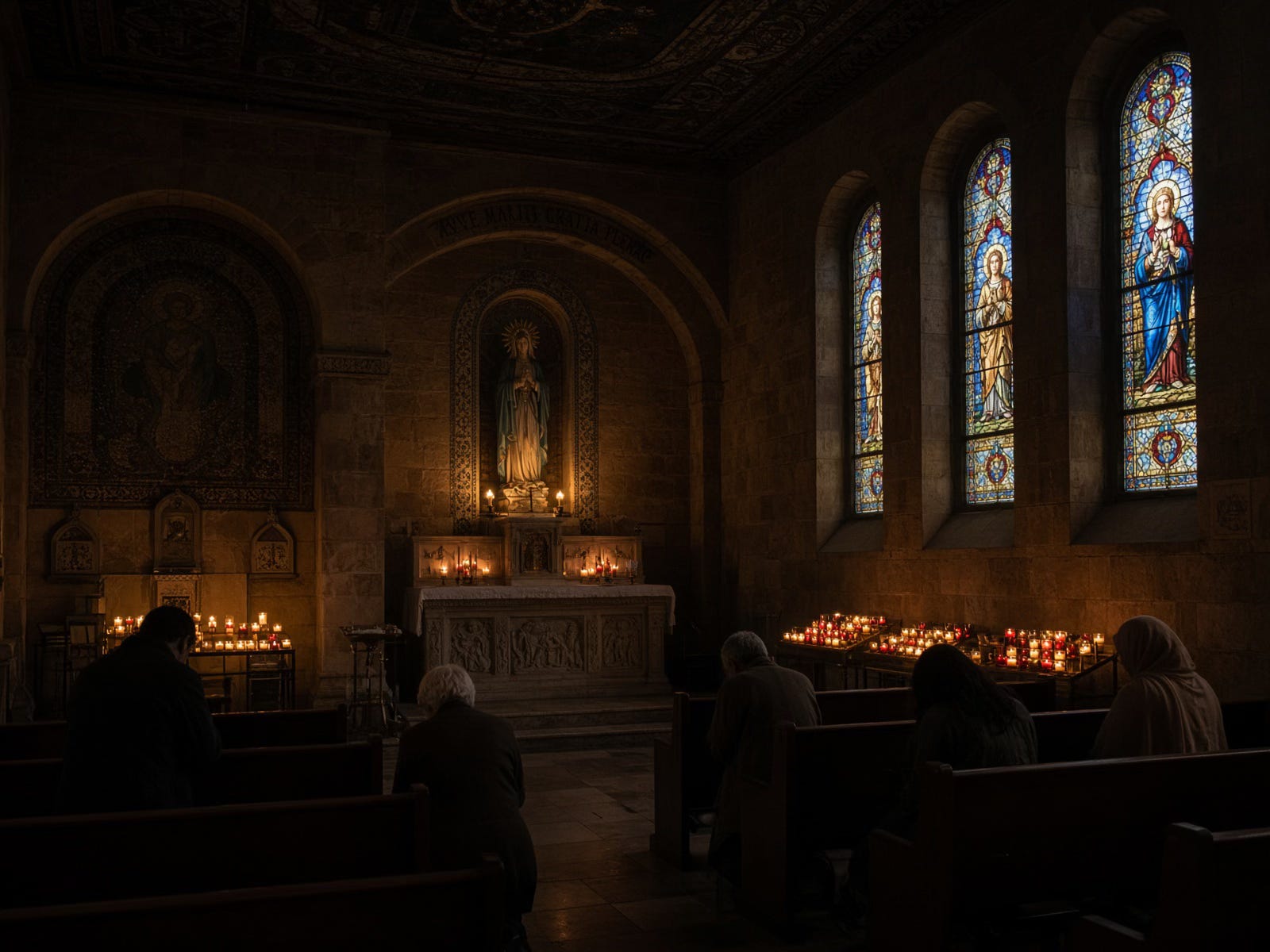
And you know… that you are also a true constituent of the greater whole; that since you are [human], you are also spirit, and are living Eternal Life now, in the midst of time. The effect of this form of contemplation… is like the sudden change of atmosphere, the shifting of values, which we experience when we pass from the busy streets into a quiet church; where a lamp burns, and a silence reigns, the same yesterday, to-day, and for ever. Thence is poured forth a stillness which strikes through the tumult without. Eluding the flicker of the arc-lamps, thence through an upper window we may glimpse a perpetual star.
— Evelyn Underhill, Practical Mysticism
I love how she speaks of “the sudden change of atmosphere, the shifting of values” as she describes moving from busy streets to the quiet sanctuary. Later in the chapter, she even hints that contemplation eventually shows us that the same reality is accessible to us both in the urban chaos and the serene church. Like any seasoned contemplative knows, nonduality is not an escape from dualism, but a newly blossoming consciousness that will transform how we relate to all things: even the apparent world of duality.
I know this can seem abstract to those who simply want to get on with the beauty of Centering Prayer or other contemplative practices. Remember, philosophical writing like Underhill’s is like a beautiful setting on a ring that holds the precious diamond in place. The setting is not as precious as the diamond: but it makes it possible for us to appreciate in all its splendor. Mystical philosophy and theology, likewise, gives us the wisdom-framework in which the deep silence of encountering the divine can thrive. Of course, Underhill reminds us that intellectual theory is never a substitute for direct contemplative practice: “As it is not by the methods of the laboratory that we learn to know life, so it is not by the methods of the intellect that we learn to know God.”
Amen.

All quotations are from chapter 8 of Practical Mysticism by Evelyn Underhill.