

My father lived from 1923 to 2013, dying just a few months before his 90th birthday. A child of the Great Depression, a veteran of World War II who also saw active duty in Vietnam, he was very much a man of his times: of the twentieth century. Although born into a family that was nominally Methodist (that came from my grandmother; the McColmans were Scottish and therefore Presbyterian), religion wasn’t much a part of the first half of his life; as a boy I remember him talking about attending a Protestant service at the military chapel before I was born, so that would have been sometime in the 1950s; dad wasn’t a regular churchgoer by any stretch, but this was either Christmas or Easter and I think mom wanted to observe the holiday. So the family gathered together, went off to church — which, of course, was packed — and sat through a sermon where the Air Force chaplain shamed all the visitors for just being “Christmas and Easter” Christians. Furious, Dad refused to darken the door of a church again except for weddings and funerals, and kept that promise for about twenty years.
When I was in sixth grade, I participated in my school’s Ecology Club, which had been formed in the wake of the first Earth Day celebration in 1970. One of the teachers who sponsored the club turned out to be a pastor’s wife; her husband was the minister at a small Lutheran Church in our neighborhood. My mom was raised Lutheran, and when I asked if we could go to church she managed to talk dad into getting over his decades-old anger and give religion another try. Time must have healed him, for soon we joined the church — and he, at the age of 49, was baptized (although to be fair, to the end of his life he found it profoundly annoying when a minister at Christmas or Easter was anything but kind and welcoming to the visitors, which of course I think was splendidly good theology on his part).
Dad became a pillar of the church, eventually serving on the church council and teaching Sunday School to both youth and adults. Mom’s and his ashes are interred at the columbarium at that church. He is a wonderful example of someone with almost no religious upbringing who had a decided bias against institutional religion, but went on to accept the teachings of mainline Protestant Christianity and even organized the second half of his life around his newfound faith.
But my dad was still a product of his times. And one quality that he carried with him steadily over all the years I knew him: he respected science, and insisted that his faith be reasonable and consistent with a scientific worldview.
And remember his times encompassed the 20th century. No quantum physics weirdness for him. Dad’s way of seeing the world was much more shaped by Isaac Newton than Albert Einstein; he loved the space program and the miracles of modern medicine and appreciated how science and math made the technology of flight possible; but I never saw that he was much interested in questions like how human consciousness shapes reality, or why writers like Fritjof Capra or Gary Zukav or Michael Talbot built their reputation on exploring the interface between Western science and Eastern mysticism.
In other words, my dad was a no-nonsense kind of guy, and this attitude extended not only to how he understood science, but also how he understood religion and spirituality.
By the time the first edition of my Big Book of Christian Mysticism was published (2010), dad was already a martyr to the dementia that would ultimately take his life. So we never had an opportunity to talk about my book, or for me to learn what he liked (and didn’t like) about it. But I can guess. He was an introvert, and a very caring and compassionate man, so I doubt if he would have readily criticized it to my face. But if I were able to get him to lower his guard, I can imagine he would ultimately confess that it just didn’t make much sense to him. If I tried to explain it to him, I imagine he would have listened to me with the kindness of a dad, but ultimately he would stick to his more practical, logical approach to life.
I may be projecting here (and he’s not around to defend himself), but I have a pretty strong hunch that, as deep as my dad’s faith ultimately was, nevertheless he would have thought mysticism ultimately just didn’t make much sense.
What is mysticism, and why is it controversial?
Is mysticism nonsense? Before we take this on, let me explain what I mean by mysticism. Although I appreciate all forms of mystical spirituality from around the world, my approach is informed primarily by western Christian spirituality. In this context, I define mysticism (which on one level can never be “defined”) as the spiritual experience of living in the mystery of the love of God.1
So mysticism is many things, but for the purpose of this essay, one way to understand it is an experiential spirituality that can involve a sense of encountering a loving presence that people of faith call “God.”2
Back to my question. Is this nonsense? One does not have to look hard to find philosophers or psychologists or even religious figures themselves who dismiss the mystical as incoherent,
Take, for example, British philosopher A.J. Ayer (1910–1989), who offers this nugget in his book Language, Truth and Logic:
If a mystic admits that the object of his vision is something which cannot be described, then he must also admit that he is bound to talk nonsense when he describes it.3
So much for the mystery of ineffability! Meanwhile, Albert Ellis (1913–2007), the psychotherapist who founded cognitive behavioral therapy, was not only a noted atheist but also a firm critic of mysticism. He was the author of a scholarly article published in 1977 titled, “Why ‘Scientific’ Professionals Believe Mystical Nonsense,”4 in which he argued that psychologists and other scientists who accept the language and worldview of mysticism were therefore deficient in their ability to think logically.
Even religious professionals joined in on the fun, as evidenced by Saul Lieberman (1898–1983), a respected Jewish scholar and seminary professor; as a scholar, Lieberman adhered to historical criticism and therefore had little patience for metaphysical language or magical thinking. He is famous for introductory remarks he supposedly made when presenting the Kabbalistic scholar Gershom Scholem at a lecture at the Jewish Theological Seminary: “Nonsense is nonsense, but the history of nonsense is science.” One might think that a Bible scholar would be a friend of mysticism: but with friends like these, who needs enemies?
Notice that all three of these quotations come from men who lived roughly the same time as my dad. And while dad was not a distinguished academic (he graduated from flight school, not college), he nevertheless, as best I could tell, shared their opinion that if you can’t prove it, then the likelihood that it is simply nonsense is pretty great.
Making sense of mysticism
The reason I am exploring this topic is not so much because I want to make sense of why my dad and I saw the world in such different ways (although that is certainly a fascinating question); rather, I got to thinking about this question recently when I was looking at chapter 2 of The New Big Book of Christian Mysticism which is called “The Mute Mystery: Making Sense of Mysticism.” The title alone of that chapter left me with this obvious question: can we make sense out of something that is often derided as nonsense (whether fairly or unfairly)?
It seems to me that there are (at least) two ways to approach this question. The first way might be the more pointless: can we make the case that mysticism is actually reasonable and logical, so much so that even the skeptics like Ellis and Ayer and Lieberman would have to admit that they were wrong?
I am not interested in debating those whose minds are made up (that mysticism, or any kind of subjective spiritual experience, is nonsense). To accept that mysticism (or really, any type of spirituality) is reasonable or logical requires accepting a way of seeing the world that many scientifically-minded people simply will not consider. It requires not only accepting, but trusting, that intuition, mythology, subjective experience, and ways of thinking or seeing that pre-date the rise of modern science have at least some value in terms of giving life meaning, purpose, and beauty. Thankfully, many scientifically-minded people do keep an open mind about such things, even if they believe that science is better than religion at explaining many things (and frankly, I would agree; if I am going to have surgery, I want my physician to be a scientist, not just a daydreamer). In his book The Marriage of Sense and Spirit, Ken Wilber offers an eloquent defense of this way of understanding science and spirituality as complementary ways of knowing and understanding life and our place in the cosmos. It’s important for both science and spirituality to stay in their lanes: but it’s possible to have a scientific appreciation of the natural world paired with a deeply mystical approach to the meaning of life as found within. And I’ll admit, those who advocate for spirituality don’t always stay in our lane — but to the extent that we keep mysticism as a contemplative practice rather than a pseudo-science, I believe we are acting with integrity.
This is where I think my dad landed in the second half of his life, and also how I try to approach the encounter between science and spirituality. But, to a convinced “hard atheist” such arguments make little sense, simply because their overall worldview seems to be strictly empirical and materialistic. I can respect that, but again, my purpose in writing this article is not to get into a philosophical debate. So from here on out, I’m speaking not to those who scoff at mysticism for being irrational, but rather to those who, like me, find meaning in the mystical life even though we don’t expect it to be a “scientific” spirituality.
Which leads me to the second way of approaching my question. Can we make sense out of mysticism, as something that is often derided as nonsense (whether fairly or unfairly)? If this question is being asked of those of us who already are disposed to accept and appreciate the worldview of mysticism, then the question takes on a different sensibility (pardon the pun). In other words, it’s no longer about defending mysticism, and has now become about the best way for us to understand mysticism. That’s the spirit in which I wrote my chapter on “making sense of mysticism,” and the point I am hoping to make now.
For me, making sense of mysticism is not about making mysticism logically defensible — I don’t think that’s possible. By its very nature, mysticism invites us into a place beyond the power and limitation of human logic. You either accept it on faith, or you reject it. It’s your choice, and I respect you for being true to your own convictions. No harm, no foul.
To make sense of mysticism, make mysticism sensible
But for those of us who do accept mysticism on faith — who see it as a kind of poetics of the soul that offers us a pathway of meaning, a sense of spiritual purpose, and a tradition that can help us make sense of our inner experience — then this question “Can mysticism make sense” is less about eliminating nonsense and more about affirming mysticism as an embodied (i.e., sensory) experience.
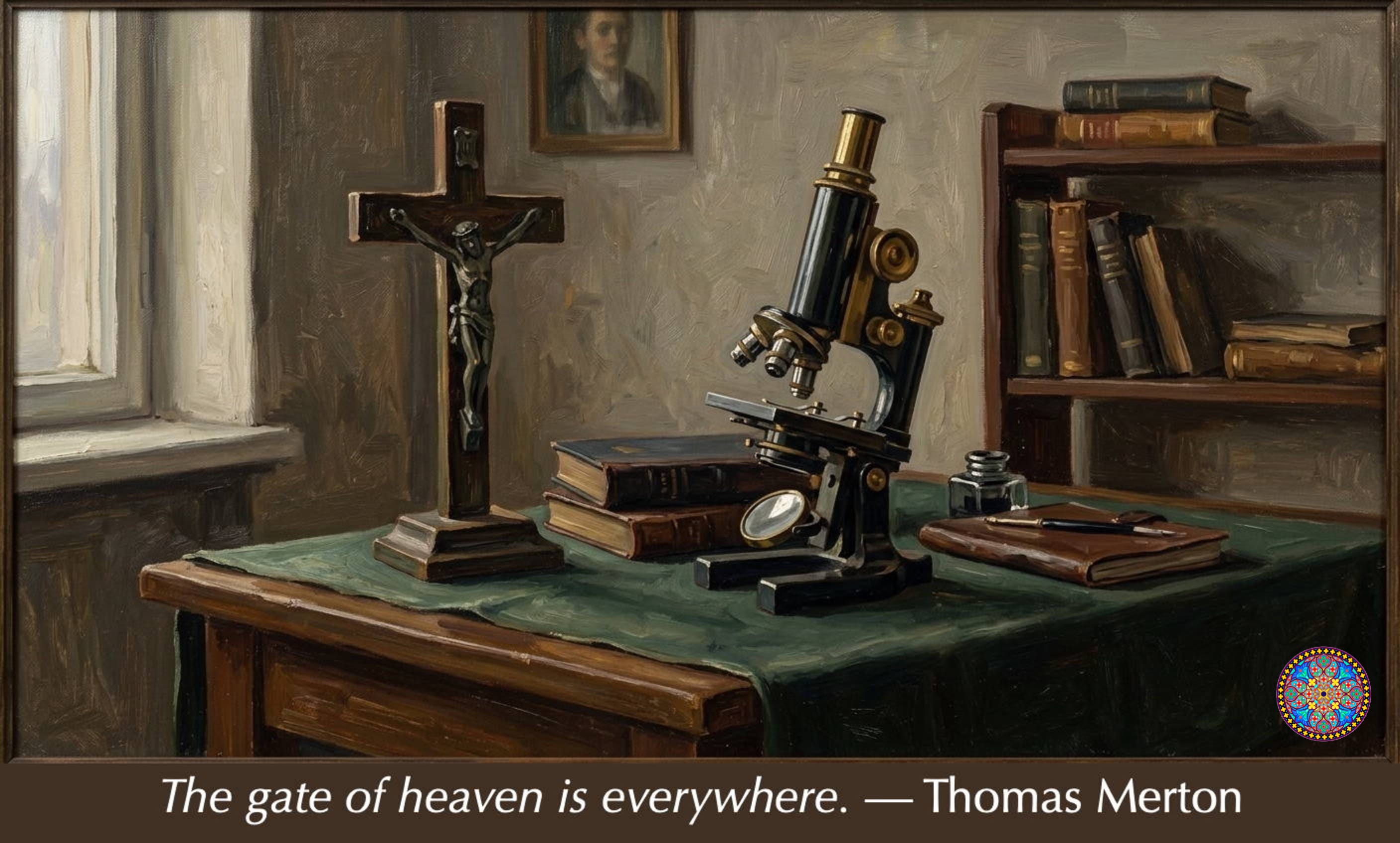
In other words, to make sense of mysticism, we need to find a way to “locate” mysticism in our sensory experience. It’s not just an idea in our minds, but rather it becomes a way of seeing, hearing, touching, smelling, even tasting. Mysticism becomes an “interpretive filter” that we use to discern the spiritual value of the things we see, hear, touch, etc. It is tied in with Julian of Norwich’s principle: “The fullness of joy is to behold God in all,” or Ignatius of Loyola’s instruction for us to “find God in all things” or even St. Benedict, who said “we believe the divine presence is everywhere” — compare that to Thomas Merton, who almost 1,500 years later proclaimed “the gate of heaven is everywhere.”5
To make sense of mysticism means to accept the idea that nature, and the human body, and our most down-to-earth experiences, are not separate from God, or heaven, or angelic presence. This is not about abandoning logic or reason, but it is about daring to believe that we can see (hear, touch, etc.) the ordinary material world through a lens of wonder and ecstasy and deeply embedded joy. A sensible mysticism lets science be science, and lets reason and logic preside over the empirical world. But without refuting or rejecting the wisdom of science, a sensible mysticism always says “and there’s more.” There’s more hope. There’s more meaning. There’s more purpose. There’s more beauty. There’s more justice. There’s more ecstasy. There’s more peace. There’s more joy.
There’s more God. There’s more life. There’s more love. And there’s more even beyond the boundaries of life and death.
Sensible mysticism does not compete with reason. But it does invite us to consider that even the most advanced articulation of human logic cannot exhaust the splendor of divine presence. God always means there’s more than meets the eye.
It’s interesting to write this essay in 2026, at a time when many young people — even those who reject institutional religion — want spiritual meaning in their lives, and living mystics like the Dalai Lama or Richard Rohr are more popular than ever. My dad’s generation was uncomfortable with mysticism, but the generations that have come after mine seem to be increasingly open to mysticism having a place in life — even a life that respects science. I hope we can, as a society, continue to explore how to marry empirical logic with contemplative wonder. It seems to me this would make for a powerful approach to life indeed.

See The New Big Book of Christian Mysticism, page 41.
This is a “kataphatic” definition of mysticism. By contrast, an “apophatic” definition would lean in more deeply into mysticism as a mystery that can never be defined or even cognitively understood: where God is beyond the furthest limits of human imagination or reason.
A.J. Ayer, Language, Truth and Logic, p. 144.
Psychiatric Opinion 14, no. 2 (1977): 27–30.
Thomas Merton, Conjectures of a Guilty Bystander, p. 156.
Thank you, well put. It seems to me spirituality/mysticism is the other side of the coin of science. Both explore the mysteries of nature and reality and in some cases for both answer the deepest questions as still mysteries. The limit of science is if it can't be measured it doesn't count. i.e. meditation: until EEG machines were invented (even though the experience of meditation had been around already for millennia's) science stated they was no proof that meditation had any physical effect. Machines measure, people feel. Science is for concepts; people are for experiencing. How does one measure Awe, a personal experience? Science may be considered a map and human experience the territory.