

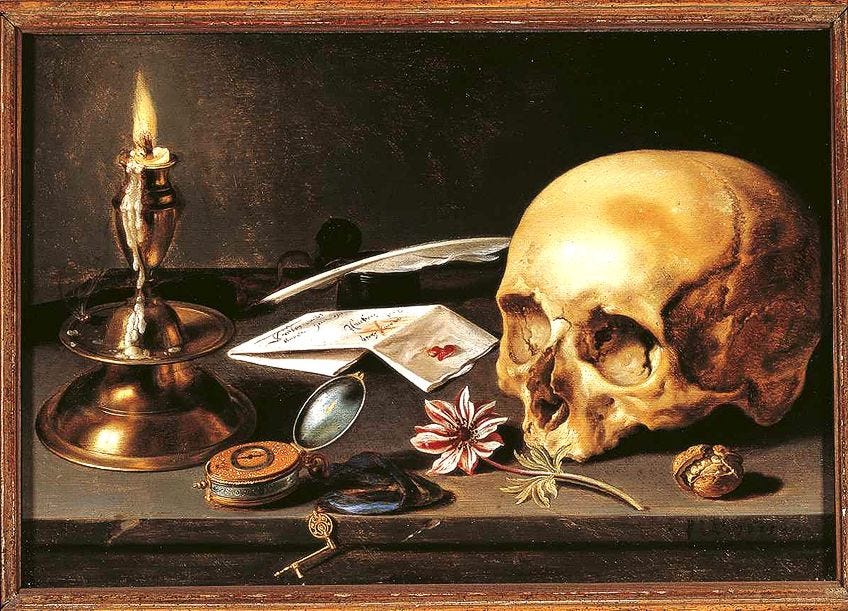
I was texting with a friend recently, someone who shares my love for the mystical heart of contemplative spirituality; we got to talking about the concept of Memento Mori. It’s Latin for “Remember to die,” but it really means “remember that you must die.” It’s a concept that is especially associated with religious art — such as a painting of a skull on the monk’s desk. Gruesome as that may sound, the idea is actually quite fascinating: to the extent that we can remain mindful of our mortality, we will be inspired to live the life we have been given well, no matter how short it may be (or how little time we might have left).
It seems to me that there might be a corollary to Memento Mori — Para ad Moriendum, which is Latin for “prepare to die.” Again, please resist the temptation to view this as morbid or macabre. To prepare to die, from a contemplative perspective, means to prepare to die with grace and faith. We will all die. May we all do so only at the end of a long and happy life. But whether our years turn out to be short or long, whether the overall tone of our days is joyful or sorrowful — eventually, the end will come. Which leads to an obvious question: how shall we greet that moment, when finally it does arrive?

Must we consign ourselves to an end that is shaped by anxiety, by fear of the unknown, by the horror of our inability to know for sure what awaits us after our last breath? Or might there be a path toward death that is marked by a sense of peace, of trust, and even of thanksgiving for the gifts that life may have bestowed upon us?
In her wonderful book The Grace in Dying, hospice worker and psychotherapist Kathryn Dowling Singh offers this insight: that a contemplative practice is the best tool we human beings have for preparing for a mindful and serene death. It makes sense: for the work of releasing attachment to thoughts and distractions in contemplation could only help in the task of releasing our attachment to physical life as we near the inevitable end. This is not about “giving up” — but it is about touching a place of deep trust at a time when we are called to surrender everything. When, by the help of grace, that happens, then our last minutes may be filled with gratitude, serenity and a loving hope.
Memento Mori. Para ad Moriendum. For me, these are invitations not to manage the very end of my life, but to let mindfulness of my final destiny shape my capacity to live deeply and heartfully in the present moment, and in every moment to come.
