

The word deconstruction has practically become a code word for people who are examining their religious faith and finding a need to re-think what they believe — or, perhaps, to abandon their prior beliefs altogether. Deconstruction implies jettisoning what simply no longer seems credible in favor of a new spiritual outlook, even if that means an entirely new way of thinking about things such as God, faith, or church.
As a concept, deconstruction comes from the postmodern philosopher Jacques Derrida (1930-2004), who coined the term in the 1960s to explain his approach to reading texts critically. Postmodern philosophy recognizes that almost any declarative statement is built on a number of assumptions, tensions, perhaps even conflicts — which, when taken into consideration, can considerably change the way we interpret or understand the text we are reading. It’s much more nuanced than just reading something through the eyes of skepticism or doubt. The idea is that the tensions and conflicts are embedded in the text itself — often because the very language that we use is so dualistic. We can’t talk about light without understanding “not-light” or dark. Same goes for male and female, good and bad, faith and doubt.
We can see that Jesus himself liked to deconstruct.
“Do not judge.”
“Love your enemies.”
“Whoever wants to save their life will lose it, but whoever loses their life will find it.”
These paradoxical statements reveal a moral understanding that goes far beyond the simple binary of good and bad that most of us were taught as children.
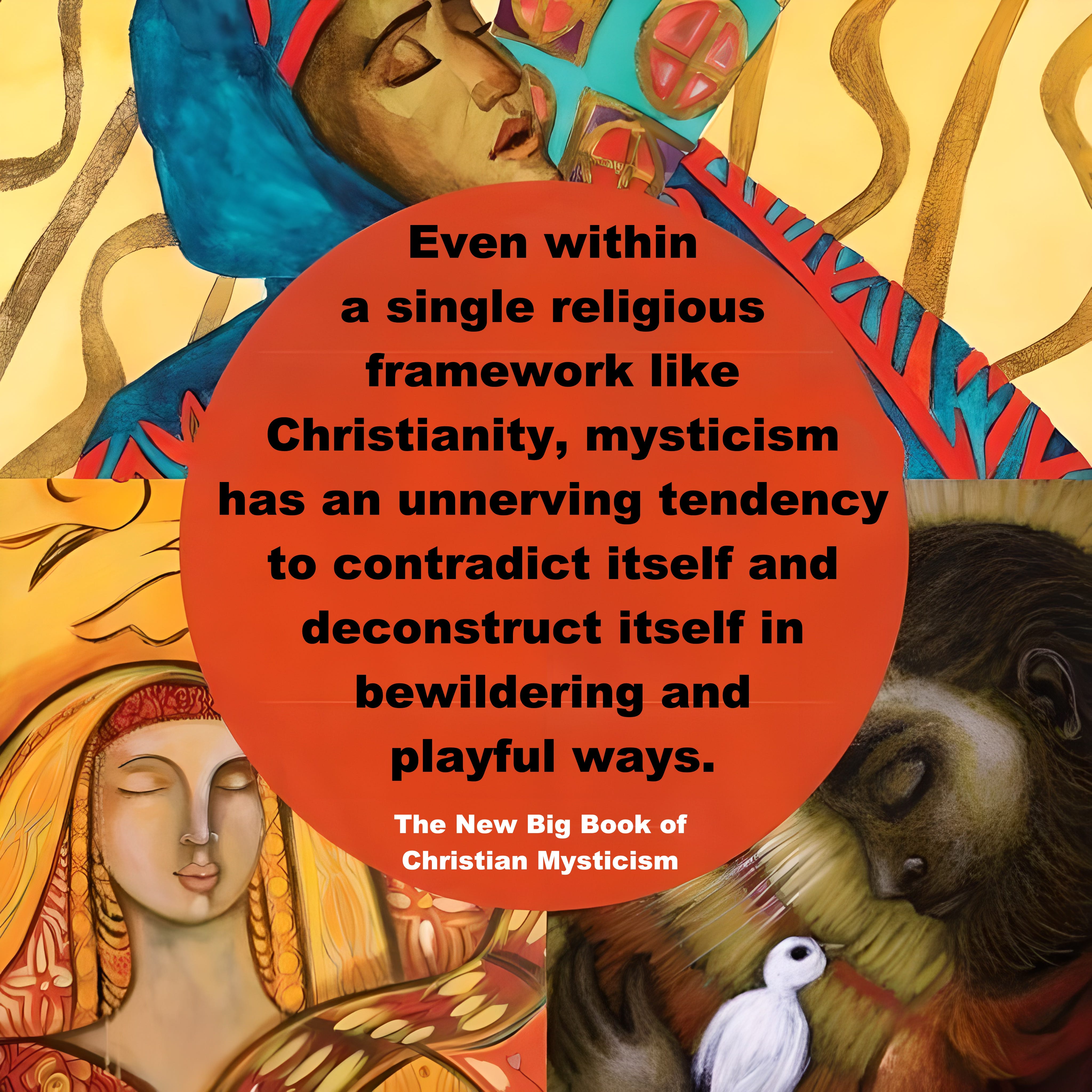
Even within a single religious framework like Christianity, mysticism has an unnerving tendency to contradict itself and deconstruct itself in bewildering and playful ways. — The New Big Book of Christian Mysticism, chapter 21
The mystics, too, were deconstructors. Again and again, they offer us statements that seem to be at odds with “common sense” or ordinary reason (and ordinary theology). Here are just a few examples:
“Sin is behovely, but all shall be well.” — Julian of Norwich2
“The eye with which I see God is exactly the same eye with which God sees me. My eye and God’s eye are one eye, one seeing, one knowledge and one love.” — Meister Eckhart3
“Nobody’s mind is powerful enough to grasp who God is. We can only know him by experiencing his love.” — The Cloud of Unknowing4
“Faith, a dark and obscure cloud to souls (also a night in that it blinds and deprives them of their natural light), illumines and pours light into their darkness by means of its own darkness.” — John of the Cross5
There’s plenty more where these came from.
My point is quite simple: for anyone who feels a need to deconstruct their faith now, there might be some small consolation in knowing that the mystics have been “faith-deconstructors” for centuries. Mystical contemplation is not a path toward nihilism: it does not lead to a place of cynical anger and rejection of faith altogether; rather, it is profoundly creative, inviting us to create a new sense of appreciation for spiritual wisdom and faith in the mystery, even when all the old doctrines and propositions have become meaningless to us. Indeed, it may be that very experience of meaninglessness which invites us to cross the threshold of mystery — a threshold where darkness invites us into a hidden yet profoundly compassionate light, the light of heaven within.

Carl McColman, The New Big Book of Christian Mysticism: An Essential Guide to Contemplative Spirituality, p. 29.
Julian of Norwich, The Showings, long text chapter 27. The middle English word behovely is basically untranslatable into modern English. Some attempts have been to equate it to world like “befitting,” “inevitable,” or “necessary” but none really capture Julian’s use of the word, which suggests that while sin is a tragedy that couldn’t be avoided, through Christ good will be the ultimate result.
Meister Eckhart, Sermon 16; Selected Writings of Meister Eckhart (Penguin Classics), p. 179.
Anonymous, The Cloud of Unknowing: A New Translation, p. 14 (Chapter four).
John of the Cross, The Collected Works of St. John of the Cross (Ascent of Mount Carmel, Book II, Chapter 3, §5–6), p. 216.