

Here’s a question I sometimes get asked:
Do I have to be a member of a church to be a Christian mystic?
The short answer is no, you don’t. But that’s not the whole story, of course.
The longer answer is much more nuanced — and begins with an ancient question posed to the desert mothers and fathers. And no matter how we approach this subject, we need to be thinking about the difference (and similarity) between church and community.
Whose Feet?
First, the question. It’s a helpful reminder that our generation is not the first to say “no thank you,” to getting involved in your local church. But it’s also a challenge to us all, no matter where we might be on a Sunday morning.
When Christians were moving out into the desert in the fourth century to live in solitude, St. Basil the Great asked a question to challenge them.
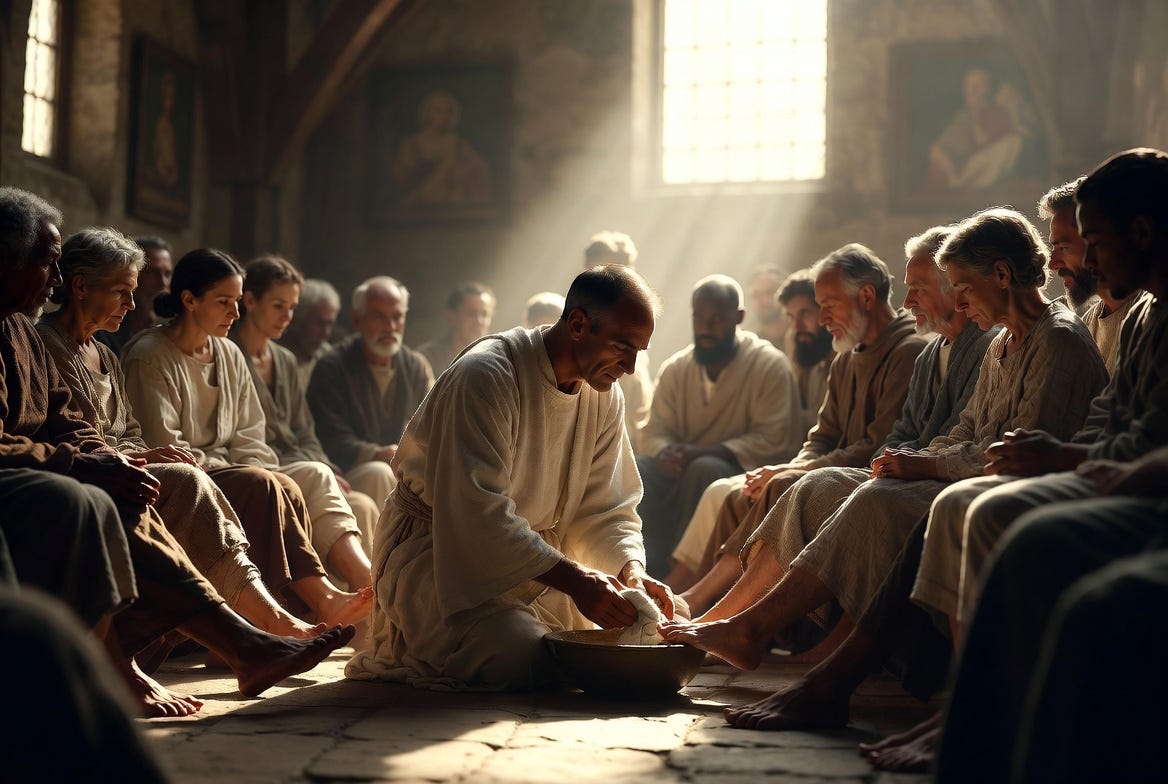
“If you become hermits, whose feet shall you wash?”
After all, the idea that spirituality is about washing each other’s feet comes from the top. It was a teaching that Jesus gave to his followers the night before he was killed. It’s a metaphor, of course (even though many churches ritually re-enact it the night before Good Friday). To wash feet means to serve and to care for others.
But that’s not always easy, is it? And churches are not always the best forums for providing us with ways to truly care for one another.
Does Mysticism Thrive Best in Community?
One of the most obvious differences between the first edition of The Big Book of Christian Mysticism, and the second edition (now called The New Big Book of Christian Mysticism) was how my thinking had evolved regarding the relationship between mysticism and the institutional church.
In the first edition, I devoted an entire chapter to making the case that mysticism, at least in its Christian form, thrives best in community.
Here’s an example of what I had to say:
Relationship forms the heart of Christianity, whether we are relating to God or to one another. Christianity undermines the idea, prevalent in our secularized society, that God is nothing more than a metaphor for the deepest, highest, or best parts of ourselves. While faith in Christ invites us to seek God within ourselves, we are not seeking just a part of ourselves. Rather, we are seeking to become part of something much bigger than ourselves — the God who is greater than the cosmos. We can seek this because, paradoxically, this transcendent God has been seeking us all along. We love God in response to God’s love for us. Likewise, Christianity also offers an alternative to the pervasive narcissism and self-obsession of our time, by calling us to look for God not only inside ourselves, but also through each other… Since God is in each of us, when we gaze into the eyes of our friends and neighbors and fellow Christians, we are gazing into the Temple of the Holy Spirit. (page 137)
That chapter, “The Mystical Body” (chapter 9 in the first edition, chapter 13 in the second) was almost entirely rewritten — even though this particular paragraph survived with only minor changes. In the new edition, I give much more space to acknowledging religious trauma and the fact that many contemplative seekers find church to be either indifferent to, suspicious of, or downright hostile to, the exploration of the mystical life.
But even though I have become much less convinced that participation is a church is necessary for mystical Christianity, I continue to believe that there is an essential necessity of finding some sort of spiritual community to both nurture and challenge our spiritual lives. For many of us, that might not look like our neighborhood church congregation. But community is worth fighting for — or seeking out, even if we have good reasons for giving the local house of worship a wide berth.
As wisdom traditions go, the heart of Christianity is not enlightenment, or unitive consciousness, or the ability to work miracles — any and all of these things can happen, and there have been mystics who have reported precisely these phenomena. But they are not the heart of Christian mysticism.
The heart of Christian mysticism is love.
Chances are, most people reading these words live in America or Australia or Western Europe (and even if you don’t live in those places, you are probably somewhat influenced by their culture). The culture of these lands tends to be highly individualistic — the mythology of the U.S., for example, lionizes solitary figures like Paul Bunyan and the Lone Ranger. “To thine own self be true” is our creed, and the unspoken shadow of that dogma is “because no one else really matters.”
Now, I do not fault the emergence of a healthy adult personality, which includes forming a unique sense of self and the ability to follow one’s own conscience even when it means going against the grain. Those are good values, so individualism certainly is not all bad. But as a spiritual tradition that places so much emphasis on love, community, and service, Christianity naturally challenges us to balance our individuality with a commitment to others — to family, to friends, to community, to colleagues, and yes, to people who share our faith.
I realize I have moved from talking about “Christian mysticism” to simply talking about “Christianity.” But that’s because the heart of Christian mysticism is, well, to intimately follow the teachings of Jesus, the Christ. And such intimacy implies following the Christian path — mystic or no.
The Pros and Cons of (Mystical) Church Membership
But does this mean you have to join a church, for heaven’s sake?!?!
Friends, I get it. Howard Thurman got it. Simone Weil got it. Brian McLaren gets it. There’s a long history of tension between mystics and contemplatives and church. Even among those who are completely in love with the wisdom of Jesus and the amazing mystics that follow his path, from Meister Eckhart to Julian of Norwich to Thomas Keating.
I understand how many people — including many people with a genuine interest in the mystics — find church to be the last place they want to be, on Sunday or any other time during the week.
There are so many reasons for this. Many people have been hurt by churches. And not just in terms of extreme trauma (like clergy sexual abuse), although that does happen to the church’s shame. But even beyond such outrageous harm, many people are hurt in much milder/smaller — but still painful or traumatizing — ways. People get shamed for a variety of reasons — from expressing their sexuality to questioning the pastor to showing an innocent interest in interfaith exploration. Sexism, racism, and homophobia often create climates in churches that can be unhealthy and even dangerous. Churches can be abusive in other ways — to learn more about this unhappy topic, read Healing Spiritual Wounds by Carol Howard Merritt.
Some churches seem to be too political — which can be a problem no matter what “side” you are on. Other churches clearly cater to a specific “tribe” of people — from “country club” churches where everyone at least appears to be wealthy, to “blue collar” churches where everyone appears to be just getting by. Too many churches appear to cater only to one specific skin color or ethnic identity. While it might be spiritually adventurous to join a church where everyone seems to be different from you, that can also be psychologically taxing. The only thing worse than that, of course, is a church where everyone is just like you.
And don’t get me started on how boring church can be.
I have lots of friends who are pastors or church musicians, and I don’t want to be unfair in my criticism of them. It’s hard to write a good sermon or perform meaningful music for a diverse congregation, week after week after week. Church leaders, at least the ones I know, are dedicated and sincere people who do their best to create worship experiences that are engaging and spiritually meaningful. But even they are facing cultural headwinds. Entire churches have been ripped apart by internal conflicts over what music to play, what language to use (just the matter of God’s pronouns can reveal deep divisions), and whether the tone of the service should be solemn and reverent, or joyful and upbeat.
But even in the congregations that are blessed with dynamic music ministries and superb preaching, the larger problems facing church today can creep in. Too many churches have, or have inherited, a culture that seems to stress conformity and nostalgia rather than truly grappling with the radical teachings of Christ (let alone the mystics). If that’s what being a Christian is all about, is it any wonder that so many people vote with their feet?
And then there’s the fact that so many churches are devoid of people interested in the teachings and practices of the mystics (but more on that below).

In Search of the “Good Enough” Church
So how do we integrate Christianity (and Christian mysticism)’s commitment to love, joy, compassion, and the importance of community, with the often problematic nature of too many churches that fall too short when it comes to truly embodying the teachings of Christ?
First, I think we have to acknowledge that we live in an imperfect world, and this extends to everything — including church. If our only complaint with church is that it is unfulfilling or boring, maybe our standards are just a bit too high: we are looking for church to be fun and exciting, rather than to be a place where we can serve. Our culture worships entertainment, and that seeps into every corner of contemporary life: including religion. I don’t think it’s unusual for people to look at church in terms of it existing “to serve our needs” — but that’s really not the point, is it? Churches are not spas. They are places where we have the opportunity to love others, and to serve God — by being in relationship with others. And that kind of thing is often the opposite of glamorous, like it or not.
But what if you are a survivor of spiritual abuse? What if the only church in your town is filled with political extremism and a conformity culture that is just plain toxic? Not only are these fair questions, but they are important ones. And this is where the difference between community and church matters. The Christian wisdom tradition is a tradition that calls us into community, but toxic or dysfunctional churches are not what Christian community is meant to be. Leaving a toxic church is like leaving an abusive marriage: it’s an act of courage, and I believe God blesses people who are willing to make that brave choice.
Fortunately, healthy churches do exist, even if they often seem to be lacking in the mystical/contemplative department. Especially if you live in an urban area, you can find churches with a strong commitment to social justice, with pastors who sometimes quote the Dalai Lama (or even Thomas Merton), where people attending do not all look the same, where LGBTQ+ people feel safe and can be visible, and where the atmosphere is genuinely warm and friendly. Such churches do exist (in fact, I’m describing the church where I am a member).
Healthy churches are transparent about their finances. They have safeguards in place to keep children and vulnerable adults safe. They are as committed to prayer and spiritual growth as they are to service and justice — and vice versa.
There may be other signs for you to look for, these are some of the signs I look for, to help me recognize that a church is healthy.
Ultimately, it’s a place where I can say “yes” to questions like “Can I truly pray/meditate here here?” “Can I truly be of service here?” “Can I truly be myself here?”
It’s worth it to try to find a healthy church. A healthy church is like a loving marriage and a creative, fun, challenging work environment — life is too short not to take the time to find (or foster) these qualities in our lives.
But let’s say you simply cannot find a truly inspirational/healthy church. What then? Back to community. Fortunately, there are many ways to foster community in our lives. We can participate in online groups or forums dedicated to spirituality or mysticism. We can become active in neighborhood organizations or centers for community activism. And — especially in terms of your interest in Christian mysticism — we can find communities that share our interest in spirituality, such as Centering Prayer groups, monastic oblate communities, or even a book club dedicated to reading spiritual literature (hey, suggest one of my books!)
So, back to the question: “Do I have to be a member of a church to be a Christian mystic?” In an absolute sense, strictly speaking, the answer is no, you don’t — especially if being involved in a church could be unsafe or (re)traumatizing. But remember St. Basil’s challenge to find those dirty feet. Church may be optional, but community is essential. We all need feet to wash: which is to say, we need a place where we can love and serve others. As imperfect as every church is, a basically healthy church can often provide that community for us. So please, don’t write church off too quickly. And no matter what, look for a some kind of community where you can grow spiritually and learn to love.
A Final Thought
I know many people who are drawn to mystical spirituality have yet another reason why church no longer makes sense. It’s easy to abandon church because, well, most churches are not particularly mysticism-friendly. The institutional bias against contemplation and mysticism is real. Too many clergy are still the product of seminaries that are great at filling their heads with facts, but far less effective at teaching them how to pray, how to contemplate, how to be silent, and how to be present with the spiritual needs of others. This has changed much for the better in my lifetime, but there’s still a long way to go.
No church is perfect — and a corollary to this, unfortunately, is “very few churches are friendly to mysticism (Christian or otherwise).” So if you participate in a church because it’s a place where you can serve and love others, you might still need to find your spiritual nurturance some other way. You might need to join (or start) a Centering Prayer group, or become a monastic oblate, or begin working with a spiritual director. Fortunately, resources do exist to help us grow deeper spiritually. It’s not a perfect solution, but it’s a workable one: participate in a church to serve, and then find other groups or relationships for contemplative, mystical, spiritual nurturing.

Wow, Skye, what a beautifully written, balanced, wise, encouraging, and empowering blog. This is something that church really needs to hear. The world needs to hear it too because of the spiritual abuse that’s gone on. However, much has changed and there are still places where people can have their mystical hearts nourished. Thanks for holding post !
Skye you are right on target. Thanks for the inspiring reflection.