

For our part we should not want health more than sickness, wealth more than poverty, fame more than disgrace, a long life more than a short one—and so with everything else; desiring and choosing only what conduces more to the end for which we are created.
— Ignatius of Loyola, “Principle and Foundation”
Today (June 15) is my dad’s birthday; were he still alive, he would have turned 103 today. It’s always good to think of him and to remember him on his birthday.
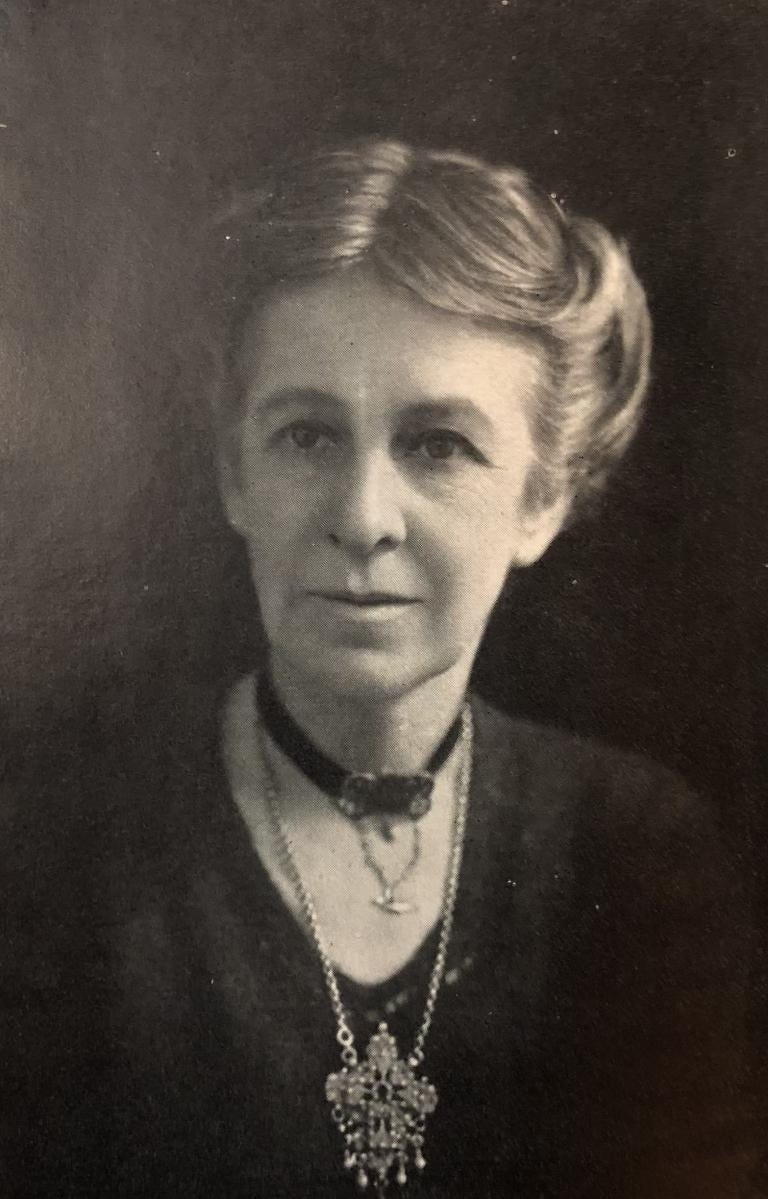
It is also the anniversary of the death of Evelyn Underhill, one of my favorite authors and a mentor I never met. She died eighty-five years ago today, on June 15, 1941 (my dad’s 18th birthday). She was only 65 years old.
Evelyn Underhill actually reached her statistical life expectancy (for a British woman of her time), although it sounds like a short life to us today. What a difference a century can make.
Not only did Underhill die on dad’s birthday, but she was born on my birthday (December 6), only she was born in 1875, and I in 1960. In other words, if she had lived long enough, she would have turned 85 on the day I was born.
This means that, as of today, I am the same age as Evelyn Underhill was the day she died. God willing that I am still alive tomorrow, I will have been granted a life longer than hers.
I know life is not about comparing ourselves to others in any way, certainly not in terms of longevity. And I firmly reject any notion that a long life is necessarily a better life — or, conversely, that a shorter life must be a tragedy.
It is nevertheless both sobering and humbling to consider the great writers and mystics (whose work I admire so much) who lived shorter lives than mine. As of now, I have lived a longer life than Simone Weil (who was only 34 when she died), St. John of the Cross (who died at age 49), Caryll Houselander (53), Thomas Merton (also 53), and St. Ignatius of Loyola (64).
If by the grace of God I live two more years, then my lifespan will be longer than St. Teresa of Ávila. Another eighteen months after that and I’ll surpass Meister Eckhart, and by 2035 I will be able to say I lived longer than Teilhard de Chardin. Of course, there’s still Hildegard of Bingen and Howard Thurman who lived into their 80s, Thomas Keating and Thich Nhat Hahn who both made it to 95, and dear old St. Anthony of the Desert, who is said to have died at the ripe old age of 105!
And as I write these words, the Dalai Lama remains alive (he’ll be 91 next month), as well as Brother David Steindl-Rast, who that same month will turn 100. So while some mystics die young, others are blessed with gloriously long lives.
I know I’m being a bit silly with this post. As Jesus pointed out, “Which of you by worrying can add a single hour to your span of life?” We are all given the life that is uniquely ours, and whether you live to 33 or 103, I suspect when your time comes it will feel like it has come too soon — if not for you, then certainly for those who love you. I have known the deaths of loved ones in their 20s and in their 100s, and the sting is much the same no matter how young or old they were. Naturally, when someone dies prematurely there’s the sense of a life cut short; but a loss is a loss, and when someone I love dies, the grief that comes to me seems to be based on the depth of our love, not the span of their years.
Ignatius of Loyola encouraged his followers to pray for non-attachment to “a long life or a short one.” That seems to be sound advice. Put another way: I believe the contemplative call places less importance on a long life than on a well-lived life.
No one knows what tomorrow brings. Evelyn Underhill had been in poor health for years, so her passing was not unexpected. But for others, the end is sudden and surprising. Thomas Merton’s death came as a shock. Dag Hammarskjöld lost his life in a plane crash and Albert Camus in a car accident, and Brother Roger of Taizé was brutally and publicly murdered — never mind that he was 90; that’s still a life tragically cut short.
We never escape the unknowing. The future cannot be mapped; only lived into, hopefully with faith and trust and appropriate care.
Of Evelyn Underhill, it has been said that no English woman made a greater contribution to Anglican spirituality in the early 20th century than she did; and I think arguably she was the most important English mystic of the entire century — and possibly even the most important of any century since Julian of Norwich, if for no other reason than for how influential her work was on the revival of interest in contemplative spirituality for our time.
It was Underhill’s writing — especially her magnum opus, Mysticism: A Study in the Nature and Development of Spiritual Consciousness, first published in 1911 — that has inspired, influenced, and shaped my own work as a contemplative writer. Without Evelyn Underhill, my life path would have probably been very different indeed.
As I mark this anniversary of her passing, I view my own life as a tremendous gift. That’s a categorical statement: all of our lives are gifts, and this is true no matter how short or long they may be, or how much they are shaped by suffering or joy. Life is a gift whether we use ours to create great art or merely to while away our years working and consuming mindlessly. Of course, I hope we all can move the needle of our lives into the grace of purpose, creativity and service. No matter how old we may be or how much time we do (or don’t) have left, life is always inviting us to make something more of it.
So for me, the gift of an ongoing life, whether I have days or decades left to go, is simply the gift to make the most of it: to keep writing, to keep pushing the envelope of how I can grow as a contemplative, and allow my reflection on the mystical life to continue expanding in ways that can be useful for readers like you.
There was a time when I secretly wanted to be a “great mystic” like Eckhart or Julian or Ruusbroec. As ambitions go, I think that’s a pretty good one, just like it’s a good desire to want to be a saint. But I have pretty much surrendered the idea that I need or want to be “great” at anything. I believe we are all called to our own unique greatness, so my true vocation is not to be the next Eckhart or even the next Evelyn Underhill, but to be simply myself: the person God created me to be.
You, dear reader, have your own God-given and heart-embedded calling, of which you may or may not be consciously aware. I hope whatever it may be, and however old or young you may be, that you discern it well and pursue it faithfully. My sense of my life calling includes writing, and teaching, and offering spiritual direction, and (most important of all) persevering in my own flawed contemplative practice. Your call, obviously, is uniquely yours, and therefore different from mine. But may we each listen carefully to our hearts so that we know what our call might be, and may we each respond to that call as fully and as wholeheartedly as possible.
Mary Oliver asked us all, “what is it you plan to do with your one wild and precious life?” Everyone will answer that question in a manner that is uniquely their own. But may we all answer that question consciously, creatively, and compassionately, and live into that answer as fully and freely as we possibly can.
As I woke up today, with a new ache in my body, I truly appreciate these helpful words on living one's life well.
In my 40s, I "discovered" the Christian mystics, and no book was more important in my re-formation than Underhill's "Mysticism." At the time, I was doing a week-long free lance job in downtown Indianapolis, and I remember skipping lunch with my fellow workers and going outside and sitting to devour this book, as people walked by. I couldn't get enough of it then, and it still holds an honored place in my library. Thanks for renewing this memory.