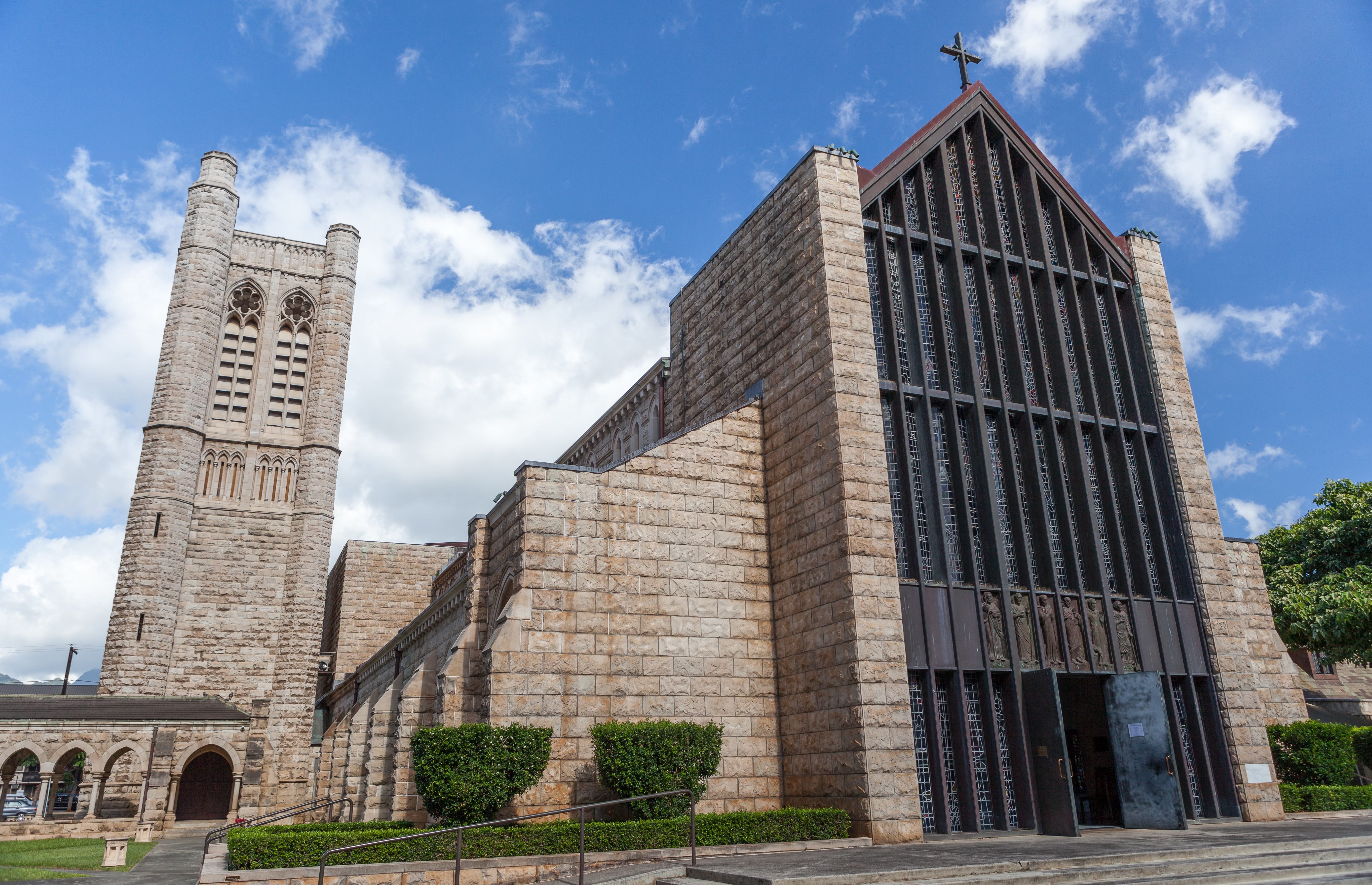
In December, I had the honor of preaching one Sunday at the Episcopal Cathedral in Honolulu. It was my first time in Hawaii, so I had never been to the Cathedral Church of Saint Andrew before. It was a joy to receive a tour of the building from the Cathedral dean. She regaled us with stories of the building’s history (probably the only church in America built through the generosity of a reigning royal family), and pointed out features in the architecture that were unusual or remarkably beautiful.
The nave of the Cathedral is dominated by a floor-to-ceiling stained glass window that was installed in 1958, more than half a century after the cathedral was consecrated. The story goes that the building had suffered termite damage, and the window was installed during the repairs. Known as the Great West Window, it is dominated by an image of Christ in glory, rays of sunlight shining over him. That large central figure surrounded by images of Biblical scenes and of church history. At his feet are figures associated with the church in Hawaii, including the Cathedral’s patrons Queen Emma and King Kamehameha IV. But the California-based artist who designed the Great West Window clearly had a sense of humor: at the bottom right corner of the window is an image of a termite, commemorating the wee pests who indirectly made this window possible; and opposite the insect, at the upper left is an image of Jesus riding a surfboard.
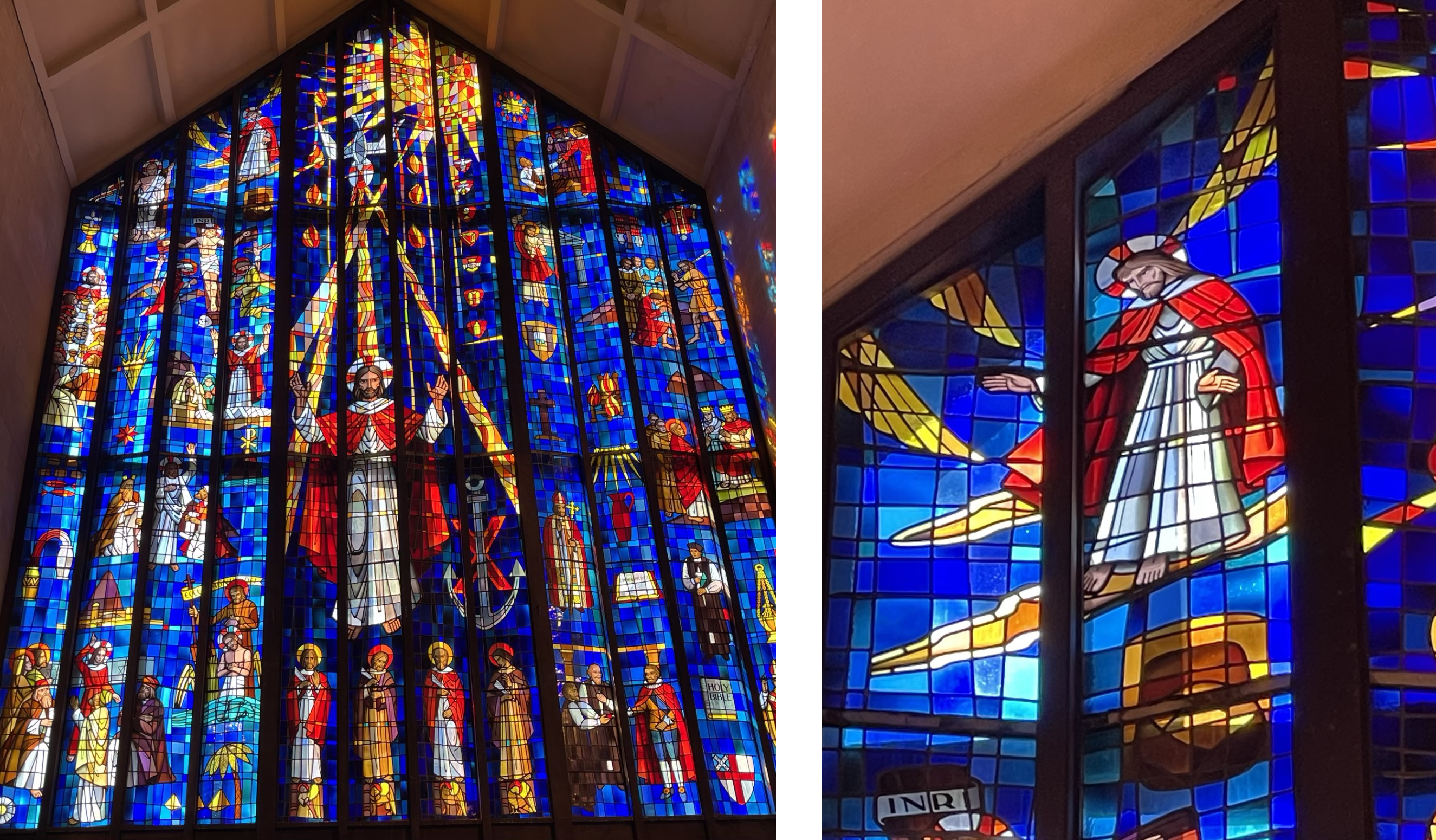
There are online commentaries on this window that suggest Jesus was depicted this way as a uniquely Hawaiian way of envisioning the miracle of walking on water. I think that’s charming, and perhaps is a helpful way of framing this image for anyone who might find it scandalous. But I’d like to suggest that we could also simply accept it for what it is: an image of the Christ that is meant to make him relatable to the people of that part of the world. Surfing, after all, is a practice that — as a sport — originated in Polynesia, and it remains deeply embedded in both traditional and contemporary Hawaiian culture. If Jesus really wanted to meet the people of Hawaii on their own turf (or should I say, on their own surf), wouldn’t he come to them riding a surfboard?
Jesus is hardly the only one. The humorous Christmas song “Hawaiian Santa” depicts Father Christmas like this:
Hawaiian Santa is a sight to see,
When he comes surfing into Waikiki…
Other local legends have Santa trading in his sleigh and reindeer for a canoe to get around the islands and share his gifts with all the children.
I can hear the objections of people who might say, “It’s all very well to make light of Santa by putting him on a surfboard, but Jesus? Isn’t that irreverent… if not blasphemous?”
Irreverent? Maybe. Blasphemous? Absolutely not. In fact, for this mainlander, seeing Jesus on a surfboard, depicted in stained glass in the midst of a beautiful house of worship, is arguably the most refreshing and wonderful image of the Christ that I have seen in quite some time.
Here’s why I say this:
Jesus Meets Us Where We Are. So many of us grew up with a distinctively European (Caucasian) image of Jesus, complete with creamy skin, blue eyes, and brown hair with just the right amount of golden highlights. If it bugs you to think of Jesus riding a surfboard, then it should also bug you to make Jesus look like those who lived hundreds of miles to the north of his actual home. As a Semitic child of the Middle East, we can trust that Jesus had dark skin, dark eyes, and probably jet-black hair. If Europeans can “revise” their image of Jesus to make him look more like them, then so can anyone else from around the world. And indeed, I’m not scandalized by blue-eyed Jesus — my only objection to this way of depicting Christ is when people start to think it’s the only way to visualize Jesus. I believe it’s human nature to want to see Jesus “look like us” — and while the most obvious way we think of this is through his physical appearance, perhaps we can also extend that to how we depict Jesus living his life. If the human Jesus had been born in O’ahu instead of Bethlehem, I think it’s reasonable to assume that he would have loved surfing. So why not depict him that way? Maybe that’s an unusual image for somebody living in Atlanta or Minneapolis, but it would make Jesus seem more like “one of us” to a Pacific Islander. The takeaway is a lot bigger than just surfing: Jesus meets us where we are, which can be interpreted to mean that God — the Spirit, the Divine, “Love-with-a-capital-L” — also, and always, meets us right where we are.
Jesus is Fully Human. People in the Christian tradition believe that Jesus was (is) the son of God — but there has been a long tension in the history of the church over how the humanity of an itinerant first-century Palestinian rabbi meets the divinity of God’s beloved child. Historically, Christians have dived into the paradox: Jesus is “fully human, fully divine.” But in practice, I suspect many Christians have an easier time keeping Jesus holy and spiritualized, and either ignoring or even denying his humanness. Emphasizing the divinity of Christ is a subtle way of keeping Jesus at arm’s length, which then makes it easier to ignore his teachings, or at the very least, dismiss them as unrealistic for mere humans, since of course that was God talking! But if we can remember the full humanity of Jesus, that is a sober reminder that Jesus is very much like us — and his teachings are meant for people just like you and me. If the son of God is fully human, that implies he had a human capacity for laughter, joy, fun, and even sports. Of course, a fully human Jesus would be the kind of person who would love to give surfing a try! When we think of Jesus on a surfboard, this has the double blessing of making surfing seem a bit more holy and making Jesus seem a bit more down to earth.
Jesus Knows How to Have Fun. I touched on this already, but it deserves to be said again: a surfing Jesus is a fun Jesus, a playful Jesus, a Jesus who is no stranger to joy. Joy, after all, is a fruit of the spirit (See Galatians 5:22) — but it seems to me that too many people forget their joy when they walk into church. Church is such a serious business, trying to get us all saved so we don’t fry in hell after we die. When that is the central message of religion, it becomes a death-cult. Hey, I’m all for seeking to live a life shaped by heaven, but to me, we do this because it is its own reward, not because it’s a way to manipulate God into doing nice things for us after we die. And if we seek a heaven-shaped life right here and now, then we are seeking a life shaped by love, by joy, by peace, and all the other fruit of the spirit. Clearly, Jesus knew joy — and what seems to capture this more than an image of Jesus riding a wave?
Jesus Knows There’s More than One Way to Perform a Miracle. Okay, let’s play it safe and assume that this is really meant to be a kind of Hawaiian version of the miracle of Jesus walking on the water. If you don’t know that miracle, here’s the story from the Bible:
Immediately he made the disciples get into a boat and go on ahead to the other side, while he dismissed the crowds. And after he had dismissed the crowds, he went up the mountain by himself to pray. When evening came, he was there alone, but by this time the boat, battered by the waves, was far from the land, for the wind was against them. And early in the morning he came walking toward them on the sea. But when the disciples saw him walking on the sea, they were terrified, saying, “It is a ghost!” And they cried out in fear. But immediately Jesus spoke to them and said, “Take heart, it is I; do not be afraid.”
Peter answered him, “Lord, if it is you, command me to come to you on the water.” He said, “Come.” So Peter got out of the boat, started walking on the water, and came toward Jesus. But when he noticed the strong wind, he became frightened, and, beginning to sink, he cried out, “Lord, save me!” Jesus immediately reached out his hand and caught him, saying to him, “You of little faith, why did you doubt?” When they got into the boat, the wind ceased. And those in the boat worshiped him, saying, “Truly you are the Son of God.” (Matthew 14:22-33)
I think we can safely assume that Jesus was not on a surfboard when the events that inspired this story took place. But whatever faith (or doubt) you might have in regard to Jesus walking on water, the idea that surfing can symbolize walking on water is, to my mind, a charming way to bring a miracle story down to earth. I’ve heard of commentators who believe the real miracle of the feeding of the five thousand is encouraging everyone to share whatever food they might have hidden away in their bags or baskets; that may be a lot less dramatic than Jesus making tons of food appear out of thin air, but it’s certainly a lot more believable — and just as wondrous. Getting tired and hungry people in a huge crowd to be generous and to share with the strangers sitting next to them? That’s a miracle indeed.
Miracles can come in all shapes and sizes. To someone who is unfamiliar with surfing, it could easily seem to be a wonder: a way for someone to walk on the waves. A more sophisticated observer might remind us that surfing breaks no laws of physics, but who said that a miracle must involving breaking natural laws? I think there’s no reason to limit miracles in such a way.
So when you go to Hawaii, consider stopping by the Episcopal Cathedral and pay your respects to surfing Jesus. Give him a smile— and remember that humanity, joy, pleasure, fun, and even a dash of wonder are all central ingredients in the spiritual life.