

March 17 is Lá Fhéile Pádraig — which is Gaelic for the Feast of Saint Patrick, although most people simply call it Saint Patrick’s Day. So happy St. Patrick’s Day!
At the risk of sounding like an Irish Grinch, I think it is fair to say that our consumerist culture has distorted this holiday almost as thoroughly as we have commercialized Christmas. Especially here in America, this has become a day for packing the Irish pubs to assuage our thirst for Guinness or some other beer, adulterated by artificial food coloring to give it a greenish hue. Meanwhile, not only in the pubs but anywhere St. Patrick’s day is observed, one is likely to find a party, replete with glitzy decorations that feature caricatures of leprechauns, jovially guarding their pots of gold at the rainbow’s end.
One can only imagine what the Celtic saints of old might make of these revels.
Not that there’s anything wrong with a good party. I love a festive get-together as much as anyone, so please, my point here is not to be some sour-faced killjoy. Then again, I have often been amused by the fact that Catholic bishops have been known to write “letters of dispensation” if St. Patrick’s Day (which always occurs during Lent) should happen to fall on a Friday. There’s no point trying to get all those Irish-American Catholics to forego their corned beef, just because March 17 falls on a day of abstinence!
Just as there is so much more to Irish culture than shamrocks and shillelaghs, there’s more to St. Patrick — and to Celtic spirituality in general — than our cultural travesty of this day reveals.
How do we get to know the beauty, wisdom and splendor of Celtic spirituality? I imagine most people who read this Substack are familiar with the writings of folks like John O’Donohue, Esther deWaal, and John Philip Newell (and if you don’t know these writers, then by all means check them out). I love each of these writers, but I also can see how their visions of Celtic spirituality can be interpreted as almost romantic — a sweet, affirming, nature-positive spirituality. But is that all there is to Celtic wisdom?
If you’re like me and you’d really like to take a deeper dive into the wisdom that made Saint Patrick tick, I’d like to recommend a relatively unknown but profoundly fascinating voice in recent Irish literature: John Moriarty (1938-2007), a mysterious, enigmatic writer and mystic who has been called “the bog shaman.”
What is a bog shaman, for heaven’s sake? Perhaps this: a shapeshifter and spiritual healer whose natural habitat is not some new age bookstore or a weekend retreat, but whose blood runs with the primal acuity of the people who inhabited the remote corners of Celtic landscape for generation upon generation.
When he wasn’t teaching literature and philosophy at universities in England or Canada, John Moriarty worked as a gardener for Carmelite monks in Oxford, before retreating back to his native Ireland to live close to the earth of his ancestors while he wrote. Author of books that are poetic, luminous but also confusing and profoundly mysterious, Moriarty’s dense and incantatory prose is challenging to read, and no one would blame you if you found yourself tempted to give up on his writing as inaccessible and incomprehensible prose.
I confided as much to an elderly priest in Dublin the last time I was in Ireland, telling him that I was stymied at how challenging it was to find a way into Moriarty’s deeply symbolic, layered words. He commiserated with me that Moriarty is not easy to read, but then he encouraged me to keep at it anyway, just like readers will keep trying to unpack and appreciate other challenging writers like James Joyce, Thomas Pynchon or Eimear McBride.
In other words, readers who bring patience and attentiveness to the writing of John Moriarty will be richly rewarded with a subtle wisdom that weaves together the deep knowing of the land with a truly mythical imagination.
While steeped in Celtic myth, Moriarty’s skill as a storyteller spanned the globe, and his writing draws from African, Native American, Buddhist, and other wisdom traditions as much as it is steeped in Irish lore.
If you’re new to Moriarty, I can’t think of a better introduction to his insight than these words from an interview he did not long before his death:
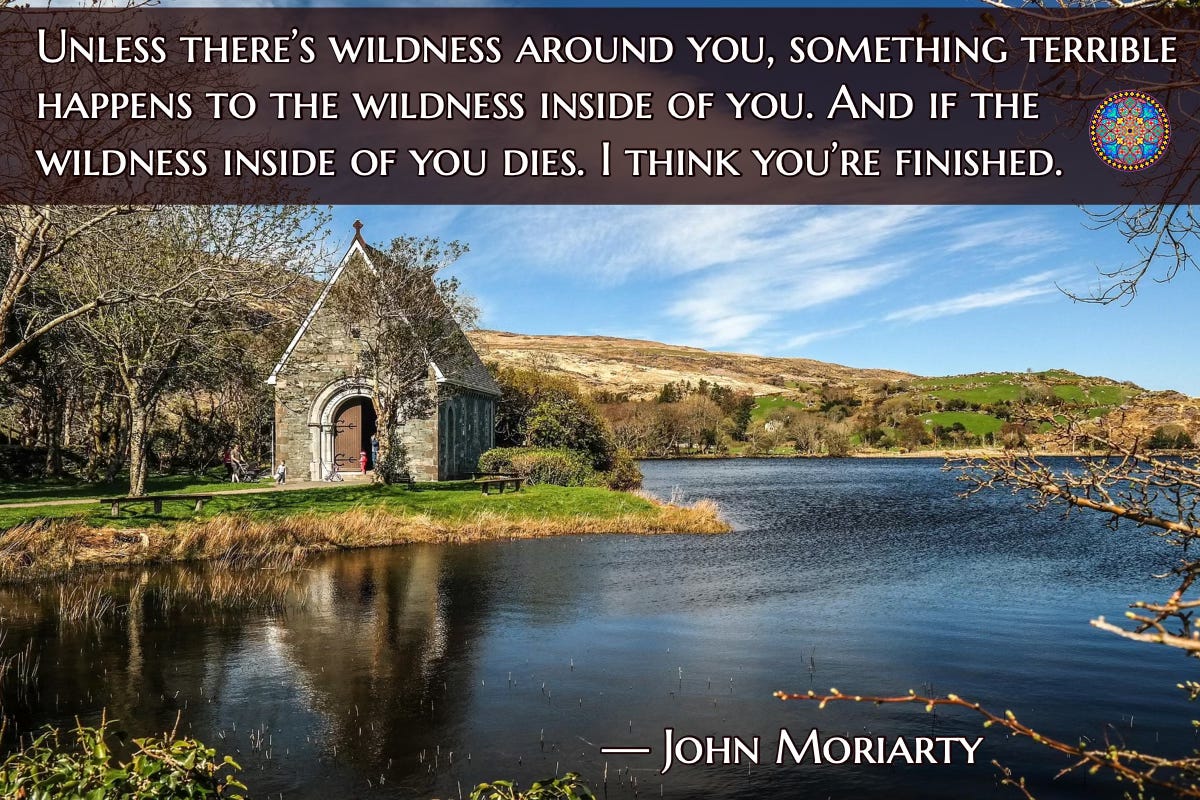
“Unless there’s wildness around you, something terrible happens to the wildness inside of you. And if the wildness inside of you dies. I think you’re finished.” — John Moriarty
Wildness has become almost a buzzword in some contemplative circles in our time, with websites, churches and other groups devoted to a spiritual vision of “rewilding” spirituality and community (from a concept first developed by Earth First! Activists as part of their call for the restoration of wilderness areas). But if eco-spirituality is trendy in our time, Moriarty, speaking some 20 years ago, reminds us that authentic Celtic spirituality has always called for a rewilding — not merely as a kind of spiritual preference, but as a matter of life or death.
What does he mean by “something terrible” happening to the wildness within us, if we’re separated from wildness in our environment? I think the specifics of what this could mean are for us to speculate each for ourselves, but I’m happy to share a few of my thoughts with you. An isolated or unsupported wilderness may not immediately die, but it would just be a matter of time before it fails to thrive. Like a land that is parched with a years-long drought, a wild place that is cut off from any greater wilderness might soon turn brown and brittle and be susceptible to fire. An isolated wilderness must, sooner or later, either be domesticated or slowly turn into a wasteland. Moriarty makes it clear that neither fate is acceptable. To worship the Spirit who created all wilderness, we must be prepared to protect, restore and inhabit the wild places, if not in our physical being, then certainly in our hearts and souls.
I live in the southeastern United States, where true wilderness is in very short supply. We have more than enough acreage given over to urban concrete or to the numbing uniformity of suburban sprawl. Even our rural areas seem to be burdened with a kind of curated sameness that replicates itself, from county to county, from region to region. If it weren’t for the national forests and parks, and the occasional wetlands protected by conservation easements, there would be no wild places left. As it is, well under 1% of the American south can be fairly described as wilderness.
The situation is different in many other parts of America and in other countries like Canada — at least for now. Still, I wonder if we as a society are not rapidly approaching that place of being “finished” as Moriarty so dourly describes it. Certainly, when we look at the problems besetting our common life—rates of addiction, mental health challenges like anxiety and depression, suicide, and income inequality—we see these issues increasing here in the American South.
Of course, we cannot simply blame these trends on just one cause, such as the region being overdeveloped (or then again, can we?). But I think it’s fair to speculate that in a landscape where the wild has been exiled, a similar exiling takes place in our own souls, and the resulting impact this has on the quality of life is a cause for concern, if not alarm.
I realize that we have traveled far afield from the jovial partying that we most often associate with March 17. But maybe not so far as it might seem. After all, a good party has an element of “wildness” about it. Consider a song from one of my favorite bands when I was in college: Georgia’s own B-52s. Their 1980 dance hit “Party Out of Bounds” is not only a frenetic send-up of how “poorly planned” parties can degenerate into their own flavor of chaos, but is also a metaphor for society as a whole: “Who’s to blame?” lead vocalist Fred Schneider asks again and again, for when things get out of hand — before the song’s final moments, when he muses on what it might take to bring the party out of bounds back in line.
Has our culture, starved of the wildness found in nature, created our own kind of compensatory “wildness,” like a party that’s gotten out of hand, only on a social level the “out of hand” refers to how our whole culture has gotten out of balance — we’re trashing mother earth, fostering increasing stress and anxiety at all levels of society, and using up resources so rapidly that it’s fair to wonder what we are leaving for our children and grandchildren — a world wracked by climate change and suffering with social structures that seem to be slowly breaking down.
So it’s not a binary question: do we have wildness or not? But rather, what kind of wildness are we preserving and nurturing in our society and in our world? Moriarty seems to be saying that if we lose the kind of wildness that we find in Mother Nature, we may be “finished” — and the frenzied angst of our entertainment-besotted party culture seems to corroborate his warning.
Contemplatives are sometimes dismissed as being killjoys: while other people want a good time, we get all focused on silence and stillness and spiritualities anchored in simplicity and austerity. But when I put John Moriarty and the B-52s together, I think we need to understand the relationship between contemplation and chaos in a slightly different way. Our commitment to silence and stillness is not meant to rob anyone of a good time. Rather, it is meant to be a tool we use for preserving true goodness: by reigning in the “wildness” of our jacked-up party culture, as a first step toward the long journey we must all take: toward restoring and preserving the kind of wildness that comes from the Spirit, that will truly help us to live sustainably, now and for generations to come.

Friends, I’m happy to announce that Spirituality and Practice will be hosting my Celtic Spirituality e-Course, running from March 23 to April 17 — a great way to journey from St. Patrick’s Day and the Spring Equinox to the ancient holy day of Beltane! The course includes 12 emails with meditations and exercises, a practice circle (which I will pop into from time to time) and a Zoom call with me on Friday, April 10! Here’s the page to learn more and register:
https://www.spiritualityandpractice.com/ecourses/course/custom/102/celtic-spirituality-2026

Sources:
John Moriarty and Tommy Tiernan, interview on Youtube:
The B-52s: “Party out of Bounds,” from the album Wild Planet