

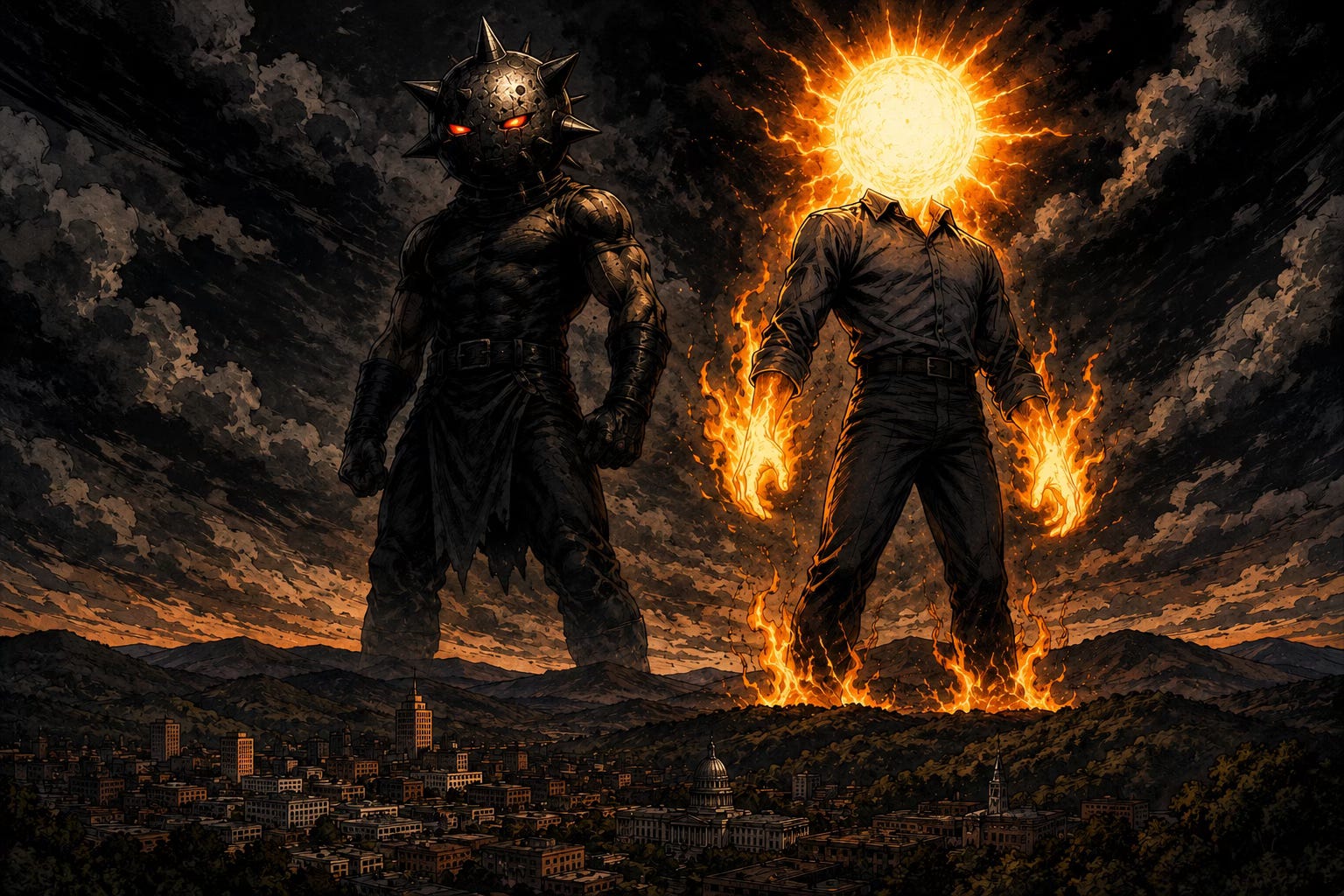
When I was a very small child — say 4 or 5 years old — I had a recurring nightmare. In it I was at one end of a large room, filled with tables and chairs — probably similar to the day care center where my mother would leave me on occasion. In the dream, the room was empty, except for two beings — myself and one other, at the other end of the chamber.
It was a grown-up. But I didn’t think of him as a person; in fact, I called him the “Iron Beast.” Not Iron Man as in music or comics — just the Iron Beast. Since I was so little, he was much taller than me. He was dressed head to toe in black, and his head was covered by a full helmet and mask. I could see nothing of his face, except for two slits where his eyes would be — but instead of eyes, all I could see was a piercing red glow, as if what was inside the mask was a furnace rather than a face. The helmet was round and covered with spikes, rather like a medieval morning star mace ball.
I assume it will surprise no one when I say the Iron Beast completely creeped me out.
But he wasn’t just waving at me from across the room. He wanted me. And it was not a “friendly” desire. I don’t know if he wanted to kill me, or eat me, or in some other way hurt, dominate or control me. I just know that he was after me — and I knew better than to just stand there and see what he wanted.
As I said, he was huge — the furniture was a minor inconvenience to him. He grabbed one of the tables by the corner, and flung it away from him as if it were no weightier than a folding chair. And he started running straight toward me.
I turned around and ran, fast as I could, for my life. And that’s when I would wake up.
The Iron Beast never caught me in my nightmares, so I couldn’t say what would happen next. Would I beg? Would he listen? What horror would ensue?
Such questions would not have occurred to me back when I was having these nocturnal terrors. All I knew was that the dream was scary and the monster was terrifying. I needed to run from it at all costs.
And frankly, that’s all I needed to know.
I couldn’t tell you how many times the Iron Beast invaded my dreamspace. I know at least two or three times, and possibly more (and who knows how many times he might have lurked in my subconscious but I graciously forgot when I woke up the next morning).
But I tell you what: the Iron Beast was such a powerful figure that even now, more than six decades later, he remains my archetypal nightmare image. I’ve tried to do my own amateur psychoanalysis concerning him: was he a symbol of my brother who bullied me? Of my own reptilian brain? Perhaps he was the embodiment of my own deep-seated anxiety, something I can clearly recognize when I look back into my early childhood memories, but back then I had no words or ways to express that all-pervasive angst, other than to cry when something particularly upset me.
When as a teenager I temporarily dallied with fundamentalist Christianity, it was obvious that on a purely archetypal level, the Iron Beast appeared to be a demon (if not the devil himself). Interestingly, though, I never had any kind of intuitive sense of him as a demon of hell — even though he did seem evil. Maybe I was just too young to even know what hell was (my family did not regularly attend church until I was 12, many years after these dreams). Looking back from today’s vantage point, I think he was more a part of me than some sort of alien intruder; what I suppose Carl Jung might have called an image of my shadow.
Eventually those nightmares faded away, and my young life carried on. I was a very shy and socially awkward child, with few friends and often given to just playing alone — and I don’t have any memories of feeling lonely or sad when I was alone; on the contrary, I found that being with other kids caused me so much anxiety, that I appreciated the peacefulness of being all by myself.
I had no interest in sports, but I played with little toy cars (Hot Wheels and Matchbox). I would draw pictures of dinosaurs. I loved music (I had a vinyl record of Disney tunes that I practically wore out), and also enjoyed reading: Disney again — I had a big book of illustrated stories based on Disney movies. Eventually I graduated from those to Hardy Boy books, but that literary evolution came a year or so after the time I scared myself thanks to the Sun Monster.
Being such a loner, I was used to entertaining myself through the power of my own imagination. I suppose you could call what I am about to describe a daydream. But it was not a passive daydream Rather, it was a kind of directed imagination where I was like a movie director creating the story that played out in my head. I might even act out the actions of this “movie” in my body as I played.
One day I was playing in just this imaginary/imaginal way. I remember vividly that I was in my mom and dad’s bedroom, and in my mind’s eye I could see a town or a city that was being besieged by a giant figure who towered over the settlement, tall like Gulliver towering over Lilliput. But this giant was not friendly, the way Gulliver was. Rather, he was somewhat menacing and threatening, like the Iron Beast — only instead of a mace-like helmet, his head was bright and white-hot, like the very sun itself perched on his shoulders. So I called him the Sun Monster. The Sun Monster’s hands and feet seemed to be all afire. As it marched on the city, the tiny people below it screamed and fled — not unlike how I had fled from the Iron Beast in my nightmares, six or seven years earlier. Clearly, the Sun Monster intended to destroy this innocent settlement — and it was all happening in my own daydream. I was the embodiment, the creator, of this very destructive force.
Dear readers, I kid you not: I got so frightened by my own daydream that I had to stop playing and take some time to calm myself down. It was probably a little child-sized panic attack, not as terrifying as the full-blown panic attacks that would visit me as an anxious young adult, but still scary enough that when it was over, I didn’t even want to think about the Sun Monster.
I was rattled. I knew that the Sun Monster was just a figment of my own imagination, and that unlike a nightmare, I had some control over the course that my daydream would take. But in retrospect, the upset feelings seemed to prevent me from resolving the emotional activation on my own, through my play.
For example, I could have imagined a beautiful woman with the moon for her head, coming to save the village and encourage the Sun Monster to be nice instead of mean. But I didn’t imagine a Moon Maiden (in fact, I just made her up right now, as I am typing out these words). No, I just recoiled in a self-generated fear from something that emerged out of my own mind. I marveled that I could imagine something that was so scary.
Integrating My Imaginal Power
It would be years before I would really unpack all of this. Years before I could begin to see the Iron Beast and the Sun Monster as anything other than terrifying fears lurking deep down within my own mind.
Today, I marvel at them, but not for how much they terrified me. Yes, I wish I could go back in time and encourage my child-me to summon forth just a bit more courage, so that I could stand up to the Iron Beast and find out what it really wanted, or call off the Sun Monster’s attack in order to save the town and talk with that inner brightness instead.
But it’s okay. I did find my courage, eventually. I would go on to learn about psychology and about concepts like the shadow and the reptilian mind. Eventually I would begin to think of the Iron Beast and the Sun Monster as not just symbols of hostility and destruction, but also as symbols of strength, of energy, of inner power.
Like Rumi in his poem “The Guest House,” today I’m more inclined to invite this beast and monster in for tea, just so we could have a talk and I might learn a bit more about them — and about myself.
I once heard a veteran psychedelic researcher, Bill Richards, talk about how to deal with having a challenging experience during an ayahuasca journey. He said if you saw something like a giant anaconda, the trick was not to run away from it, but to stand your ground — to ask it questions like “What are you doing here in my mind?” And “What is it that you are here to teach me?” Indeed, he even suggested that you could jump into the mouth of the anaconda, look through its eyes, and become the anaconda! Then you could really experience its lesson, from the inside out.
When I consider the similarities between the Iron Beast and the Sun Monster, I wonder if I was trying to do something along those lines, even as a small anxiety-ridden child. I subconsciously “became” the beast, by conjuring the monster in my own daydream. At the time, it unfortunately scared me so much that I cut the “experiment” short and didn’t allow myself to see it through. But between therapy and meditation, I eventually learned as an adult to befriend even my own inner dark places.
One thing I certainly learned from the Iron Beast, and especially the Sun Monster, was the power of my own imagination. So powerful, in fact, that it could actually frighten me. Which tells me that there is a “reality” at work, even in our dreams and our imagination. Of course, the Iron Beast and the Sun Monster are not real in any kind of empirical sense — they only exist in my mind. I tried drawing the Iron Beast a few times as a kid, and now as an adult it is uncanny how an AI image generator like ChatGPT can render an accurate illustration of these imaginal beings, just from my prompts. But that’s as “real” as they get, at least in an empirical sense.
But the reality that counts here is not empirical reality: it’s imaginal reality. The reality of the power of the imagination. Bill’s questions are helpful: what were the Iron Beast and the Sun Monster doing in my young mind, and what were they there to teach me?
Here are a few of my thoughts.
First, I can’t help but wonder if the Iron Beast and the Sun Monster are actually the same archetypal figure: the light that shone through the Beast’s mace-like helmet seemed to have been the very sun itself, once the headgear was removed. The proportions are different and the circumstances of the daydream were unlike the setting of the nightmares. But still, it’s remarkable how heat and light seemed to characterize both of these imaginal fiends.
The literature of contemplation provides some interesting anecdotes that offer a perspective on my childhood anxieties. Here are two stories, one from many centuries ago, the other from just the middle of the last century, and a couple of verses from the Bible that I think contribute to this reflection. First, a story from antiquity, recounting an encounter between two desert elders:
Abba Lot visited Abba Joseph and said to him, “Abba, to the best of my ability I do a little fasting, praying, and meditating. I maintain hēsychia and purge my thoughts to the best of my ability. What else should I be doing?” Standing up, the elder stretched out his hands to heaven, and his fingers became like ten lamps of fire; and he said to him, “If you are willing, become entirely like fire.”1
Now, a more recent story, from the great 20th century mystic Thomas Merton:
In Louisville, at the corner of Fourth and Walnut, in the center of the shopping district, I was suddenly overwhelmed with the realization that I loved all those people…
This sense of liberation from an illusory difference was such a relief and such a joy to me that I almost laughed out loud…
As if the sorrows and stupidities of the human condition could overwhelm me, now I realize what we all are. And if only everybody could realize this! But it cannot be explained. There is no way of telling people that they are all walking around shining like the sun.
…I have no program for this seeing. It is only given. But the gate of heaven is everywhere.2
If you are willing, become entirely like fire… and realize that you are shining like the sun. I’ve written before about how Jesus is quoted as saying both “I am the light of the world” and, speaking to his followers, “you are the light of the world.”3 Is there a fundamental unity between light, embodiment, and divinity? Merton and Abba Joseph both seem to think so, and I rather think Christ would agree with them.
So where do the Iron Beast and the Sun Monster fit in — as archetypes of light that is not cuddly and encouraging, but frightening and seemingly destructive? I do not know the answer to this question, and perhaps it is only for me to try to make sense of the nightmares of my childhood. But what is relevant, I believe, to us all, is simply this:
The power of the human imagination seems to entail far more than just a capacity to tell a meaningful story. It touches on powerful emotions, powerful archetypes, deep dimensions of the psyche that may elude our understanding. From a child’s nightmare to an adult’s challenging psychedelic experience to the awe-inspiring work of deep therapy (including the “divine therapy” of centering prayer), we all have incredible capacities within us for interior transformation, even if brought to us through experiences that are unsettling and discomfiting. I am not a therapist, and I would caution readers not to take any of this as therapeutic guidance for your inner journey: but I am suggesting that the inner work that may arise through nightmares, meditation, or therapy invites us into can help us find meaning, unveil layers of self-understanding, and even facilitate spiritual awakening.

Featured image: “The Iron Beast and the Sun Monster,” AI-generated with OpenAI's ChatGPT; concept and creative direction by Carl “Skye” McColman.

Wortley, John. The Book of the Elders: Sayings of the Desert Fathers: The Systematic Collection (Cistercian Studies Series 240), Kindle edition, pp. 217-218.
Merton, Thomas. Conjectures of a Guilty Bystander (Image Classic), Kindle edition, pp. 153-156.
John 8:12; Matthew 5:14.
Hi Skye, thanks for your candid sharing of the work of early life imagination. These sometime unwelcome experiences that arise from who-knows-where give us the opportunity to respond with either curiosity or fearful retreat. The latter would be expected and OK for a child without much capacity for abstract thought. But curiosity opens many possible doors for understanding, exploring questions like "what complex inner parts of me do these dreams represent?", "what do these images tell me about my strengths?", "what do these images imply about choices I have?", and "how would I choose to change the dream next time?" And then of course, the fact that we humans have such vivid imaginal experiences raises other questions such as "how do we know what we know?", "what is real?", and "how many of our every day experiences are metaphorical and symbolic?" Interestingly, I think all of those questions could also be applied to sacred texts, which also can be perplexing and disturbing at times. It's a good reminder for me to approach scripture with curiosity rather than recoil when the text frightens me or seems offensive.