

Alexandra Elene MacLean Denny (1947-1978), better known by her nickname Sandy, was a British singer and songwriter, known for her contribution to the music of bands like the Strawbs, Fairport Convention, and Fotheringay, but also for her four solo albums. To many people of my generation, she might be best known as a guest vocalist on Led Zeppelin’s song “The Battle of Evermore.” She died tragically young, at age 31, after sustaining injuries from falling down a flight of stairs.
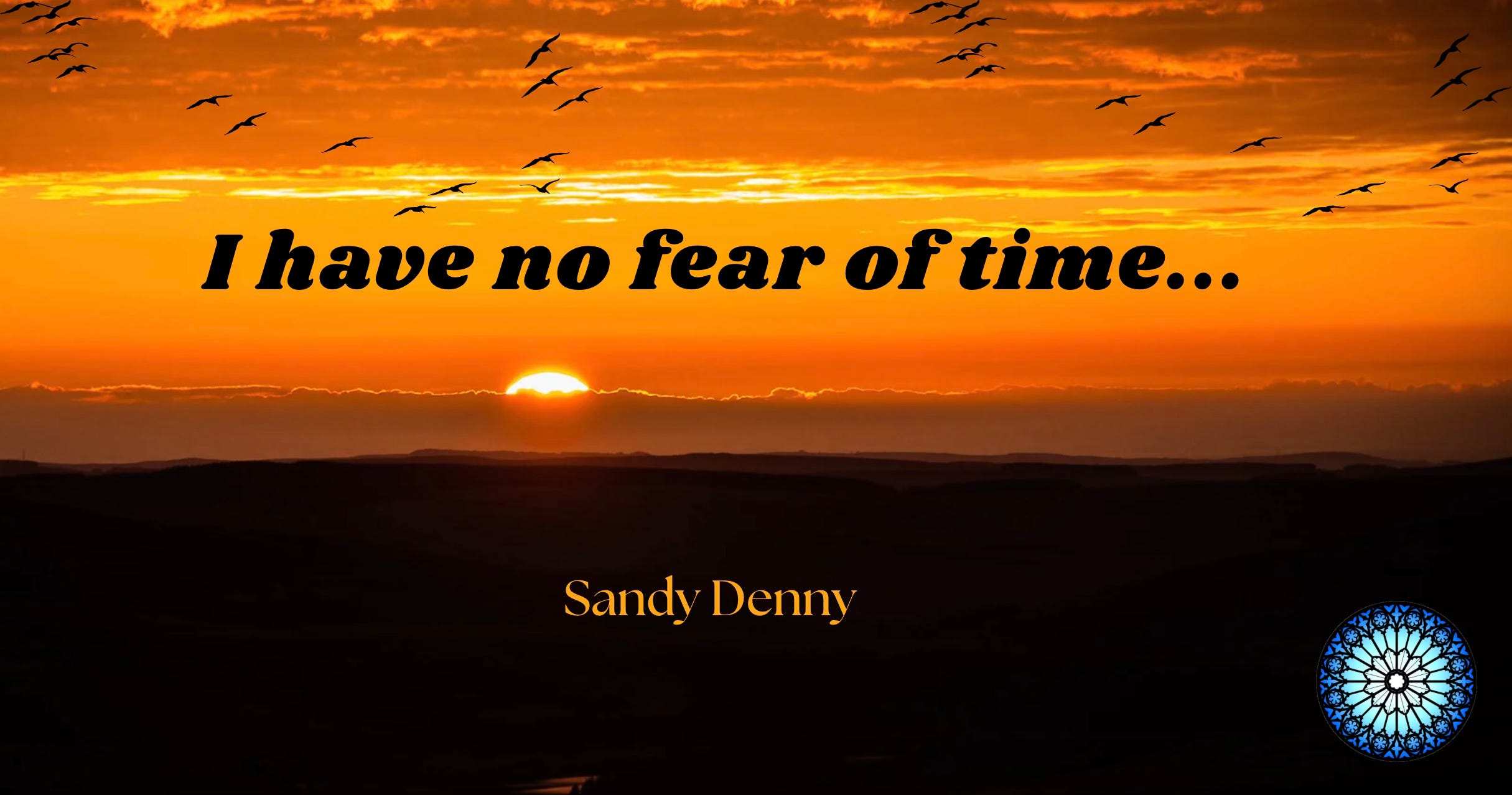
At her very last concert, just weeks before her sudden death, she ended the evening by singing “Who Knows Where the Time Goes?” a wistful ballad about losing friends as our days inevitably pass — a song that became her signature tune, as well as being covered by artists like Judy Collins and Nina Simone. It’s an achingly beautiful but profoundly sad song, acknowledging the inevitability of grief and loss. Still, the most beautiful moment in the song comes when Denny sings, with an almost angelic defiance, “I have no fear of time.”
Perhaps most people would share Sandy Denny’s courage. But often we dread what time brings to us: inevitable losses of those who die or go away, the limitations of old age, the infirmity of disease, the finality of death. We may not fear time, but we fear what it seems to bring our way.
Yet Denny makes this bold statement in the midst of a song about the necessary losses that come as a result of the passage of time. So she is not in denial when she speaks of having no fear of time. She is a realist, she knows that suffering comes to everyone sooner or later, and still, she faces the inevitable from a place of fearlessness.
Take it further: not only does she lack dread — she seems to actually trust time. For most of us, this could only be possible through the grace of contemplation. Which makes me wonder if we (all of us) relate to time in a manner similar to how we relate to God. So many people seem to carry a quiet awe for God that too easily prevents us from ever seeking divine intimacy. We try not to be offensive or rambunctious, we keep a respectful distance. As a Mennonite friend of mine once said, “We watch God the way the mouse watches the cat.” This might help us to maintain a polite religious observance, but does not ultimately nurture the soul.
By contrast, the First Letter of John reminds us that, spiritually speaking, love casts out fear. Perhaps for Sandy Denny, time is not only to be trusted, but even to be loved.
What could life be like if we accepted, affirmed, and even cherished the relentless passage of time? I’m not sure that any of us could answer that question, left to our own devices. But “with God all things are possible,” especially grace. Grace helps us to choose love and confidence over angst and self-protection. It’s not a magic bullet, of course, but it is a quality of a life well lived. May we all find the capacity to trust the flow of life’s passage, and to live in a manner consistent with the faith that the life-giving Spirit places in us.

Unfortunately, almost no video footage of Sandy Denny is available; but here is a brief clip of her with Fairport Convention in 1975 that gives you a taste of her heavenly voice.
Very nice.