
Wake Up!
A Sermon for the First Sunday of Advent
St. James Episcopal Church, Waimea, HI
November 29 and 30, 2025
Isaiah 2:1–5
Psalm 122
Romans 13:11–14
Matthew 24:36–44
It is such a joy to be with all of you today, for I have been in Hawaii for less than two days: I flew in on Friday. While everyone else in Atlanta was getting up early to hit the Black Friday sales, my wife and I were heading to the Atlanta airport — we had to be there by 5:15 Atlanta time, to catch a 7:15 AM flight, which took us to Dallas, where we boarded a second flight to Kona; we arrived here at about 3:30 local time, but our bodies were still on Eastern time, so it felt like 8:30 in the evening. All this to say, we are completely in jetlag-la-la land, and here I am, preaching a homily about… staying awake!
Do not tell me that God has no sense of humor. Of course she does.
Did you know that the first alarm clock, at least in America, was built in the year 1787? The inventor was a clockmaker in New Hampshire named Levi Hutchins. And here’s a fun fact: the first alarm clock was not adjustable: it only would ring at the same time every morning, and that was at 4 AM. Which makes me wonder if Levi Hutchins was a monk. Actually, he was probably a farmer, but still.
When you think about the late 1700s, so many Americans of that time are remembered by history, you have Betsy Ross, who sewed the first American flag, Thomas Jefferson, who wrote the Declaration of Independence, Ben Franklin, who conducted early experiments with electric, and so forth and so on. Those people are all practically household names — but hardly anybody remembers poor Levi Hutchins. And why should we remember him — the man created an alarm clock, for heaven’s sake! It’s like he unleashed one of the seven plagues of the Apocalypse on us. (Hold up iPhone). Look at us — and now we carry our alarm clocks with us wherever we go. To think that 250 years ago, none of us were burdened by that truly pernicious piece of technology.
Now let’s be fair: without an alarm clock, Fran and I would not have caught that flight on Friday. So it does have its uses, doesn’t it? Although thank heaven that it doesn’t go off at 4 AM every single morning!
Today is the first Sunday of Advent, and in honor of old Levi Hutchins, I’d like to declare that this is Alarm Clock Sunday. Because the theme of today’s readings is all about either staying awake and keeping watch, or at least being willing to wake up.
When we read scripture, regardless of the passage, I think there are two things to look for: a reason to hope, and a promise. I think when we look at the readings for today, it’s easy enough to find a reason to hope. “Salvation is nearer to us today” than when we first believed. In other words, every second of our lives brings us closer and closer to the love and grace of God. That’s a powerful promise indeed! But these readings have a bit of an edge to them. There’s a sense of urgency, a warning that if you are not careful, you could miss out. One person gets taken, and another person gets left behind. Now, if you own a business, you probably know that the best way to get a customer to make a purchase is by warning them that you have a special deal, just for them, but that it could go away at any time. Nobody likes to miss out on an opportunity — so we all make sure to close that deal before the sale prices go away.
I’m not sure if Jesus is indulging in a little bit of marketing psychology, I’ll let the Bible scholars try to figure that one out. But I do think there is a message of hope, even in the urgency: it’s not so much a message of “act now or else,” but rather an invitation like this: “wake up, act now, pay attention — and the blessing will surely be yours!”
Still, we gotta keep watch, because we never know when the limited time opportunity will come… or go. “The Son of Man is coming at an unexpected hour.” I knew exactly what time my flight was on Friday: when most of us set an alarm clock, we have a pretty good inkling as to what we need to wake up for, and when we need to do it by. We can trust that old Levi Hutchins had a pretty good reason to wake up at 4 AM, if for no other reason than to milk his cows.
But no one knows when the Lord will return. Or arrive. Or suddenly transform everything in our midst. We have a reason to hope, but not a timetable.
There was a Trappist Monk named Thomas Merton who became famous after he wrote a memoir in the late 1940s called The Seven Storey Mountain. Merton’s writing was beautiful and deeply spiritual, but also pretty garden-variety. Ten years after his bestseller was published, Merton was still writing more books, but most of his writing was pretty predictable, really kind of just “more of the same.” There’s nothing wrong with that, but it is rather safe and maybe even a bit… well, boring.
But then one day, something happened. Merton had to leave his monastery in Kentucky to run an errand, and the story goes that when he reached downtown Louisville, Kentucky, he stood on a street corner and suddenly he WOKE UP. Of course, Merton was already awake in a purely physical sense, but I am referring to a sudden and unexpected spiritual awakening. As Merton described it, he suddenly fell in love with everyone he saw on that bustling street corner. When he wrote about it later, he said that everyone was walking around, shining like the sun. He began to speculate that if we could all see what he saw in that single instant, we would be seeing each other with the same loving and compassionate eyes through which God sees us. Can you imagine, seeing all human beings through the eyes of infinite love, compassion, mercy and wonder? Just imagine!
And Merton, of course, experienced this firsthand, so he wrote about it:
“It was as if I suddenly saw the secret beauty of their hearts, the depths of their hearts where neither sin nor desire nor self-knowledge can reach, the core of their reality, the person that each one is in God’s eyes. If only they could all see themselves as they really are. If only we could see each other that way all the time. There would be no more war, no more hatred, no more cruelty, no more greed…. I suppose the big problem would be that we would fall down and worship each other.”
Merton’s bold statement might sound slightly sacrilegious, but remember, the Bible clearly says that we are all created in the image and likeness of God. If we could see the face of God in each other, how could we ever hurt one another? How could we ever be anything but kind and caring and deeply respectful of one another?
As for Merton’s writing being safe and almost predictable? Not any more. After he fell in love with everyone that spring day on the street corner, he began to take spiritually meaningful risks in his writing. He became an outspoken critic of the nuclear arms race and an equally strong voice for the Civil Rights Movement. He never forsake his Christian identity, but he began to call for greater understanding and respect between the great religions of the world. I often think that if we had managed to listen to Thomas Merton, we might have found a way to avoid the horrors of religious conflicts like we’ve seen in Northern Ireland, or in the Middle East, or even in the tragedy of 9/11.
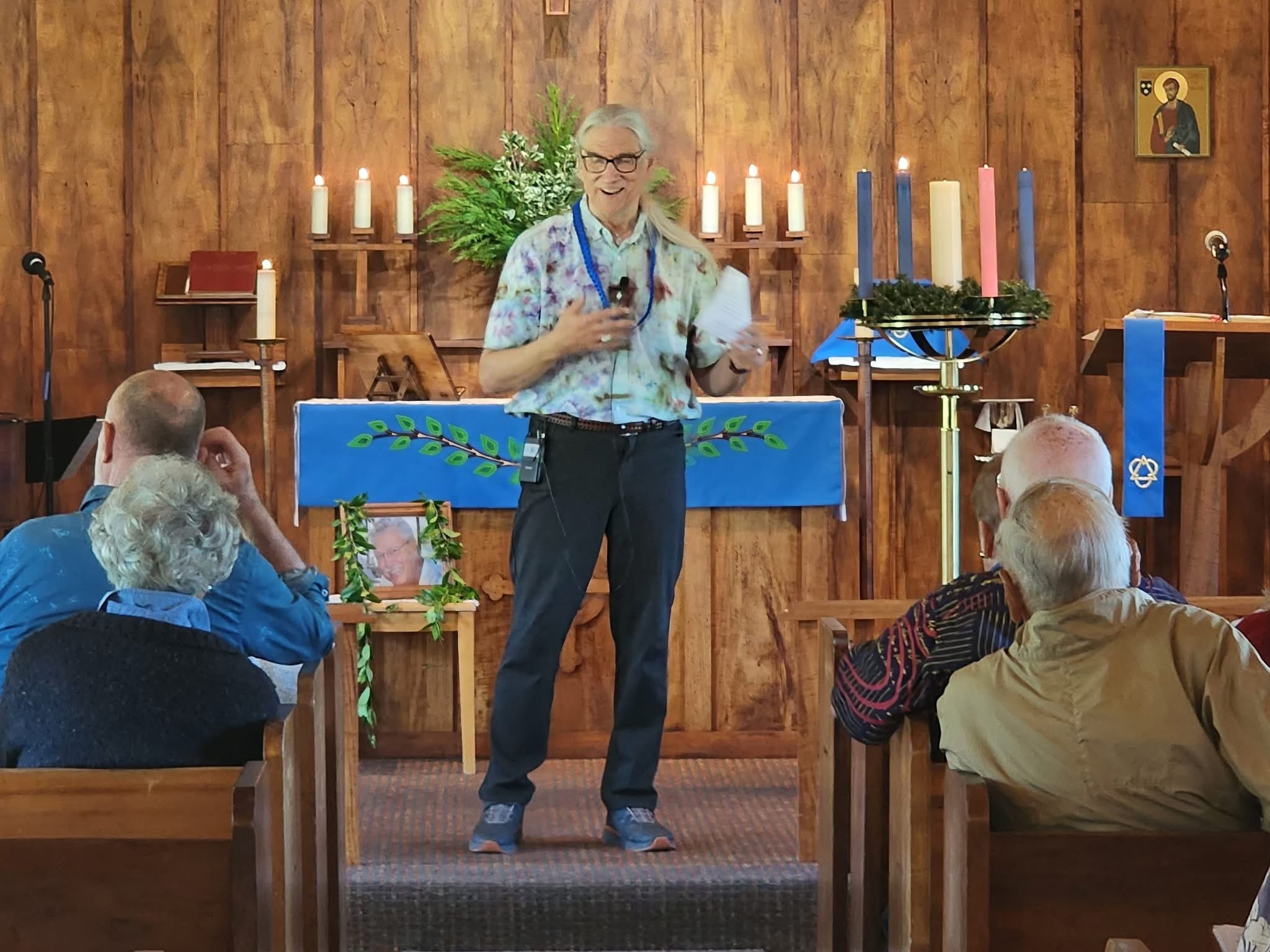
Many people never or rarely have a kind of dramatic waking-up moment like the one that transformed Merton. We hear stories like Moses encountering the burning bush, or St. Paul’s dramatic conversion on the road to Damascus. Looking outside the Christian tradition, we all know about the Buddha who achieved sudden enlightenment one morning while meditating under the Bodhi Tree. But aren’t these stories of sudden mystical experiences kind of like being awakened by an alarm clock? As much as the alarm clock helped me to catch that plane yesterday morning, speaking in general I would much rather wake up slowly and gently, to the sound of birds singing the sunlight gently streaming through the window. I think as we reflect on the meaning of Advent, perhaps we need to remember that waking up can happen in slow motion — and frankly, most of us prefer it that way. I don’t want Jesus, or one of the archangels, to have to conk me over the head with a heavenly two-by-four when it is time for me to spiritually wake up. I’d much rather let the sunlight do its work slowly but steadily, that I may be awake and ready at the appointed hour.
This leads us to the second theme of our readings today: not just “waking up” but “staying awake.” Consider the words of Jesus: “about that day and hour no one knows, neither the angels of heaven, nor the Son, but only the Father… Keep awake therefore, for you do not know on what day your Lord is coming… for the Son of Man is coming at an unexpected hour.” Merton could not have predicted what day he would fall in love with the world. Neither can anyone of us foretell when the Holy Spirit will visit our hearts and transform them into chalices of love. So the invitation is clear: stay awake! Once gain, not in a literal or physical sense: it’s okay for Christians to take a nap or get a good night’s sleep, I like to do that as much as I can. But let’s stay awake spiritually! In other words, let’s cultivate the fruits of the spirit in our hearts and our lives. Let’s make prayer, and meditation, and contemplation, a joyful part of everyday life. In the Buddhist world there is this saying: “Enlightenment is an accident, but meditation makes you accident prone.” We can translate that into Christian spirituality like this: for us, the experience of salvation is always a gift of unexpected grace, and so a daily commitment to prayer and service opens our heart to receive the grace and love of God, no matter when and where it might come to transform us.
If the unexpected coming of Christ — into our hearts and into our lives, is the reason for us to hope this advent season, then what is our Advent promise? Today’s reading from the Hebrew Writings comes from Isaiah; we did not read it in the liturgy, but it’s found in your bulletins. And it contains one of the most beautiful promises in all of Scripture: “God shall arbitrate for many peoples; they shall beat their swords into ploughshares, and their spears into pruning-hooks; nation shall not lift up sword against nation, neither shall they learn war any more.” Living as we do in a world marred by conflicts in Gaza, the Ukraine, Myanmar, and the Sudan, to name just a few, we recognize that the promise of a world where we no longer learn war is a promise as yet unfulfilled. It is God, and God alone, who will deliver us from the scourge of war, but it is by our work, our hands, and our lives that such deliverance will take place. May we all calibrate our lives to live by that sacred promise of peace.
Friends, I am just beyond overjoyed to be able to walk with all of you during this sacred Advent Season: I hope we can all come together not only in joyful anticipation of the blessings to come, but also with an eye toward the beauty of the coming of Christ in our hearts and our lives: right here, and right now. For when that happens, we will be immersed in love, and everything will be made new in Christ’s love. Amen.

Emptiness and Good Things
A Sermon for the Third Sunday of Advent
Cathedral of Saint Andrew, Honolulu, HI
December 14, 2025
Isaiah 35:1-10
Luke 1:46-55
James 5:7-10
Matthew 11:2-11
It is such a joy to be with you today here at the Cathedral of Saint Andrew in Honolulu. I come to you from Atlanta, Georgia, some 4500 miles away. That in itself may not be particularly remarkable; after all, a beautiful city like Honolulu receives guests from all around the world. But I mention where I’m from because, as a lifelong resident of the American south, when I ponder today’s lessons, I find myself thinking of an old southern proverb: “Don’t brag about the catfish before you’ve got it in the frying pan.” There are a number of variations to this old saying, but they all pretty much point to the same basic principle: if you’re going to make a promise, you need to be able to deliver.
For a number of years in my younger days, I worked for a company that managed college bookstores. Now I can tell you, in the great chain of social respectability, college bookstores are only slightly more popular than the Internal Revenue Service, which means that being a college store manager puts you more or less in the same league as Zacchaeus the Tax Collector. I may as well have been Zacchaeus, given the kind of dirty looks that students, and often their parents, would give me as they watched their discretionary income get swallowed up by the cost of textbooks and supplies at the start of each semester. For me, working in the bookstore was kind of a trial by fire, learning the ins and outs of business management while checking my car every morning to make sure that a fraternity had not planted a bomb in it overnight. Okay, I’m kidding, but still. My point is, I learned a basic principle of customer service during those years in the bookstore: You always under-promise, and over-deliver.
For example, we would always tell students that they had ten days to return their textbooks if they decided to drop the class — or if they managed to get a used copy from their girlfriend’s older brother. But in practice, we would accept returns for at least thirty days. We promised very little, then we tried to deliver as much as we could. And when a student would come in, a day or two after the returns deadline, and start to beg for us to take their book back, I’d always say, “Well, just for you, I’ll make an exception to the rule.” And then they would be so grateful that they would bring their parents to the store on Homecoming Day, and Mom and Dad would always buy an overpriced sweatshirt or two!
So: promise very little, but deliver all you can. In other words: “Don’t brag about the catfish before you’ve got it in the frying pan.”
And now here we are, listening to Isaiah, the voice of the prophet, positively singing about those catfish, promising us the world.
Then the eyes of the blind shall be opened, and the ears of the deaf unstopped; then the lame shall leap like a deer, and the tongue of the speechless sing for joy. For waters shall break forth in the wilderness, and streams in the desert; the burning sand shall become a pool, and the thirsty ground springs of water; the haunt of jackals shall become a swamp, the grass shall become reeds and rushes.
Wow. Those are some bold promises. And the last time I, for one, took a cold hard look at our world, I’d have to admit that I don’t think we have finished frying the catfish. The desert is still dry, those who are deaf to the cries of the poor and the oppressed seem to be just as hard of hearing as ever. Meanwhile, those who are blind to their own power and privilege sure could use a good pair of glasses.
It might be easy for us to dismiss Isaiah as just someone who tended to get a bit overly enthusiastic with his public relations, but we also have the words of Mary and Jesus to contend with. First let’s revisit what Jesus had to say about himself when offering the followers of John the Baptist a few words to take back to their teacher (who happened also to be Jesus’s cousin):
Go and tell John what you hear and see: the blind receive their sight, the lame walk, the lepers are cleansed, the deaf hear, the dead are raised, and the poor have good news brought to them. And blessed is anyone who takes no offense at me.
Now the Gospels are pretty clear that Jesus was a healer, and quite an effective one at that. But Jesus also said, later in his ministry, that those who believe in him will also do the works that he does and, in fact, “will do greater works than these.” Now it’s getting a little tricky. I’ll be honest with you: I’ve been a part of the Christian family for more than sixty years now, and I’ve yet to raise the dead, or do any other of the amazing things that Jesus said we would do.
I’m beginning to wonder about the quality of those catfish.
Finally, we have Mary, the mother of Jesus, whose amazing prayer that we know as the Magnificat was our canticle for today. Like Isaiah and Jesus, here we have Mary, bragging about the mighty deeds of God:
He has mercy on those who fear him in every generation. He has shown the strength of his arm, he has scattered the proud in their conceit. He has cast down the mighty from their thrones, and has lifted up the lowly. He has filled the hungry with good things, and the rich he has sent away empty.
This sermon is in danger of becoming a real downer right now, so let me talk myself off of the cliff by invoking one of my favorite books about Advent, a collection of sermons by Fleming Rutledge, one of the first women ordained to the Episcopal priesthood. Rutledge repeatedly offers this principle: that Advent is far, far more than just the four weeks leading up to Christmas, that there is a very real sense that the entire life of the pilgrim people of God is, in fact, a perpetual advent. We are always on a pilgrimage, always waiting for the coming of the one who will save and redeem us.
In other words, the fish are still in the frying pan.
We don’t have to look very hard to see the magnitude of suffering in the world at large. Most of us don’t even need to look far beyond our own families, or even our own lives, to be humbled by just how enormous the need is, in our lives and in our world, for healing, for relief, for justice, for mercy. Isaiah and Jesus and Mary are not merely proclaiming the miracles that they had witnessed first hand in their lives, but they are also declaring to us that we are living in the midst of a world where the miracles sometimes seem to be happening in slow motion. While they may be cold comfort for those who are suffering today, I believe it represents both a source of hope and a source of challenge for us all.
The first letter of John says that we love because God first loved us. I think we can rework that to say that we can hope, because God has given us a reason to hope. More than once in the New Testament, God is proclaimed to be a God of possibility — with God all things are possible, nothing shall be impossible with God. This might be the biggest and juiciest catfish of them all, and yet it is available to every one of us. No matter how bad things are today, or how terrible it seems they might become tomorrow: we can hope, because our God is a God of infinite possibilities.
There is no word for despair in the language of Christian spirituality, thanks be to God.
But this hope is not a passive hope, and that’s where the challenge comes in. If we’re going to brag about the catfish, you know, it’s not just the reputation of the fish that’s on the line: it’s just as much about the cook who’s doing the frying. Jesus, and Mary, and even Isaiah can proclaim the mighty works of God because every one of us, every single one of us, is called to be a chef in God’s heavenly kitchen. In other words, we are the ones we’ve been waiting for: God’s infinite possibilities are made manifest in the acts of kindness and compassion and care and peacemaking and justice-creating that we, the visible body of Christ here on earth, are called to do.
Yes, it’s a challenge. And I’ve already admitted that I’m not very good at all this miracle-making. You, too, might feel inadequate for the task: “I can’t help the blind to see, the deaf to hear, the lame to walk, the poor to be fed.” Or… can I? Or can we? If we are still waiting on the mighty works of God, if that’s what Advent is promising us, isn’t that also how Advent is challenging us?
Christianity has a long history of people who don’t just talk to talk when it comes to discipleship — they also walk the walk. We call them saints, and mystics. A recurring theme in the wisdom of the mystics is this: Mary isn’t the only one who gives birth to Christ; John the Baptist isn’t the only one who proclaims what Christ is coming to do, and Jesus isn’t the only one who works miracles. You and I are called to do great things in the name of Jesus. We may not be able to work a miracle at lightning speed: it might take us years, or even centuries, to do the work of God. But no one ever said that miracles can’t happen in slow motion. They can — and that’s all the more reason for us to get started on doing the amazing work of God’s love, in our neighborhoods and in the world, starting right now.
In closing, I’d like to revisit those inspiring words of Mary, sung in the presence of her beautiful and powerful cousin Elizabeth, mother of John the Baptist. But this time let’s hear those words as rendered by the Presbyterian theologian Eugene Peterson, who created an insightful and powerful translation of the Bible called The Message. Here’s the voice of Mary, once again:
What God has done for me will never be forgotten,
the God whose very name is holy, set apart from all others.
His mercy flows in wave after wave
on those who are in awe before him.
He bared his arm and showed his strength,
scattered the bluffing braggarts.
He knocked tyrants off their high horses,
pulled victims out of the mud.
The starving poor sat down to a banquet;
the callous rich were left out in the cold.
It’s a different, and beautiful, rendering of Mary’s amazing words of hope and possibility, but the underlying message (pardon the pun) is still the same. You and I are called to be partakers of God’s nature — but that’s not just we get to feel all the good feels of God. That means we get to be the conduits of mercy, flowing in wave after wave. We get to the be the ones that pull those who suffer out of the mud. We get to round up those who are hungry, and throw them an incredible party.
We may not always be very good at this — but the fish is still in the frying pan. Advent, in the big sense of the word, is still going on. In the immortal words of those great prophets, Led Zeppelin, “there’s always time to change the road you’re on.” Repentance doesn’t just mean we think different thoughts, it means we do different things. And if we are willing to dare that God meets us in the midst of the mess, and make miracles happen: then watch out world: there’s no limit to what is possible.